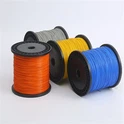
I'm a supplier of UL10064 tin plated FEP insulated wire, and today I wanna talk about the coefficient of transmission of this awesome wire.The transmission performance of wires is never a fixed number, and will fluctuate with signal frequency, wire specifications, and usage scenarios. Below, based on the real experience of our Zhejiang IRONFLON production factory and customer testing, we will talk about the transmission performance of UL10064 wire.
Many friends who are just starting to learn about transmission coefficient will be discouraged by this professional term. To put it simply, it's not as profound as people imagine, and we can easily understand it in a more practical way.
In the industry, we usually use attenuation coefficient to evaluate transmission capacity, measured in dB/m. You can imagine the current signal as the sound of our daily speech, and the wire is the channel for transmitting sound. The better the transmission coefficient, the smaller the signal loss during transmission within the wire material; On the contrary, the higher the value, the more severe the signal loss and distortion.
Just as the clear shouting in an open room weakens the sound in a narrow and noisy corridor, high-frequency signals and thin wires invisibly exacerbate signal loss. The core advantage of UL10064 tin plated FEP insulated wire in precision electronics and high-temperature wiring circles lies in its low loss configuration, which is inherently more suitable for high-quality signal transmission than ordinary electronic wires.
The transmission limit of a wire depends entirely on the two core components of the conductor and insulation layer. The UL10064 series wires produced by our company are made of high standard tin plated copper material, covering the full specifications of 10AWG-40AWG. Both solid and twisted structures can be customized according to needs. The biggest advantage of tin plating process is that it can isolate air oxidation, stabilize conductor resistance from the root, and avoid problems such as poor contact and intermittent signals after long-term use, which is particularly evident in long-term high-temperature conditions.
The most eye-catching part is still the FEP insulation layer. Compared to common PVC insulation materials, FEP has significant performance advantages. Its dielectric constant remains stable at around 2.1, while the dielectric constant of conventional PVC electronic wires is generally in the range of 3.5-4.0, and the dielectric loss is several times higher than that of FEP. It is precisely this feature that allows UL10064 to easily detach from ordinary wires when facing high-frequency signals. At the same time, this wire supports wide temperature range operation from -80 ℃ to 105 ℃, while also considering VW-1 flame retardant performance, suitable for the vast majority of harsh industrial and precision electronic usage environments.


Under low-frequency conditions, in a 1MHz frequency environment, UL10064 attenuates by only about 0.15dB per meter, which is almost negligible. The vast majority of low-frequency small appliances and ordinary control circuits can be perfectly adapted; When the frequency rises to 10MHz, the attenuation value is about 0.8dB/m. I can put it bluntly: directly crushing the same specification PVC wire, under the same conditions, the attenuation of ordinary PVC wire can reach 2.3dB/m, and the loss is directly increased by more than 60%.
The signal frequency is the most intuitive factor affecting the loss. The higher the frequency, the more obvious the skin effect, and the current can only be transmitted through the surface of the conductor. As the equivalent resistance increases, the signal loss naturally increases. In addition, wire specifications are also crucial. Many customers blindly choose ultra-fine wires in order to save internal space of the equipment. Here's a small suggestion for everyone: In the same frequency environment, the loss of AWG36 fine wire should be 30% -50% higher than AWG30. If space allows, try to choose thicker wire gauges as much as possible.
The length of the wire cannot be ignored, and the loss will accumulate with the length of the wiring. Simply put, under the condition of a length of 10 meters and a frequency of 10MHz, the overall loss is about 8dB, which is still sufficient for the use of conventional precision equipment; But if the wiring length reaches tens of meters, even with low loss FEP wires, it is recommended to calculate the overall loss in advance to avoid equipment debugging failures in the later stage.
Here's a selection suggestion for everyone: If you're just looking for ordinary low-frequency short distance wiring and pursuing low cost, ordinary PVC wire is sufficient to meet your needs; But as long as it involves high-frequency signal transmission, high-temperature operations, precise wiring in narrow spaces, and budget allows, directly locking UL10064 tin plated FEP insulated wire will not make mistakes, and the overall cost of use will be lower.
Finally, let me briefly outline the key points for everyone to quickly remember. There is no universal transmission coefficient for UL10064. Overall, within the commonly used frequency range of 1-100MHz, the attenuation range is maintained between 0.15-2.5dB/m; In the ultra-high frequency 1GHz scenario, the attenuation is about 8dB/m. Prioritize pairing with AWG28-AWG32 specifications, which can balance transmission loss and wiring volume, and adapt to the vast majority of high-end wiring scenarios.
Our Zhejiang IRONFLON UL10064 tin plated FEP insulated wires hold full UL certification and comply with RoHS environmental standards. In the production process, we will strictly control the thickness of the insulation layer and the tin plating process. Each batch of wire will be randomly inspected for high-frequency attenuation testing to ensure the stable transmission performance of each roll of wire from the source.