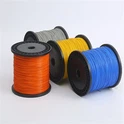
Low temperature flexibility is a key characteristic of UL1886 tinned FEP insulated wire, especially in various industrial and commercial applications.
Everyone may have experienced this kind of "pain": the wires in the factories in the south were still in good condition, as soft as noodles, but when they were shipped to the north or directly entered the cold storage environment of minus tens of degrees Celsius, a roll of wire became as brittle as a slider, with a slight bend and a "click" sound, causing the insulation layer to crack. Today, let's talk about our "cold resistant star" - UL1886 tinned FEP insulated wire, and see how it maintains its "figure" in cold weather.
Understanding UL1886 tinned FEP Insulated Wire: Its "Origin" and "Constitution"
Firstly, we need to clarify what UL1886 is. Simply put, this is a special type of wire that meets the UL certification standards in the United States. Its core structure is actually very interesting:
- The "core" is good: Tin plated copper conductors. Everyone knows that copper is prone to rusting (oxidation), and once oxidized, its conductivity deteriorates. We plated a thin layer of tin on the surface of the copper wire, just like wearing a bulletproof vest. It is not only corrosion-resistant, but also very obedient when welding, without the need to scratch the oxide layer with great effort.
- 'Leather' is real: FEP insulation (polytetrafluoroethylene) sounds high-end, but in fact, it is a member of the 'Teflon' family that we often refer to. Its most impressive feature is that its molecular structure is very stable, not only resistant to high temperatures (above 200 ° C), but also its ability to withstand low temperatures is the "top current" in the cable industry.
By combining these two, it becomes UL1886 that we are going to talk about today. It is not only wear-resistant and flame-retardant, but most importantly, it is a typical "all-weather athlete".
Maintaining flexibility at low temperatures: this is not really a "bonus point", but a "must-have" option
Many people ask, "Isn't it enough to just power on the wires? Is it that important to be soft and hard
At room temperature, it may not be that important. But in low temperature environments, flexibility is the lifeline. Why emphasize 'retention rate'?
- Prevent physical cracking : Wires must always be bent during installation or maintenance. If the material becomes brittle and the bending radius is slightly smaller, microcracks will occur in the insulation layer. These cracks may not be visible to the naked eye, but once moisture enters, electrical leakage, short circuits, and even fires can follow.
- Anti vibration requirements : Many wires are installed on robotic arms or mobile devices. Cold shrinkage will make the material harder, and once the equipment starts moving, the hard wires are like broken branches that cannot withstand repeated vibrations.
- Installation convenience : Imagine a construction worker in an environment of minus 20 degrees Celsius. If the wires are as hard as steel bars, it is impossible to wire them, which not only reduces efficiency but also makes it easy to break the connectors.


What exactly affects flexibility at low temperatures?
Whether wires can maintain flexibility at low temperatures mainly depends on the following behind the scenes drivers:
- Glass transition temperature (Tg) : This is a professional term, let's put it in layman's terms. Every type of plastic has a "glass transition" point, after which it transforms from soft rubber to crisp glass. The advantage of FEP is that its point is very low, far lower than ordinary polyvinyl chloride (PVC) or polyethylene (PE).
- Loss of Plasticizer (for ordinary materials) : Ordinary PVC thread will add plasticizers in order to soften, but over time or when exposed to low temperatures, plasticizers will run out and the thread will become harder. And FEP itself is this molecular structure, which does not soften with additives, so it is "naturally cold resistant".
- The twisting method of conductors : If the conductor is too thick or too hard, it will also limit the flexibility of the entire wire. We use multiple strands of thin tinned copper wire twisted together, leaving room for flexibility in terms of physical structure.
To be honest: UL1886 low-temperature flexibility retention test
How is the "retention rate" that everyone is most concerned about measured? We usually take the following steps:
1. Cold Bend Test
Wrap the wire around a specific diameter core rod and freeze it in a low-temperature chamber at minus 65 ° C (or even lower) for several hours. After taking it out, immediately rotate it at a constant speed and see if it cracks. Our performance: UL1886 still maintains a smooth surface in such extreme environments, without any "dry skin cracking".
2. Low temperature tensile strength retention rate
We measure one tensile data at room temperature and another at low temperature.
- Ordinary cables : They may not reach 20% of their original length at low temperatures before breaking.
- Our FEP wire : Even under extremely cold conditions, its elongation and strength retention can still be maintained at a very high level. Although we do not excessively stack data, industry experience tells us that its physical performance fluctuates very little, usually maintaining over 80% -90% of its performance at room temperature.
Why choose our UL1886?
Why choose us when there are so many lines in the market?
- Raw material purity : We insist on using high-purity FEP raw materials without mixing back materials. If there is too much material returned, there will be more impurities, and the performance at low temperatures will be greatly reduced.
- Exquisite craftsmanship : Extrusion technology is crucial. If the temperature is not controlled properly, there will be stress inside the insulation layer. We use a slow cooling process in production to make the arrangement of molecules more relaxed, so that during cold shrinkage, there will be no "internal rolling" causing cracking.
- True 'tin plating' : Our tin plating layer is uniform and dense, not only for corrosion prevention, but also to reduce the adhesion and friction between the conductor and the insulation layer at the micro level, making the entire wire smoother when bent.
These places are indispensable!
If you are still hesitating whether to use such high-end cables, check if these are available in your application scenarios:
- Cold chain logistics equipment : Sensors and conveyor belts in cold storage, which are in a low-temperature environment 24 hours a day, and ordinary wires cannot last for a quarter.
- Outdoor monitoring and communication : In winter in the north, the pan tilt of surveillance cameras needs to be rotated. If the connecting wires freeze hard, the motors may be damaged.
- Aerospace and military : The extremely low pressure and low temperature in high-altitude environments are the main battlefields of FEP.
- Precision instruments : For devices that require extremely high resistance stability, even small cracks in the insulation layer can cause electromagnetic interference, and UL1886 can provide the most stable guarantee.
Conclusion: Don't let low temperature become the "weakness" of your product
Ultimately, choosing UL1886 tinned FEP insulated wire is actually a "peace of mind". In laboratory data, it is a high percentage retention rate number; But in practical engineering, it represents equipment not crashing, maintenance not worrying, and customer not complaining.
If you are worried about wiring solutions in cold climates or want to improve the overall durability level of your product, UL1886 is definitely a cost-effective choice. Although it is slightly more expensive than ordinary PVC wire in terms of initial procurement costs, considering the maintenance costs and brand reputation in the later stage, this account is worth it no matter how it is calculated.
Do you want to know if your specific application scenario is suitable for this line? Or would you like to take some samples back and personally go to the cold storage to try it out?
You can contact us directly( luna@ironflon.com )We are happy to provide you with detailed selection guidance and sample testing.