1. Material innovation and performance improvement
PEEK special cable
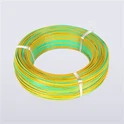
The cable made of polyetheretherketone (PEEK) material can operate stably at a high temperature of 260 ℃, with a 30% improvement in torsion resistance. It is suitable for high-frequency bending scenarios such as robot joints and automated production lines.
PEEK material has strong chemical stability and can extend its service life to twice that of traditional cables in corrosive industrial environments such as chemical and metallurgical industries.
Graphene composite conductor
Graphene modified cables have a 15% increase in conductivity and thermal stability exceeding 200 ℃, and have been applied in desert photovoltaic power stations and high-temperature smelting workshops.

2. Breakthrough in High Temperature Superconducting Technology
Progress in Commercial Applications
The Shanghai 35 kV kilometer level superconducting cable demonstration project has achieved full load operation, with a transmission capacity of 2200 amperes and losses only 0.5% of traditional cables, solving the problems of high electricity density and tight land resources in mega cities.
The liquid nitrogen cooled superconducting cable developed by VEIR Corporation in the United States has a transmission power 5-10 times that of traditional cables, and plans to launch a large-scale power grid renovation pilot in 2026.
Breakthrough in technical difficulties
Superconducting cables achieve zero resistance power transmission in a liquid nitrogen environment at -196 ℃, using low-temperature insulation technology to reduce the temperature difference between the inside and outside to 200 ℃ and improve operational stability.
The Chinese team has overcome the challenge of large-scale production of superconducting materials, increasing the production capacity of copper oxide high-temperature superconducting tapes to 1000 kilometers per year and reducing costs by 40%.

3. Application scenario expansion
In the field of new energy
High temperature cables support the desertification deployment of photovoltaic power stations, and UV resistant materials extend the cable life to 25 years, meeting the high-efficiency power generation needs of monocrystalline silicon modules.
Offshore wind power adopts 500kV cross-linked polyethylene submarine cables, with a 50% improvement in salt spray corrosion resistance and a single seamless length exceeding 28 kilometers.
Industrial and Urban Power Grid
The introduction of superconducting cable systems in steel smelters has reduced energy loss by 60%, resulting in an annual power savings of 120 million kilowatt hours per plant.
In the renovation of power grids in mega cities, replacing traditional copper cables with superconducting cables can save 70% of underground pipe gallery space and increase transmission capacity by three times.

4. Challenges and Future Directions
Cost and scalability: The initial investment in the liquid nitrogen cooling system for superconducting cables is three times that of conventional cables, and modular design is needed to reduce operation and maintenance costs.
Material development: Room temperature superconducting materials are still in the laboratory stage, and hydride superconductors require an environment of 2.67 million times atmospheric pressure. The practical path is not yet clear.