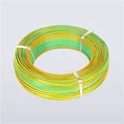
Many friends often encounter this dilemma when purchasing wires: either choose wires based solely on price, and problems may arise after a period of use; Either being surrounded by a variety of materials, I don't know which one is suitable for my scene. Whether it's new energy projects, precision instrument wiring, or construction in industrial workshops or seaside scenes, choosing the right wire directly determines the maintenance cost in the later stage, and even affects the normal operation of equipment. Today, let's talk about a practical wire that has both the excellent conductivity of copper and the corrosion and high temperature resistance advantages of nickel, called Nickel Clad Copper Wire.
Let's first talk about what makes this type of wire special. We all know that pure copper wire has good conductivity and is a commonly used substrate for wires. However, pure copper wire has a small drawback: it is prone to oxidation in humid and corrosive environments, and surface rust can affect conductivity efficiency. Over time, it may also break; The characteristics of nickel complement each other perfectly, with strong corrosion resistance and the ability to withstand high temperatures. By uniformly plating nickel on the surface of copper wire, this "strong combination" wire is formed, which takes into account the advantages of both, is more durable than pure copper wire, has lower cost than pure nickel wire, and is cost-effective.
Here are a few practical testing methods that can be directly used to verify product quality on site without the need for complex equipment. Take a small sample and measure the thickness of the nickel layer using a commonly used micrometer to ensure uniform thickness; Soak the sample in salt water for a few more days and observe whether there is oxidation or peeling on the surface; Use a simple conductivity tester to test the conductivity effect. If the conductivity is significantly low, it can be ruled out directly. These methods are more intuitive in judging the quality of a product than simply looking at the information provided by the manufacturer.
Many people find it difficult to distinguish between "scene adaptation" and "excess performance" when choosing wires. In fact, the applicability of nickel plated copper wire depends on the requirements of the actual usage environment, rather than blindly choosing "high performance". For example, the wiring harness used in new energy vehicles must withstand high and low temperatures, high voltages, and vibrations. When selecting, the focus should be on its high temperature and pressure resistance to ensure that there will be no problems during long-term operation of the vehicle; The wiring in ordinary precision electronic devices focuses on whether the signal transmission is stable, without pursuing excessively high corrosion resistance standards, to avoid unnecessary cost increases.
For example, in the field of precision electronics, such as the wiring of 5G base stations, high stability requirements are placed on signal transmission. The nickel layer of nickel plated copper wire can provide a certain shielding effect, reduce signal interference, and have a more stable transmission effect than ordinary pure copper wire; If it is a highly corrosive environment such as the seaside or chemical workshop, the outer skin of ordinary wires will not be damaged for long. Nickel plated copper wire can adapt to this environment and long-term use will not cause obvious corrosion problems, reducing the frequency of replacement.


Regarding the selection and avoidance of pitfalls that everyone is most concerned about, without discussing vague suggestions such as "checking qualifications and reputation", only three simple and easy to operate key points that can be directly implemented, making it easy for beginners to get started.
Firstly, focus on the actual quality of the substrate and coating, don't just listen to what the manufacturer says. The purity of the copper core should be high enough to ensure stable conductivity and prevent easy heating; The nickel layer should be uniform and have good adhesion. It can be tested using a simple grid cutting method. Only when there is no peeling or detachment after cutting, can it be considered qualified. Some manufacturers rely on thickening the nickel layer to cover up the problem of poor copper core quality. When purchasing, it is necessary to check both of these items at the same time to avoid being deceived.
Secondly, choose based on your actual scenario and do not blindly follow the trend. For example, the wiring on industrial robots needs to be frequently bent, so choose models with good flexibility and bending resistance to ensure that they will not break during long-term use; The wiring in the chemical workshop should not only consider the corrosion resistance of the nickel layer, but also pay attention to the material of the wire sheath. Choosing materials that are resistant to chemical corrosion is more secure for dual protection. If you are unsure which one to choose for your scenario, explain the usage environment clearly to the supplier and ask them to recommend a suitable model. It is best to try it out with a sample first.
Thirdly, when calculating costs, don't just look at the unit price, consider the service life. The unit price of copper plated wire is indeed slightly higher than that of ordinary pure copper wire, but its service life is much longer, and it is more convenient and cost-effective to maintain in the later stage. When purchasing in bulk, including the cost of replacement and maintenance, Nickel Clad Copper Wire is actually more cost-effective. You don't have to choose ordinary wires that frequently have problems in the later stage just because you are greedy for cheap.
Many people believe that manufacturers with formal qualifications guarantee good product quality. Actually, qualification is just a basic threshold, it doesn't necessarily mean that the product is suitable for your usage scenario. Some qualified manufacturers produce nickel copper wire, which may also experience nickel layer oxidation and decreased conductivity in high temperature environments. This is the reason why the process has not been optimized for specific scenarios. So when purchasing, instead of placing too much emphasis on qualifications, it is better to conduct more on-site testing, and the actual test results are the most reliable proof of quality.
In conclusion, the core of purchasing nickel copper wire is to "test the effect and adapt it to the scene". Don't be misled by fancy marketing tactics. The reason why Nickel Clad Copper Wire is so useful is not because of the concept of "copper nickel bonding", but because of its practical conductivity, corrosion resistance, high temperature resistance, and quality that can be verified through simple testing.
If you don't know how to conduct simple testing or which model to choose for your scenario when purchasing, you can ask the manufacturer to provide samples first, try the method described in the article, and then calculate the cost based on your own budget. This way, you can choose products that are suitable for your needs and cost-effective, truly achieving peace of mind, effort saving, and cost saving.