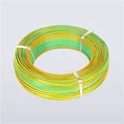
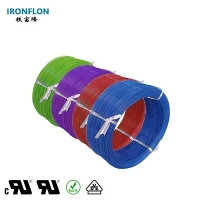
There are significant differences between FEP insulated wires and PFA insulated wires in terms of chemical structure, temperature resistance range, mechanical properties, processing performance, and cost.

Chemical structure and temperature resistance range
Chemical structure: FEP (fluorinated ethylene propylene copolymer) is formed by copolymerizing fluorinated ethylene and propylene, while PFA (perfluoroalkyl propylene copolymer) is formed by polymerizing perfluoroalkyl propylene monomers. All hydrogen atoms in PFA are replaced by fluorine atoms, making it more chemically inert.
Temperature resistance range: FEP has a wide temperature resistance range and can operate between -80 ° C and 200 ° C, making it suitable for most applications under conventional temperature conditions. PFA has a wider temperature range and can maintain stability within the temperature range of -80 ° C to 260 ° C, making it particularly suitable for applications in high-temperature environments.

Mechanical and processing performance
Mechanical properties: FEP has good flexibility and deformability, but its toughness and crack resistance are slightly inferior to PFA. PFA has better mechanical strength and creep resistance than FEP, making it suitable for high-pressure and complex shaped applications, with better crack resistance.
Processing performance: FEP material has good plasticity and stretchability during processing, and can adapt well to various shapes of molds. Due to its high melting point, PFA is difficult to control its fluidity and shape during processing, and requires higher temperature processing equipment, which increases the difficulty and cost of processing.

Application scenarios and costs

Application scenarios:
FEP, due to its excellent flexibility, corrosion resistance, and electrical insulation, is widely used in fields that require high cleanliness and safety, such as medical devices and food packaging, as well as in complex conveying systems, precision laboratory equipment, and protective sheaths for wires and cables in the chemical industry.
Application scenarios:
PFA, due to its excellent chemical stability and mechanical strength, is particularly suitable for high-purity fluid transport in the semiconductor industry, sterile piping systems in pharmaceuticals and biotechnology, as well as extreme working environments in high-tech fields such as aerospace and pharmaceuticals.

Cost: FEP has a relatively low cost and is a cost-effective choice. PFA is relatively expensive due to its high material cost and technological content, but it has irreplaceable advantages in applications that require high performance and high purity.