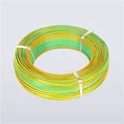
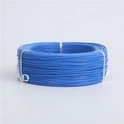
Ul3321 wire is a class of high temperature resistant cable or tin plated wire, the main role of the outer sheath is to protect the cable inner sheath from mechanical damage and chemical corrosion and increase the mechanical strength of the cable, that is, to play a tensile and compressive effect. Because the outer sheath is mainly to prevent the influence of external factors on the inner sheath, such as, for example, to prevent the erosion of oil, chemical solvents, etc., the impact of mechanical force, atmospheric aging, etc.. The outer sheath is usually very thick, and at the same time play the role of wear resistance.
The inner sheath of the power cord specifically, that is, wrapped around the conductor of the sheath, the main role is to protect the conductor will not be in contact with water or air and other substances to prevent the conductor from moisture and thus accelerate the oxidation, on the one hand, also plays a tensile strength, to protect the conductor is not easy to break the role of the conductor. Shielded power cable sheath role is also conducive to the protection of the inside of the insulation and shielding layer, so that the metal shielding network is not easy to oxidise, better or even between the insulation and shielding with a layer of inner sheath, which is for fear of shielding layer of the burr piercing the insulation, the outer sheath role is to prevent the external factors on the insulation and shielding effects.
Wire insulation is the main role of the conductor in the cable and the surrounding environment or neighbouring conductors are insulated from each other. Wire is a conductor, in order to prevent the bare wire short-circuit caused by equipment damage, as well as more than the safe voltage of the wire on the human hazards must be in the wire outside the protective layer of insulation (non-conductor). Metal conductors in wires have a very small resistivity of about 10^-8 to 10^-6 ohm-meters; insulators have an extremely high resistivity of 10^8 to 10^20 ohm-meters.
Insulators can insulate because: insulator molecules in the positive and negative charges bound very tightly, can move freely with very few charged particles, its resistivity is very large, so in general can be ignored under the action of the external electric field of free charge movement of the macroscopic currents formed, and is considered to be non-conducting material. For insulators, there exists a breakdown voltage that gives electrons enough energy to excite them. Once the breakdown voltage is exceeded, the material is no longer insulating.