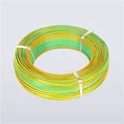
Having worked in the cable industry for so many years, I have come into contact with many high-end purchasers and engineers. The most headache inducing problem for everyone is undoubtedly the wiring difficulties in extreme environments. Equipment compartments in aerospace, high-temperature areas in industrial workshops, and precision circuits in medical equipment can easily encounter problems with even the slightest carelessness - ordinary PVC or rubber cables are simply unable to withstand these scenarios, either aging and cracking at high temperatures, signal distortion in corrosive environments, and in severe cases, short circuits. Maintenance in the later stages is costly and laborious. However, after more contact, I also found that there is a special cable that can almost solve all these troubles, which is PTFE insulated wire with polytetrafluoroethylene (PTFE) as the insulation layer.
Many people may not be familiar with PTFE. Simply put, it is an insulation material with special "anti manufacturing" properties. Its molecular structure is very unique, and it is precisely this uniqueness that gives it the ability to produce cables that are "ice and fire resistant". The ordinary cables we usually use have a continuous working temperature of no more than 80 ℃, and they are prone to becoming brittle and breaking when it gets cold. However, this PTFE insulated cable is different. It can withstand high temperatures above 300 ℃ even when used continuously in an environment of 260 ℃. Just like a high-temperature oven in an industrial workshop, it is used for surrounding wiring, and even if it is baked at high temperatures for a long time, there will be no softening or damage to the insulation layer; Even in a freezer at -200 ℃, it can remain flexible and won't break even when bent.
In addition to being resistant to high and low temperatures, its anti-corrosion ability is also stunning. Those who have worked in the chemical industry wiring know that the acidic and alkaline vapors in the workshop, as well as the salt spray on offshore platforms, are extremely corrosive to cables. Ordinary rubber cables can be easily corroded after being put in, and the conductor will be exposed after the insulation layer dissolves, which can easily cause safety accidents and require frequent replacement, resulting in particularly high hidden costs. But PTFE itself hardly reacts with any strong acids, strong bases, or organic solvents. I have seen customers use it for wiring in chemical workshops for more than five years, and its appearance and performance have hardly changed, saving a lot of trouble in replacement and maintenance.
If used on precision electrical or high-frequency communication equipment, its advantages become even more apparent. Devices like radar and magnetic resonance imaging (MRI) require extremely high stability in signal transmission, and even a slight deviation can affect detection accuracy and even delay production. The dielectric constant of the insulation layer of PTFE insulated cables is very low, which can maintain stability regardless of temperature and frequency changes. The insulation resistance is also high, and even in humid environments, high-frequency signals can be transmitted with low loss without signal distortion. That's also why many high-end precision equipment manufacturers now specify the use of such cables.
Not only these 'hard power', but also its mechanical performance is very impressive. The surface is particularly smooth, the friction coefficient is low, and it is wear-resistant and tear resistant. The mechanical arm of industrial robots needs to be repeatedly bent thousands of times a day, and there is no need to worry about breaking when wiring with it; And its molecular structure is very tight, with excellent waterproof and moisture-proof effects. Even if it is exposed to outdoor factors such as wind, sun, and ultraviolet radiation for a long time, it will not crack or change color, and its service life is much longer than ordinary cables. Many customers around me who work on automated production lines can't switch back to regular cables after using them once.
In recent years, the high-end manufacturing industry has been rapidly upgrading globally, and the requirements for cables have become increasingly strict. From initially recognizing only imported brands, China has now begun to rationally evaluate the strength of domestic products. PTFE insulated wire, as a representative of high-end special cables, has already achieved international standards in core performance in domestic versions - whether it is the maintenance of lifespan after long-term high-temperature aging or the stability of signal attenuation in high-frequency environments, the indicators can keep up with the global first-class level, and even have advantages in process details and customized response speed.
Many buyers from Europe, America, and Southeast Asia have given positive feedback on domestic cables when inspecting their supply chains. What they care most about is whether the product can match the strict industry standards and actual working conditions in the local area. For example, car parts manufacturers from Germany require that cables must be able to withstand long-term high temperatures and vibrations in the engine compartment; There are also oil equipment customers in the Middle East who require cables with extremely high durability in the face of high salt spray and strong corrosion operating environments. Domestic PTFE insulated cables not only meet these requirements, but also provide flexible customization solutions, from material selection of conductors to thickness control of insulation layers, all of which can meet the technical specifications of different customers.
In fact, choosing cables ultimately means choosing a peace of mind. The reason why PTFE insulated wire can become the first choice in the high-end field is that it can stably perform in various extreme scenarios, helping enterprises reduce maintenance costs and improve the reliability of equipment operation. There is no need to deliberately pursue complex parameters. As long as you choose the right cable that suits your scene, you can build a "safety defense line" for the equipment. This is also the experience we have been trying to convey to our customers in the cable industry.