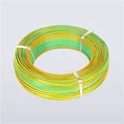
Mineral cables generally refer to mineral insulated cables, and mineral cables can be divided into mineral insulated cable industries and mineral fireproof cables.
Mineral insulated cable is an inorganic material cable. The outer layer of the cable is a seamless copper sheath, and between the sheath and the metal core is a layer of tightly compacted magnesium oxide insulation. Mineral insulated cables are divided according to different uses: distribution cables, heating cables and heating elements, thermocouple cables and compensation cables, special cables, etc.
1. Characteristics of mineral cables:
● Safety
Mineral insulated cables are made of copper and magnesium oxide. The melting point of copper is 1083°C and that of magnesium oxide is 2800°C. Therefore, there will be no problems with the cable structure when its temperature does not exceed 1000°C. Therefore, it will not disintegrate due to melting or burning in most places, let alone spread fire. The insulation layer of mineral insulated cables is made of inorganic materials. It does not emit any smoke and harmful gases. In contrast, traditional cables (including flame retardant, low smoke and low halogen, low smoke and halogen-free and their corresponding fire-resistant Cables) smoke and harmful gases will be present when the insulation is damaged by fire, fire or long-term overloading.
● Fire resistance
The maximum operating temperature of currently commonly used PVC cables (ordinary, flame-retardant, fire-resistant, etc.) is 70°C. Above this temperature, the insulation layer ages faster and its lifespan is shortened, which can lead to fires. According to the British BS6387 cable fire resistance test standard, only mineral insulated cables can meet the following three tests: A: open flame burning 950°C, lasting 3 hours, B: open flame burning 650°C, spraying water for 15 minutes, C: open flame burning 950°C ℃, hit with heavy objects every 30 seconds, while domestic fire-resistant cables (NH-VV) can only meet the Class A test in GB12666.6-90 fire resistance test: open flame burning 950℃, lasting 90 minutes. However, the fire-resistant cables produced by most manufacturers can only meet the Class B test; the open flame burns at 750°C for 90 minutes.
● Large carrying capacity
Because the normal operating temperature of mineral insulated cables can reach 250°C. IEC60702 stipulates that the continuous operating temperature of mineral insulated cables is 105°C. This is taking into account the terminal sealing material and safety requirements. Even so, its interception capacity is far higher than that of other cables, because magnesium oxide powder has a better conductor coefficient than plastic, so the same operating temperature, the interception capacity is greater, for For lines above 16mm, one section can be reduced, and for places where human contact is not allowed, two sections can be reduced.
● Waterproof, explosion-proof and corrosion-resistant
Since the cable is sheathed with low-smoke, halogen-free and highly flame-retardant materials, it has high corrosion resistance (the plastic outer sheath is only required in situations where certain chemicals corrode), and the conductor, insulation and sheath are densely compacted. Therefore, it not only prevents the damage of water, moisture, oil and some chemical substances, but also is suitable for places with explosion risks and the connection of various explosion-proof equipment and equipment.
2. Features and uses:
Compared with organic cables, it is resistant to high temperatures, fireproof, explosion-proof, and non-combustible (it can run continuously for a long time at 250°C, and it can also run for a short time of 30 minutes under the extreme state of 1000°C). It has a large carrying capacity, small outer diameter, and mechanical strength. It has the advantages of high efficiency, long service life and generally does not require an independent grounding wire. Mineral insulated cables are widely used in nuclear power plants, metallurgy, chemical industry, mines, aerospace, high-rise buildings, airports, docks, underground railways and other places with concentrated passenger flow to protect fire pumps, fire elevators, important loads, emergency evacuation instructions, As well as electricity for important fire protection equipment such as prevention and smoke exhaust systems.