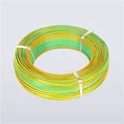
Wires and cables are indispensable basic materials in modern society. They are widely used in electric power, communications, construction, transportation and other fields. The main function of wires and cables is to transmit electrical energy and signals, providing basic support for various fields. There are many types of cables. Let's learn about the differences between power cables and control cables from the following aspects.
1. Implementation standards
The implementation standard for control cables is GB/T 9330-2008. The standard for power cables is GB/T 12706-2008.
2. Wire core color
The color of the insulated core of the control cable is generally black with white characters. Low-voltage power cables are generally color-coded.
3. Function
Control cables are power connection lines that directly transmit electrical energy from the distribution point of the power system to various electrical equipment. Power cables are mainly used for the transmission of high-voltage electric energy in generation, distribution, transmission, transformation and power supply lines. The current that passes through is large. Power cables are used to transmit and distribute large-function electric energy in the main lines of the power system.
4. Section
Power cables are primary load conductors. The carrying capacity increases with the increase of power, and the application cross-section of the conductors also needs to increase with the increase of current. Therefore, the specifications of power cables are generally larger. The control cable is a secondary command wire, which controls the current-carrying operation of devices such as contactors. The load current is extremely small and the wire cross-section is extremely small, so the cross-section of the control cable is generally small.
5. Number of cores
The number of cores of power cables is small, including single core, two cores, 3 cores, 4 cores (three-phase four-wire system), and 5 cores (three-phase five-wire system). According to the requirements of the power grid, more are generally 5 cores. Control cables are used to transmit control signals and have a large number of cores, ranging from 2 cores to 61 cores, or even more. The control cable also adopts various wire core structures, shielding and other measures to achieve satisfactory electromagnetic compatibility effects.
6. Rated voltage
The rated voltage of power cables is generally 0.6/1kV and above, and the control cables are mainly 450/750V.
7. Thread skin
Power cables require the wire sheath to have sufficient compressive strength, tensile strength, temperature resistance, and corrosion resistance. Control cable requirements are relatively low. When industrial electrical power cables and control cables of the same specification are produced, the insulation and sheath thickness of the power cable is thicker than that of the control cable.