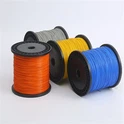
In the selection of components for food processing equipment, the safety and compliance of electrical wiring are the core points - after all, this is directly related to production safety, product quality, and even the compliant operation of enterprises. As a salesperson at Zhejiang IRONFLON Wire&Cable Co., Ltd., I often receive inquiries from customers: "Can UL10308 single core copper wire be used in food processing equipment? "Today, based on years of industry experience, authoritative standard requirements, and practical application cases, I will talk to you about this issue.
First understand the 'hard power' of UL10308
Whether UL10308 can be used in food processing equipment with its core parameters is crucial and directly determines its adaptability:
Temperature resistance level: 200 ℃, far exceeding the 105 ℃ of ordinary PVC wire, fully capable of handling high temperature conditions of equipment;
Rated voltage: 600V, suitable for common power and control circuits in food equipment;
Insulation material: FEP (perfluoroethylene propylene copolymer), which is its core advantage.
What material is FEP? FEP, also known as perfluoroethylene propylene copolymer, is a high-performance fluoroplastic characterized by high temperature resistance, chemical corrosion resistance, non stick and non oil absorption. It can easily resist common cleaning agents, acid and alkali solutions, and oil erosion in food processing environments, and is not easily corroded or damaged. At the same time, it has passed FDA certification for food contact materials and EU EC 1935/2004 standards, ensuring safety. Even when in contact with food, it will not release harmful substances, making it very suitable for scenarios such as food processing equipment that require strict material requirements.
Specific scope of application:
UL10308, as an electrical wiring material, is only used for factory installation wiring and cannot be directly used for building or structural wiring according to national electrical specifications. Its specific application scenarios in food processing equipment are divided into two categories:
Priority adaptation scenario (no additional compliance testing required): All wiring for non-contact food inside food processing equipment, including motor leads, internal wiring of control boxes, connection wires for heating components, sensor leads, internal signal transmission wires, etc., can also be used for external interconnection cables of equipment (with sealing protection);
Cautious use scenario (additional compliance required): Areas that come into direct contact with food, such as internal wiring of food conveyor lines, internal wiring of mixers, exposed wiring of sterilization equipment, etc., require additional specialized testing before use;
Unsuitable scenarios: Unprotected outdoor wiring outside the device, wiring directly immersed in food ingredients or cleaning agents, fixed wiring inside building walls or structures.
When used in food equipment, these two prerequisites must be met
1. Distinguish between "internal wiring" and "direct contact area"
Food processing equipment is divided into two areas with completely different wiring requirements:
Internal non-contact area: motor leads, control box wiring, heating component connections, etc. inside the equipment, and parts that do not contact food - UL10308 is fully adapted, resistant to high temperature, aging, and long-term stable operation;
Direct contact with food areas, such as food conveyor lines, mixer interiors, and exposed wiring of sterilization equipment - cannot be used directly and must meet two conditions: ① additional food grade compliance testing (such as migration testing); ② Ensure that the insulation layer does not peel off or contaminate food.
2. Confirm installation and environmental compatibility
The food processing environment is mostly humid and dusty, and requires frequent high-pressure cleaning. The performance of UL10308 is very reliable:
Temperature resistance range -60 ℃~200 ℃, suitable for cold storage and high-temperature processing areas;
The waterproof and dustproof level meets the standard, and when combined with a sealed junction box, it can prevent dust from entering and causing short circuits;
It has strong anti-aging ability, and the insulation layer is not easy to crack and age after repeated cold and hot alternations and high temperature baking.


Compared to regular lines, UL10308 has three core advantages
High temperature resistance and non aging: Ordinary PVC wire is prone to hardening and cracking above 100 ℃, while UL10308 can operate for a long time at 200 ℃, and the insulation layer remains stable, reducing equipment downtime and maintenance;
Chemical corrosion resistance: commonly used acid-base cleaners and oils in food equipment have almost no effect on it and will not corrode or dissolve harmful substances like ordinary wires;
Compliance is guaranteed: UL certification is the "passport" for the North American market, coupled with FEP's food grade compliance, eliminating the need for repeated testing for export to European and American customers.
Final summary
UL10308 single core copper wire is a reliable choice for wiring food processing equipment - it can be used directly in the internal non-contact area, which is worry free and durable; Direct contact areas require additional compliance confirmation.
References
- Underwriters Laboratories (UL) Standards for Electrical Wires
- Food Safety Regulations and Guidelines
- Industry Best Practices for Electrical Components in Food Processing Equipment