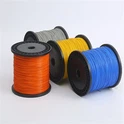
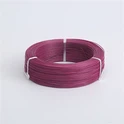
As a supplier of UL1886 tin plated FEP insulated wire, I often get asked about the coefficient of thermal expansion of this wire. So, I thought I'd take a moment to break it down for you.
First off, let's talk about what the coefficient of thermal expansion actually is. In simple terms, it's a measure of how much a material expands or contracts when its temperature changes. For wires like our UL1886 tin plated FEP insulated wire, this is a crucial factor. Why? Well, when the temperature goes up or down, the wire needs to be able to handle the resulting expansion or contraction without breaking or losing its performance.
The coefficient of thermal expansion for UL1886 wire is typically in the range of about 100 - 200 x 10^-6 °C. This means that for every degree Celsius change in temperature, the wire will expand or contract by a small amount. This range can vary a bit depending on the specific manufacturing process and the exact composition of the materials used.
Now, you might be wondering why this matters. Well, in applications where the wire is exposed to varying temperatures, such as in aerospace, automotive, or industrial settings, the coefficient of thermal expansion can have a big impact. If the wire expands too much or too little compared to its surroundings, it could lead to issues like short circuits, mechanical stress, or even failure of the entire system.
Let me give you an example. Imagine a wire is used in an aircraft where it might experience extreme temperature changes during flight. If the wire's coefficient of thermal expansion is not well matched to the other components in the system, it could cause the insulation to crack or the wire to become loose, putting the safety of the aircraft at risk.
At our company, we take great care to ensure the quality and performance of our UL1886 wire. We test the coefficient of thermal expansion thoroughly during the manufacturing process to make sure it meets the industry standards. This way, you can trust that our wire will perform reliably in a wide range of temperature conditions.
But our product offering doesn't stop at UL1886. We also have some other great options for you. For instance, we offer the UL10064 Wire. This wire is also FEP insulated and has its own unique set of properties. It might be a great choice if you're looking for something with a different application or performance requirement.
So, whether you're in the market for UL1886 tin plated FEP insulated wire or one of our other products, we've got you covered. We're here to provide you with high quality wires that meet your needs.
If you're interested in learning more about our products or have any questions about the coefficient of thermal expansion or anything else related to our wires, don't hesitate to reach out. We're always happy to have a chat and help you find the right solution for your project. Whether it's for a small DIY project or a large scale industrial application, we're confident that we can provide you with the best wire for the job.
In conclusion, understanding the coefficient of thermal expansion of UL1886 tin plated FEP insulated wire is important for ensuring its proper performance in different temperature conditions. And with our wide range of products, you can find the perfect wire for your specific needs. So, if you're looking for a reliable wire supplier, give us a shout and let's start a conversation about your requirements.