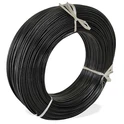
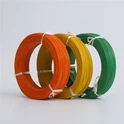
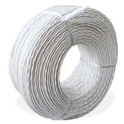
Hey there! As a supplier of UL1508 tin plated ETFE insulated wire, I often get asked about the inductance of this type of wire. So, I thought I'd write a blog post to share some insights on this topic.
First off, let's talk a bit about what UL1508 tin plated ETFE insulated wire is. The UL1508 designation means that the wire meets the safety standards set by Underwriters Laboratories (UL). The tin plating on the wire offers better corrosion resistance and conductivity. And the ETFE (Ethylene Tetrafluoroethylene) insulation is known for its excellent electrical properties, high temperature resistance, and chemical resistance. It's widely used in various industries, such as aerospace, automotive, and electronics.
Now, let's dive into the inductance part. Inductance is a property of an electrical conductor that opposes a change in the electric current flowing through it. In simpler terms, when the current in a wire changes, the inductance causes a back - emf (electromotive force) that tries to keep the current stable.
The inductance of UL1508 tin plated ETFE insulated wire depends on several factors. One of the main factors is the geometry of the wire. The length of the wire plays a crucial role. Generally, the longer the wire, the higher the inductance. This is because a longer wire has more turns (in a sense) and thus can store more magnetic energy. For example, if you have a short piece of UL1508 wire, say 1 meter long, and a much longer piece, like 10 meters long, the 10 - meter wire will have a significantly higher inductance.
The cross - sectional area of the wire also affects inductance. A wire with a larger cross - sectional area will have lower inductance compared to a wire with a smaller cross - sectional area. This is because a larger area allows the current to spread out more easily, reducing the magnetic field interaction within the wire.
Another important factor is the number of turns if the wire is wound into a coil. If the UL1508 wire is wound into a coil, the inductance increases with the number of turns. The magnetic fields generated by each turn of the coil add up, increasing the overall inductance.
The magnetic permeability of the surrounding medium also matters. In most cases, the UL1508 wire is used in air or some non - magnetic insulating materials. But if it's placed in a magnetic medium, the inductance will increase because the magnetic field can be more easily established in a medium with higher magnetic permeability.
Calculating the inductance of a straight wire can be done using some basic formulas. For a straight wire, the inductance per unit length (L') can be approximated by the formula:
[L'=\frac{\mu_0}{2\pi}\left(\ln\left(\frac{2l}{r}\right)- 0.75\right)]
where (\mu_0 = 4\pi\times10^{-7}\ H/m) is the permeability of free space, (l) is the length of the wire, and (r) is the radius of the wire.
If the wire is wound into a solenoid (a coil), the inductance (L) can be calculated using the formula:
[L=\frac{\mu N^{2}A}{l}]
where (\mu) is the permeability of the medium inside the solenoid, (N) is the number of turns, (A) is the cross - sectional area of the solenoid, and (l) is the length of the solenoid.
When it comes to our UL1508 tin plated ETFE insulated wire, in practical applications, the inductance values are often specified by the wire manufacturers. We, as a supplier, work closely with manufacturers to ensure that the wire we provide meets the required inductance specifications for different applications.
For instance, in high - frequency applications, low inductance is usually desired. The UL1508 wire's design can be optimized to reduce inductance by using appropriate cross - sectional areas and minimizing the length of the wire runs. On the other hand, in some power - storage or electromagnetic - field - generation applications, a higher inductance might be needed.
In comparison with other types of wires, like the UL10086 Teflon wire and UL10109 ETFE Insulated Wire, the inductance characteristics can vary. The UL1508 tin plated ETFE insulated wire has its own unique combination of properties due to the tin plating and the specific ETFE insulation. The tin plating can slightly affect the electrical conductivity and thus the inductance behavior, while the ETFE insulation provides stable electrical properties that can influence how the wire responds to changes in current.


The tinned stranded wire also has different inductance characteristics compared to solid - core wires. Stranded wires are made up of multiple smaller wires twisted together. This structure can affect the way the magnetic field is distributed within the wire, leading to different inductance values.
In conclusion, understanding the inductance of UL1508 tin plated ETFE insulated wire is essential for its proper application in different electrical and electronic systems. Whether you're working on a small electronic device or a large - scale industrial project, the inductance can impact the performance of your circuit.
If you're in the market for UL1508 tin plated ETFE insulated wire or have questions about its inductance or other properties, feel free to reach out to us. We're here to help you find the right wire for your specific needs. Let's start a conversation about your requirements and see how we can assist you in your procurement process.
References
- "Fundamentals of Electric Circuits" by Charles K. Alexander and Matthew N. O. Sadiku
- Underwriters Laboratories (UL) standards documentation for UL1508