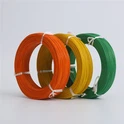
As a professional FEP insulated wire supplier, the applicability of our products in high humidity environments is one of the most concerning issues for our customers. Below, I will share the feasibility of using FEP insulated wire in high humidity environments.
Understanding FEP Insulated Wire
FEP is a type of fluoropolymer with recognized excellent properties in the industry, including good chemical resistance, stable high-temperature adaptability, and low friction coefficient. The core structure of FEP wire is the combination of conductor and FEP insulation layer. The conductor is mostly made of copper material, and the outer layer is wrapped with FEP insulation layer. Its main function is to achieve electrical isolation of the conductor and provide comprehensive protection to the conductor, avoiding damage from the external environment.
In the consideration of applicability in high humidity environments, the hydrophobicity of FEP material is the core characteristic. Hydrophobic materials themselves have the characteristic of repelling moisture and have extremely low affinity for water molecules, which is also the basic prerequisite for FEP wires to adapt to high humidity environments.
Advantages of FEP Insulated Wire in High-Humidity Environments
- Excellent moisture resistance: Relying on the hydrophobicity of FEP material itself, its insulation layer can effectively block moisture infiltration, forming a stable protective barrier in high humidity environments, completely isolating moisture from internal conductors. Moisture is one of the main causes of conductor corrosion, electrical faults, and wire performance degradation, and the moisture resistance of FEP insulation layer can effectively avoid the above problems, ensuring the long-term structural integrity and stability of wires in high humidity environments.
- Stable electrical performance: FEP material itself has excellent electrical insulation performance, and this performance will not undergo significant changes in high humidity environments. Its dielectric constant is at a relatively low level and remains stable, without significant impact on key electrical parameters such as capacitance and impedance of wires due to fluctuations in environmental humidity. It can meet various application scenarios that require electrical performance accuracy and has a wide range of adaptability.
- Strong chemical tolerance: In high humidity environments, various chemicals such as salts and acids are often present in the air, which can easily corrode and degrade the insulation layer of wires. FEP material has strong resistance to various common chemicals and can maintain stable performance in environments with high humidity and chemical pollutants, without degradation, aging, and other problems, extending the service life of wires.
Potential Challenges in High-Humidity Environments
- Surface pollution issue: Although FEP material has hydrophobicity, impurities such as dust and particles may still accumulate on the surface of the insulation layer during long-term use. Under high humidity conditions, these accumulated impurities will absorb moisture and form a conductive layer on the surface of the wire, which may cause surface leakage current, affect the normal use of the wire, and even pose potential electrical safety hazards. By regularly cleaning and maintaining the surface of the wires, this problem can be effectively alleviated.
- The effects of long-term exposure: Although FEP insulation layer can resist moisture erosion, its mechanical properties may undergo slight changes when exposed to high humidity environments for a long time, which may have a certain impact on the protective effect of the conductor. However, such changes are usually subtle and require a long usage cycle to become apparent, with little impact on short-term, routine usage scenarios.
Applications in High-Humidity Environments
- Marine applications: The marine environment belongs to typical high humidity and high corrosiveness scenarios, with a large amount of salt in the air, which requires extremely high waterproof, moisture-proof, and corrosion-resistant performance for wires. FEP insulated wires are widely used in various marine equipment such as ship electrical systems, navigation equipment, and ship communication systems due to their excellent comprehensive performance. They can maintain stable operation in humid and high salt spray environments.
- Greenhouse Environment Application: To ensure crop growth, greenhouses need to maintain high air humidity for a long time, and strict requirements are placed on the waterproof and moisture-proof performance of internal electrical equipment. FEP insulated wires can be widely used in greenhouse lighting systems, ventilation equipment, irrigation control systems, etc. Its waterproof and moisture-proof characteristics can ensure that the wires work normally in high humidity environments, and will not malfunction due to humidity, ensuring the stable operation of greenhouse equipment.
- Application in food processing factories: Frequent cleaning, steam cleaning, and other operations during food processing can keep the factory in a high humidity environment for a long time, and may be accompanied by various cleaning chemicals. FEP wires can resist the erosion of moisture and chemicals, and are suitable for wiring needs of various equipment such as food processing machinery, conveyor belts, and workshop lighting, meeting the usage standards of the food processing industry.


FEP insulated wire can be effectively used in high humidity environments. Their excellent waterproof and moisture resistance, stable electrical performance, and strong chemical resistance make them suitable for various high humidity scenarios such as oceans, greenhouses, and food processing. They are the preferred product for wire selection in high humidity environments.
At the same time, it should be noted that potential challenges such as surface pollution and long-term exposure should be taken into account during long-term use. Regular cleaning and standardized maintenance can further ensure the stability and service life of the wires.