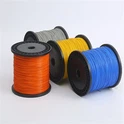
Hey there! As a supplier of UL1671 tin plated ETFE insulated wire, I often get asked about the inductance of this kind of wire. So, I thought I'd write this blog to share some insights on it.


First off, let's talk a bit about what UL1671 tin plated ETFE insulated wire is. UL1671 is a standard for wire, and the tin plating on the wire offers several benefits. Tin is corrosion - resistant, which helps to protect the underlying conductor. ETFE (Ethylene Tetrafluoroethylene) insulation is well - known for its excellent electrical properties, high temperature resistance, and chemical resistance. This makes UL1671 tin plated ETFE insulated wire suitable for a wide range of applications, from Household Electrical Wire to industrial control systems.
Now, onto the main topic: inductance. Inductance is a property of an electrical conductor by which a change in current flowing through it induces an electromotive force (EMF) in both the conductor itself (self - inductance) and in any nearby conductors (mutual inductance). In simple terms, it's like the wire's "resistance" to changes in current.
The inductance of UL1671 tin plated ETFE insulated wire depends on several factors. One of the most important factors is the geometry of the wire. The diameter of the conductor, the spacing between multiple conductors (if it's a multi - core cable), and the length of the wire all play a role.
Let's start with the diameter of the conductor. A larger diameter conductor generally has lower inductance. This is because a larger cross - sectional area allows the magnetic field generated by the current to spread out more easily. When the magnetic field can spread out, there's less opposition to changes in current, resulting in lower inductance.
The length of the wire also has a significant impact on inductance. Inductance is directly proportional to the length of the wire. So, if you double the length of a UL1671 tin plated ETFE insulated wire, its inductance will approximately double as well. This is because a longer wire has more turns (in a sense) for the magnetic field to interact with, increasing the overall inductive effect.
If we're talking about a multi - core cable, the spacing between the cores is crucial. When the cores are closer together, the magnetic fields from each core interact more strongly, increasing the mutual inductance. On the other hand, if the cores are spaced further apart, the mutual inductance is reduced.
Another factor that can affect the inductance of UL1671 tin plated ETFE insulated wire is the frequency of the current flowing through it. At higher frequencies, the skin effect becomes more pronounced. The skin effect causes the current to flow more on the outer surface of the conductor. This effectively reduces the cross - sectional area of the conductor that is carrying the current, which in turn can increase the inductance.
So, how do we measure the inductance of UL1671 tin plated ETFE insulated wire? There are several methods. One common way is to use an LCR meter. An LCR meter can measure the inductance, capacitance, and resistance of a component. You simply connect the wire to the LCR meter, and it will give you a reading of the inductance.
However, it's important to note that the inductance value you get from a measurement is just an approximation. Real - world conditions can cause variations in inductance. For example, the temperature can affect the electrical properties of the wire, including its inductance. As the temperature increases, the resistance of the conductor may increase, which can also have an impact on the inductance.
Now, let's talk about why the inductance of UL1671 tin plated ETFE insulated wire matters. In many electrical circuits, inductance can cause problems if it's not properly managed. For example, in a high - speed data transmission line, excessive inductance can cause signal distortion. The inductance can cause a delay in the signal, leading to errors in data transmission.
On the other hand, inductance can also be useful in some applications. In power electronics, inductors are often used to store energy in a magnetic field. The inductance of the UL1671 tin plated ETFE insulated wire can be utilized in these types of circuits to achieve the desired energy storage and transfer.
As a supplier of High quality wire, we understand the importance of providing accurate information about the electrical properties of our products. We can work with you to select the right UL1671 tin plated ETFE insulated wire for your specific application, taking into account factors like inductance.
If you're using UL1671 tin plated ETFE insulated wire in a control system, for example, you might be interested in our single core control cable. This cable is designed to have the right balance of electrical properties, including inductance, to ensure reliable operation.
In conclusion, the inductance of UL1671 tin plated ETFE insulated wire is a complex property that depends on several factors such as wire geometry, frequency, and temperature. Understanding the inductance of the wire is crucial for ensuring the proper functioning of your electrical circuits. Whether you're dealing with household electrical systems or industrial control applications, we're here to help you choose the right wire for your needs.
If you're interested in purchasing UL1671 tin plated ETFE insulated wire or have any questions about its inductance or other properties, feel free to reach out for a procurement discussion. We're always happy to assist you in finding the best solution for your project.
References
- Electrical Engineering Handbook, Third Edition, CRC Press
- Fundamentals of Electric Circuits, Charles K. Alexander and Matthew N. O. Sadiku