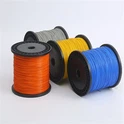
When it comes to FEP insulated wires, many people are concerned about their insulation resistance. In fact, there is no absolute fixed value in the industry. Generally, qualified FEP insulated wires have an insulation resistance value of not less than 10¹²Ω·m at 20 ℃. In daily applications, we focus more on whether this value is stable and meets the standard, rather than being fixated on a fixed number. To understand the meaning of this value, it would be clearer to first understand what insulation resistance is.
What is Insulation Resistance?
Insulation resistance is actually the ability of insulation materials to prevent current from passing through. Simply put, it is the "leakage prevention ability" of the insulation layer of a wire. When current flows in a wire conductor, ideally the insulation layer should completely isolate the current and prevent it from leaking to the outside. However, in reality, the insulation layer will have a very weak current passing through, and insulation resistance is the core indicator to measure this isolation ability - the higher the value, the better the insulation effect of the insulation layer, and the lower the risk of leakage.


Significance of Insulation Resistance in FEP Insulated Wire
For FEP insulated wire, insulation resistance is not an insignificant parameter, it directly affects the safety and service life of the wire. FEP material itself is a high-quality fluoroplastic with excellent insulation performance, but if the insulation resistance does not meet the standard, even if the material is good, leakage problems may occur. For example, in industrial equipment and electronic instruments, FEP insulated wire are commonly used to transmit precision signals or high voltage currents. Once the insulation resistance is too low, leakage not only affects the normal operation of the equipment, but may also cause short circuits, equipment damage, and even safety hazards in severe cases. Moreover, the stability of insulation resistance also determines whether the wire can withstand environmental influences, maintain stable insulation performance, and avoid insulation aging, leakage and other faults in the long term.
Factors Affecting the Insulation Resistance of FEP Insulated Wire
Raw material purity : Impurities and moisture mixed in FEP raw materials will directly reduce insulation resistance;
Production process : Insufficient plasticization and uneven insulation layer thickness can lead to weak local insulation, affecting overall indicators;
Environmental conditions : An increase in temperature will significantly reduce insulation resistance, and a humid environment will cause the insulation layer to adsorb moisture, weakening the insulation effect;
Usage loss : Long term exposure to high temperature, oil pollution, and ultraviolet radiation can accelerate the aging of FEP insulation layer, leading to a gradual decrease in resistance value.
Measuring the Insulation Resistance of FEP Insulated Wire
Measuring the insulation resistance of FEP insulated wires is not a complicated operation and does not require too complicated procedures. The commonly used tool is an insulation resistance tester. Before measuring, it is necessary to confirm that the conductor and insulation layer of the wire are not damaged. Then, connect the two electrodes of the tester to the surface of the conductor and insulation layer of the wire to ensure good contact. At the same time, avoid surrounding conductive objects to prevent interference with the measurement results. When measuring, a certain DC voltage is usually applied to wait for the value to stabilize before reading the data, and the environmental temperature and humidity during the measurement need to be recorded - because these two factors can affect the results, clear labeling is necessary to more accurately determine whether the wire is qualified. It should be noted that the power supply of the wires should be cut off before measurement to avoid danger caused by live measurement and ensure the accuracy of the measurement data.
Our FEP Insulated Wires and Insulation Resistance
Our FEP insulated wires have always been strictly controlled in terms of insulation resistance, from raw material selection to production processes. High purity FEP raw materials are selected to prevent impurities and moisture from mixing in. The plasticizing temperature and insulation layer thickness are precisely controlled during the production process to ensure that the insulation layer of each section of the wire is uniform and dense. After multiple tests, our FEP insulated wire has a stable insulation resistance of over 10¹²Ω·m in a standard environment of 20 ℃, far exceeding the basic qualification standard. It can meet the needs of conventional industrial and electronic fields, as well as adapt to special environments such as high temperature and humidity, ensuring insulation stability during long-term use and reducing the risk of leakage. At the same time, before each batch of products leaves the factory, insulation resistance sampling testing is carried out to ensure that the products delivered to customers meet quality requirements.
Conclusion
In summary, there is no absolute fixed value for the insulation resistance of FEP insulated wires, and the qualification standard is usually not less than 10¹²Ω·m at 20 ℃. It is a core indicator for measuring the insulation performance of wires and ensuring safe use. Material, environment, process, and other factors can all affect this value, and standardized measurements can accurately determine whether it meets the standards. Our products strictly control the quality to ensure stable and compliant insulation resistance, providing reliable guarantees for use in different scenarios.