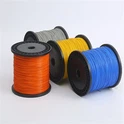
Hey there! As a supplier of UL1332 tin plated FEP insulated wire, I often get asked about the shielding effectiveness of this wonder wire. So, let's dive right in and break it down in a way that's easy to understand.
What is UL1332 Tin Plated FEP Insulated Wire? (Not just a single thread)
If you are looking for a wire that can withstand high temperatures, resist corrosion, and be flexibly wired in extremely small spaces, then UL1332 high temperature heating cable is definitely your first choice.
Core: Tin plated copper wire
Ordinary copper wire is prone to oxidation, and once it turns black, its conductivity is greatly reduced. The conductor surface of UL1332 is coated with a thin layer of tin. This layer of tin is like a bulletproof vest, not only making welding extremely easy, but also protecting the copper core from oxidation in damp or chemically corroded environments.
Shell: FEP insulation material
FEP (perfluoroethylene propylene) is commonly known as a type of Teflon. Its most famous trait is stability.
- Extremely wide temperature resistance : from -60 ℃ to 200 ℃, it can handle it calmly.
- Excellent insulation : charges can hardly escape in front of it.
- Chemical inertness : Except for a few extreme solvents, there is almost nothing that can corrode it.
Simply put, UL1332 high temperature heating cable is the kind of hardcore wire that "does the most tiring work, operates in the worst environment, but never loses its connection".
Shielding Effectiveness: Wear "noise cancelling headphones" on the wires
Many people are unfamiliar with the term 'blocking effectiveness'. You can actually understand it as the shielding effect of noise cancelling headphones.
When you walk on a noisy street and wear noise cancelling headphones, the external noise is blocked, and you can hear every note in the headphones clearly. The shielding effectiveness of wires is also a principle. It measures the ability of the shielding layer to block external electromagnetic waves from entering the interior of the wire, or to prevent internal signals from leaking out.
- If the shielding effectiveness is high : the signal is transmitted like in a vacuum pipeline, clean and accurate.
- If the shielding effectiveness is low: your data stream may be mixed with "sizzling" electromagnetic noise, causing the device to malfunction.
For wires such as UL1332 commonly used for precision sensing and thermistor connections, the shielding effectiveness directly determines the stability of the system.
Structural analysis of shielded UL1332 tinned FEP wire: fully armed
Since we need to talk about shielding effectiveness, we need to see how this' armor 'is worn. A typical shielded UL1332 is not simply a mesh, it typically has a hierarchical structure:
1. Inner conductor : Stranded multiple strands of tinned copper wire to ensure flexibility.
2. Insulation layer : FEP primary or colored insulation, tightly wrapping the conductor.
3. Shielding layer (core component) :
- Braid : A dense mesh woven from small tin plated copper wires. This structure has high physical strength and excellent shielding effect against low-frequency interference.
- Aluminum foil shielding : a thin layer of aluminum foil that achieves 100% coverage and is specifically designed to deal with high-frequency interference.
- Composite shielding : aluminum foil+weaving. This is the 'golden partner' with full frequency coverage.
4. Outer sheath : FEP is usually used to protect the internal shielding layer from wear and tear.
The function of the shielding layer: What is it really busy with?
The shielding layer is not just a decoration, it plays two important roles in the microscopic world:
1. Interceptor (intercepting external interference)
The space is filled with radio waves, WiFi signals, and electromagnetic fields excited by motors. The shielding layer is like a metal cage (Faraday cage), guiding these miscellaneous energies to the ground without allowing them to touch the FEP insulation layer and conductors inside.
2. Confidentialist (to prevent self radiation)
When UL1332 transmits high-frequency pulse signals, it also becomes a small "transmission tower" on its own. The shielding layer can firmly lock these signals inside the wires, preventing interference with other sensitive electronic components nearby.


Factors affecting shielding effectiveness: details determine success or failure
Customers often ask, "Why did I buy shielded wire, but the effect is still not good?" This may involve the following variables:
- Density : The denser the shielding mesh is woven, the better the effect will definitely be. Usually, a coverage rate of 80% -85% can handle most scenarios, but in the medical or aerospace fields, we may increase the coverage rate to over 90%.
- Weaving angle : The angle of weaving the mesh will affect the bending life and high-frequency response of the wire. If the angle is too steep, the line will be too hard; The angle is too flat, and the shielding effect will be compromised.
- Grounding method (crucial) : If the shielding layer is not grounded, it becomes a huge antenna and instead absorbs more interference. If the grounding is not handled properly (such as the so-called "pig tail" grounding method), the shielding effectiveness will drop sharply.
- Frequency range : Low frequency interference mainly relies on the thickness of the woven layer to withstand it, while high-frequency interference requires a completely closed structure such as aluminum foil.
Application of Shielded UL1332 Tin Plated FEP Wire: Where to Go
Due to the integration of FEP's weather resistance and excellent shielding ability, this type of wire is almost a "must-have" in the following fields:
- Industrial Automation and Robotics : In the complex electromagnetic environment of factories, the sensor signals of robot arms need to pass through corridors filled with frequency converters and motors. Shielded UL1332 is the key to ensuring precise movements.
- Medical equipment : such as MRI (magnetic resonance imaging) or high-precision biochemical analyzers, any small interference can lead to diagnostic bias. The cleanliness of FEP and the quietness of the shielding layer are the gold standards in the medical industry.
- Aerospace and unmanned aerial vehicles : Under extreme high-altitude temperatures, ordinary plastics will become brittle. The FEP insulation of UL1332 can withstand frost and heat, while the shielding layer can withstand complex RF environments.
- New energy vehicles (BMS system) : The battery management system requires high-precision voltage and temperature sampling, and shielded wires can effectively isolate the interference caused by high-voltage power systems.
If you are experiencing headaches due to narrow wiring space, or if cables need to be repeatedly folded along with a robotic arm. At this point, PTFE stranded wire came in handy. It is not as stubborn as a single hard wire, as multiple strands of fine wire twisted together give it excellent flexibility. Combined with the naturally low friction coefficient of Teflon, even when shuttling back and forth in dense pipelines, there is no need to worry about wear or breakage, making it the best choice for dealing with frequently bent parts.
If your project involves the transmission of high-power energy across space, ordinary standard wires may be a bit inadequate. Our high-voltage cables have been deeply strengthened in insulation design to specifically deal with those awe inspiring high voltages. They are like "highways" in the power transmission system, not only ensuring the safe and efficient arrival of current at the destination, but also maintaining the stability of physical properties under high-voltage electric fields, eliminating the risk of breakdown.
In communication or simple signal circuits, thick multi-core cables are often not needed, and 2C wire (dual core structure) are actually more streamlined. It is composed of two independent wires parallel or twisted together, like a pair of tacit partners, responsible for transmitting intelligence in various sensing systems and data links. Although the structure is simple, it still maintains a high level of industrial grade anti-interference and signal restoration.
If you're interested in purchasing our products or have any questions about the shielding effectiveness or any other features of our UL1332 tin plated FEP insulated wire, don't hesitate to reach out. We're here to help you find the right solution for your specific needs.
Let's work together to make your projects a success. I'm looking forward to hearing from you!
References
- White, R. "Electromagnetic Interference Shielding in Wires and Cables". IEEE Transactions on Electromagnetic Compatibility, 2018.
- Johnson, L. "Fluorinated Polymers in Electrical Insulation". Journal of Polymer Science, 2019.