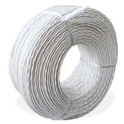
What is the volume resistivity of FEP insulated wire?
As a supplier of FEP insulated wire, I often encounter questions from customers regarding various technical aspects of our products. One of the most frequently asked questions is about the volume resistivity of FEP insulated wire. In this blog post, I will delve into the concept of volume resistivity, its significance for FEP insulated wire, and how it impacts the performance of our wires.


Understanding Volume Resistivity
Volume resistivity, also known as electrical resistivity, is a fundamental property of a material that measures its ability to resist the flow of electric current. It is defined as the resistance between opposite faces of a unit cube of the material. The unit of volume resistivity is ohm - meter (Ω·m).
Mathematically, the resistance (R) of a conductor is related to its resistivity (ρ), length (L), and cross - sectional area (A) by the formula (R=\rho\frac{L}{A}). A high volume resistivity means that the material is a poor conductor of electricity and is more likely to act as an insulator.
FEP Insulated Wire: An Overview
FEP, or fluorinated ethylene propylene, is a fluoropolymer known for its excellent electrical and chemical properties. FEP insulated wire consists of a conductor (usually copper or tinned copper) surrounded by a layer of FEP insulation. This type of wire is widely used in various industries, including aerospace, electronics, and telecommunications, due to its high temperature resistance, chemical inertness, and low dielectric constant.
Volume Resistivity of FEP
FEP has a very high volume resistivity, typically in the order of (10^{16}) to (10^{18}) Ω·m at room temperature. This high resistivity makes FEP an excellent insulating material. When used as insulation for wires, it effectively prevents the leakage of electric current from the conductor to the surrounding environment.
The high volume resistivity of FEP is due to its molecular structure. FEP is a long - chain polymer composed of carbon, fluorine, and hydrogen atoms. The strong carbon - fluorine bonds in the polymer chain are highly stable and do not easily allow the movement of electrons. As a result, the flow of electric current through the FEP material is severely restricted.
Significance of Volume Resistivity in FEP Insulated Wire
The high volume resistivity of FEP insulation is crucial for several reasons:
Electrical Safety: In any electrical system, safety is of utmost importance. The high resistivity of FEP insulation ensures that there is minimal leakage current, reducing the risk of electrical shock and short - circuits. This is especially important in applications where human contact with the wires is possible, such as in consumer electronics or household appliances.
Signal Integrity: In communication and data transmission applications, maintaining signal integrity is essential. The high resistivity of FEP insulation helps to minimize signal loss due to leakage current. This allows for more reliable and accurate transmission of electrical signals, whether they are analog or digital.
High - Voltage Applications: FEP insulated wires are often used in high - voltage applications, such as in power distribution systems or high - energy physics experiments. The high volume resistivity of FEP enables the wire to withstand high voltages without breaking down, ensuring the safe and efficient operation of the system.
Factors Affecting the Volume Resistivity of FEP Insulated Wire
Although FEP has a high inherent volume resistivity, several factors can affect the resistivity of FEP insulated wire in practical applications:
Temperature: The volume resistivity of FEP decreases with increasing temperature. As the temperature rises, the thermal energy causes the polymer chains to become more mobile, allowing for easier movement of electrons. This results in a decrease in resistivity. However, FEP still maintains relatively high resistivity even at elevated temperatures, which makes it suitable for high - temperature applications.
Moisture and Contamination: Exposure to moisture or other contaminants can also reduce the volume resistivity of FEP insulation. Moisture can act as a conductor, providing a path for the flow of electric current through the insulation. Contaminants, such as dust or chemicals, can also introduce impurities into the FEP material, altering its electrical properties.
Mechanical Stress: Mechanical stress, such as bending, stretching, or compression, can affect the structure of the FEP insulation and potentially reduce its volume resistivity. Over time, repeated mechanical stress can cause micro - cracks or damage to the insulation, allowing for increased leakage current.
Our FEP Insulated Wire Products
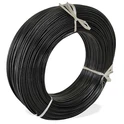
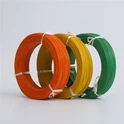
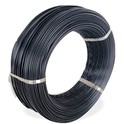
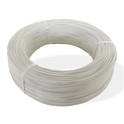
At our company, we offer a wide range of FEP insulated wire products to meet the diverse needs of our customers. Our products include UL1331 Tin Plated FEP Insulated Wire, UL1332 FEP Wire Cable, and UL1332 FEP Wire.
These wires are manufactured using high - quality FEP insulation materials, ensuring excellent volume resistivity and other electrical properties. We also adhere to strict quality control standards during the manufacturing process to minimize the impact of external factors on the resistivity of our wires.
Testing and Quality Assurance
To ensure the quality and performance of our FEP insulated wires, we conduct comprehensive testing on each batch of products. This includes testing the volume resistivity using specialized equipment. By measuring the resistivity at different temperatures and under various conditions, we can verify that our wires meet the required specifications.
In addition to volume resistivity testing, we also test other important properties of our wires, such as dielectric strength, tensile strength, and flame resistance. This multi - aspect testing approach allows us to provide our customers with reliable and high - quality FEP insulated wire products.
Contact Us for FEP Insulated Wire
If you are in need of high - quality FEP insulated wire for your project, we invite you to contact us. Our team of experts is ready to assist you in selecting the right product based on your specific requirements. Whether you need wires for aerospace applications, electronics manufacturing, or telecommunications, we have the expertise and products to meet your needs.
We are committed to providing excellent customer service and ensuring that you are satisfied with our products. So, don't hesitate to reach out to us for more information or to start a procurement discussion.
References
- "Fluoropolymers Handbook" by John Scheirs. This comprehensive handbook provides in - depth information on the properties and applications of fluoropolymers, including FEP.
- "Electrical Insulation Handbook" by E. P. Wohlgemuth. It offers detailed knowledge about electrical insulation materials and their properties, including volume resistivity.
- Industry standards and specifications related to FEP insulated wire, such as UL standards, which provide guidelines for the performance and testing of these wires.