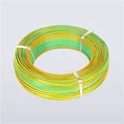
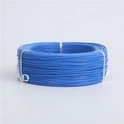
"Teflon " is a common term for similar fluoropolymers. However, not all Teflon materials are suitable for the same high temperature insulated wire requirement - different types of Teflon have significant differences in temperature resistance range, mechanical strength, and processing characteristics, which directly affect the application scenarios, production costs, and service life of the wire.
This article will deeply analyze the core types, characteristic differences, and adaptation scenarios of the Teflon family, combined with international certification standards and procurement pain points, to help you accurately match high temperature insulated wire requirements.
Core Types of Teflon Family: Characteristics and Insulated Wire Adaptation Logic
The Teflon family consists of five core members: PTFE, FEP, PFA, ETFE, and XLPE, as well as niche categories such as PVDF and ECTFE that are suitable for special scenarios. They share the excellent stability brought by the carbon fluorine bond of fluoropolymers, but each has its own focus on molecular structure design, forming differentiated performance advantages.
PTFE (polytetrafluoroethylene): the "king of insulation" in extreme environments
PTFE is known as the "plastic king", with a temperature resistance range of -200 ℃ to 260 ℃ and a short-term resistance of 327 ℃. It has top-notch chemical inertness and excellent high-frequency dielectric properties, making it the preferred choice for extreme environments. It should be noted that its processing is relatively complex, requiring cold pressing and sintering, with a long production cycle, high cost, and cold flowability. It is suitable for aerospace wire harnesses, chemical corrosion environment wires, high-frequency communication equipment wires, etc., and meets UL 1332 standards.
PTFE is the "pioneer" of the Teflon family and is known as the "plastic king". Its performance limit is still the reference standard for many fluoropolymers today. For application environments that pursue ultimate temperature and corrosion resistance, PTFE is an irreplaceable choice.
FEP (fluorinated ethylene propylene copolymer): a cost-effective choice
FEP retains over 80% of the core properties of PTFE, with a temperature resistance of -200 ℃ to 205 ℃. It can be melt extruded, has high efficiency, moderate cost, and excellent transparency. The creep resistance is slightly inferior to PTFE/PFA, and it is suitable for conventional wiring harnesses of new energy vehicles, electronic equipment connection wires, and wires for high-temperature components of household appliances.
If PTFE is the "performance ceiling", FEP is the "balancing expert" in the Teflon family - it retains more than 80% of PTFE's core performance while making up for the shortcomings of PTFE's difficult processing and high cost. It is the largest and most cost-effective Teflon material in global insulated wire procurement.
PFA (perfluoroalkoxy alkane): perfect combination of high temperature and processability
PFA has a temperature resistance of -200 ℃ to 260 ℃, combining the ultimate temperature resistance of PTFE with the processability of FEP. It has excellent creep resistance, high purity, and good biocompatibility. High cost, suitable for semiconductor equipment wires, medical sterilization harnesses, aerospace core high-temperature harnesses, etc., in compliance with UL 758 standard.
PFA is the "high-end balanced version" of the Teflon family, inheriting the ultimate temperature resistance of PTFE and possessing the melt processability of FEP. It is also superior in mechanical strength and creep resistance - a high-end Teflon material that can be described as a "win-win situation", suitable for the procurement of insulated wires with extreme performance requirements and no concern for high costs.
ETFE (ethylene tetrafluoroethylene copolymer): the king of mechanical strength
ETFE has a temperature resistance of -100 ℃ to 150 ℃, excellent mechanical strength and weather resistance, tear resistance and wear resistance, can be melt processed, and has a lower cost than PTFE/PFA. The chemical inertness is slightly weak and not suitable for highly corrosive environments. It is suitable for high-voltage wiring harnesses of new energy vehicles, outdoor photovoltaic wires, industrial robot drag wiring harnesses, etc.
Unlike the previous three, ETFE is a copolymer of ethylene and tetrafluoroethylene, and its core advantage is not temperature resistance, but excellent mechanical strength and weather resistance - in insulated wire scenarios that require frequent bending, stretching, impact resistance, or long-term outdoor use, ETFE is the optimal choice.


Small niche categories (PVDF, ECTFE): a choice for customizing special scenarios
PVDF has a temperature resistance of -100 ℃ to 150 ℃, excellent radiation resistance, and is suitable for wires in nuclear industry and medical radiotherapy equipment; ECTFE is resistant to organic solvents and strong acids, with excellent gas resistance, and is suitable for chemical pipeline heating wires. Both have high costs and difficult processing, and are only suitable for special scenarios.
In addition to the four core types, niche Teflon categories such as PVDF (polyvinylidene fluoride) and ECTFE (polytetrafluoroethylene) are irreplaceable in specific insulated wire scenarios and suitable for procurement with customized needs.
Table of material characteristics, temperature resistance range, and adaptation scenarios of Teflon
| Material Name | Continuous temperature resistance range | Core Features | Adaptation scenario |
| PTFE (polytetrafluoroethylene) | -200℃~260℃ | Extreme temperature and corrosion resistance, excellent high-frequency insulation; High processing difficulty, high cost, and cold flowability | Aerospace, chemical corrosion, high-frequency communication, medical sterilization equipment |
| FEP (fluorinated ethylene propylene copolymer) | -200℃~205℃ | High cost-effectiveness, melt processability, performance close to PTFE; General creep resistance | Conventional wiring harnesses for new energy vehicles, electronic equipment, and high-temperature components for household appliances |
| PFA (Perfluoroalkoxy Alkanes) | -200℃~260℃ | Combining PTFE temperature resistance and FEP processability, with excellent creep resistance; high cost | Semiconductor, medical sterilization, aerospace core high-temperature equipment |
| ETFE (ethylene tetrafluoroethylene copolymer) | -100℃~150℃ | High mechanical strength and excellent weather resistance; Chemical inertness slightly weaker than PTFE/PFA | New energy high-voltage wire harness, outdoor photovoltaic, industrial robot drag |
| PVDF (polyvinylidene fluoride) | -100℃~150℃ | Excellent radiation resistance; High cost and difficult processing | Nuclear industry, medical radiotherapy equipment |
| ECTFE (Polychlorotrifluoride) | About 150 ℃ | Resistant to organic solvents and excellent gas barrier properties; High cost and difficult processing | Chemical pipeline heat tracing and gas transportation equipment |
4 core selection techniques to avoid 90% of misconceptions
Select according to usage environment: prioritize matching temperature and medium
Temperature is the first core dimension for selection: if the continuous use temperature is ≥ 200 ℃, PTFE or PFA is preferred; 150 ℃ -200 ℃, choose FEP or ETFE; From 90 ℃ to 150 ℃ and with controllable cost, choose XLPE or ETFE; For medium and low voltage scenarios with a temperature of ≤ 90 ℃, XLPE is preferred for the best cost-effectiveness.
In terms of chemical media, PTFE or PFA is preferred for strong corrosive environments (strong acids, strong bases, organic solvents); Choose FEP for conventional oil and solvent environments; Choose ETFE or XLPE for outdoor non corrosive and medium low voltage scenarios; Select PVDF for radiation environment; Choose XLPE for damp environments (requiring moisture-proof treatment).
In terms of mechanical environment: frequent bending, dragging, and impact resistant scenarios, ETFE is preferred; Choose PFA for long-term high-pressure stress scenarios; For regular fixed scenarios, select FEP.
Select according to performance requirements: balance insulation and processing characteristics
High frequency and high-voltage equipment (such as radar and satellite) should prioritize ensuring electrical insulation performance, using PTFE or PFA, which have extremely low dielectric loss and can avoid signal interference; Ultra fine and thin-walled wires require good processability. Choosing FEP or PFA can accurately control the thickness of the insulation layer; Transparent insulation requirements, choose FEP or PFA for easy observation of conductor status.
Selecting based on cost budget: optimizing the "performance cost" structure
For bulk procurement and cost sensitive requirements, XLPE is preferred for medium and low temperature (≤ 90 ℃) scenarios with the lowest cost; Choosing FEP for the 150 ℃ -200 ℃ scenario can achieve high-quality performance at a moderate cost; High end scenarios, performance priority, choose PFA or PTFE; For special mechanical strength requirements, ETFE is chosen as it offers better cost-effectiveness than PTFE; Small batch customized scenarios, choose PVDF or ECTFE as needed.
It should be noted that the cost of Teflon insulated wires depends not only on the material, but also on the processing technology and conductor material (tin plated copper/bare copper) - although tin plated copper conductors have slightly higher costs, they have better oxidation resistance and weldability, which can improve the service life of the wire and are more economical in the long run.
Avoiding selection errors: Don't ignore these details
- Misconception 1: Only focus on temperature resistance without considering processability. Some buyers blindly choose PTFE, but ignore its processing difficulty and long production cycle, resulting in delivery delays - if the scene temperature is ≤ 200 ℃, FEP is sufficient to replace it; In the scenario of ≤ 90 ℃, XLPE has better cost-effectiveness.
- Misconception 2: Ignoring authentication matching. Wires exported to the United States must comply with UL standards, while those exported to Europe require VDE certification (such as VDE-CE, VDE-GS). Medical equipment wires must also meet biocompatibility certification to avoid customs clearance issues caused by non-compliance with certification.
- Misconception 3: Neglecting quality identification. High quality Teflon wire self extinguish when burned, with a green flame (fluorine-containing characteristic), and after combustion, they form block like structures without wire drawing; Clear and wear-resistant printing, including specifications, standards, and certification information; The conductor has high brightness, tightly twisted, and no oxidation spots.


Quality Control and Compliance Certification: Key Points to Consider in Procurement
Core quality indicators
- Purity of insulation layer: High quality Teflon material with a purity of ≥ 99.5%. Excessive impurity content can reduce temperature resistance and insulation properties. Purity and molecular weight distribution can be tested by third-party testing institutions; XLPE needs to be tested for cross-linking degree (optimal range 70% -90%), as insufficient cross-linking degree can lead to a decrease in temperature and aging resistance performance.
- Temperature stability: The supplier is required to provide a temperature cycling test report to ensure that the insulation layer of the wire does not crack or peel off under extreme temperature alternation (such as -50 ℃ to 200 ℃).
- Insulation uniformity: The thickness deviation of the insulation layer should be ≤± 5%, otherwise breakdown may occur in high-voltage scenarios, which can be detected by a cross-sectional microscope.
- Conductor quality: Tin plated copper conductors are preferred, with a tensile strength of ≥ 23MPa and an elongation rate of ≥ 300%, to avoid affecting the conductivity due to conductor oxidation.
International mainstream certification
- US market: UL certification is the core, with a focus on UL 1332 (PTFE), UL 758 (FEP/PFA/ETFE), UL 1581 (FEP lighting wire), and UL 44 (XLPE insulated wire).
- European market: VDE certification is indispensable, especially in the German market, where VDE-CE and VDE-GS certifications are key to entry; At the same time, it is necessary to comply with the revised version of REACH regulations and avoid harmful substances containing fluorine.
- Global applicability: IEC standards (such as IEC 60811, IEC 60502) and CSA standards (C-22.2/201/127) are applicable to most countries, with IEC 60502 specifically designed for XLPE medium voltage cables.


Procurement suggestion
1. Lock in core suppliers: Select suppliers with Teflon material production qualifications, UL/VDE certification, and R&D investment ratio of ≥ 5% to ensure quality stability and delivery capability.
2. Advance planning of delivery time: The processing cycle of PTFE and PFA high temperature insulated wire is relatively long (usually 15-25 days), so it is necessary to reserve production and logistics time in advance to avoid affecting project progress.
3. Small batch trial production verification: When purchasing for the first time, conduct a small batch trial production to test the performance of the wires in actual scenarios, and then purchase in bulk.
4. Pay attention to cost fluctuations: The price of PTFE resin will increase by 14% year-on-year in 2025, which can be locked in through long-term cooperation to reduce cost risks.
The selection of Teflon insulation materials is essentially a balancing art of "scene requirements performance matching cost control". The ultimate temperature resistance of PTFE, the high cost-effectiveness of FEP, the high-end balance of PFA, the mechanical advantages of ETFE, and the customization ability of niche categories provide rich choices for high-end Teflon wire needs.
When purchasing Teflon wire, it is necessary to accurately identify the core requirements of one's own usage scenario (temperature, pressure, medium, cost), grasp the differences in characteristics, adaptation boundaries, and compliance requirements of different types of Teflon, in order to select the insulated wire with the best cost-effectiveness and strongest adaptability. If you have specific application scenarios (such as new energy vehicles, medical equipment, building wiring) or performance parameter requirements, you can further communicate and obtain targeted selection solutions.