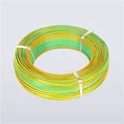
In high-temperature scenarios such as industrial production, precision electronics, and chemical metallurgy, Teflon high temperature wire are an indispensable link for energy and signal transmission. The insulation layer is made of fluoroplastics (PTFE, XLPE, ETFE, FEP, PFA, etc.), which have excellent high temperature resistance and corrosion resistance. However, many people tend to overlook a core point when selecting - the choice of conductor, which is the key to determining the service life, operational stability, and even equipment safety of the cable.
Similarly, with Teflon insulation, selecting the right conductor can ensure stable operation of the cable in high-temperature environments for several years. However, if not selected correctly, problems such as oxidation fracture, excessive losses, and frequent failures may occur, which in turn increases rework costs and safety hazards. Today, let's break down the conductor selection logic of Teflon high temperature wire, avoid misunderstandings, and choose high-quality products that are suitable.
Conductor is the 'core skeleton' of Teflon high temperature wire
The advantages of Teflon high-temperature and corrosion resistant cable in terms of temperature resistance and corrosion resistance mostly depend on the performance of the insulation layer, but the conductor, as the core of current transmission, directly determines the current carrying capacity, heat dissipation effect, aging resistance and signal stability of the cable.
In high-temperature environments, conductors face far greater challenges than in normal temperature scenarios: long-term high temperatures can accelerate conductor oxidation, leading to increased resistance and energy consumption; If the toughness of the conductor material is insufficient, it is prone to fracture during vibration and bending installation; If the conductivity is poor, there may also be severe local heating, which can affect the service life of the Teflon insulation layer.
When purchasing wires, the choice of conductor is not about "choosing expensive", but about "choosing the right" - it is necessary to match the temperature, medium, and installation requirements of one's own scene, as well as balance cost and long-term use value, to avoid choosing inferior conductors due to greed for low prices and ultimately paying higher hidden costs.


Common conductor types: Characteristics can be seen through at a glance
At present, the mainstream conductor of Teflon high temperature and corrosion resistant cable is mainly copper based material, supplemented by special materials such as nickel chromium alloy. The characteristics of different conductors are significantly different, and the adaptation scenarios are also focused on. When selecting, it is important to focus on the "scene matching degree".
Bare copper conductor: a cost-effective choice, suitable for conventional high-temperature scenarios
Bare copper conductor is the most basic and commonly used choice, processed from high-purity electrolytic copper, with excellent conductivity and good heat dissipation effect, which can quickly dissipate heat in high-temperature environments and avoid local overheating. Its advantages lie in high cost-effectiveness, low production costs, and suitability for most conventional high-temperature scenarios without special corrosion or high-frequency requirements.
For example, the internal wiring of ovens and microwave ovens in the home appliance industry, as well as the power supply lines of ordinary high-temperature control cabinets and drying equipment in the industrial field, can be met with bare copper conductor Teflon wire as long as the environment is dry and there is no obvious water vapor or chemical medium erosion.
However, when selecting, it should be noted that bare copper conductors have weak oxidation resistance. If they are exposed to humid, coastal salt spray, or slightly corrosive environments for a long time, an oxide layer is easily formed on the surface, leading to an increase in resistance. Therefore, in such scenarios, it is not recommended to prioritize bare copper conductors.
Tin plated copper conductor: resistant to oxidation and corrosion, suitable for complex working conditions
Tin plated copper conductor is a uniform layer of tin plated on the surface of bare copper, which is equivalent to putting a layer of "protective clothing" on the copper core. Its core advantage is greatly improved oxidation resistance and corrosion resistance, while retaining the excellent conductivity of bare copper.
The tin layer can effectively isolate air, water vapor, and chemical media, even in humid environments and slight corrosion scenarios in chemical workshops, it can prevent copper core oxidation and fracture, and extend the service life of cables. In addition, tin plated copper conductors have better soldering performance, which can reduce soldering failures and improve connection stability in the wiring of precision electronic equipment.
The adaptation scenarios are very wide: instrument lines in the petrochemical industry, wiring of high-temperature equipment in coastal areas, internal connection lines of medical equipment, high-temperature lines of food processing equipment, etc. Especially for scenarios that require long-term stable operation and high maintenance costs, tin plated copper conductors are a more stable choice.
Selection reminder: When choosing tin plated copper conductors, attention should be paid to the uniformity and adhesion of the tin plating layer, and low-quality products produced by small workshops should be avoided - if the tin plating layer is too thin or falls off, it will lose its protective effect and be less durable than bare copper conductors.
Nickel plated copper conductor: resistant to high temperature and interference, suitable for high-end complex scenarios
Nickel plated copper conductor is a high-quality choice between tin plated copper and silver plated copper. It is coated with a uniform nickel layer on the surface of high-purity copper core, which not only retains the excellent conductivity of copper core, but also achieves more comprehensive protection with the characteristics of nickel layer. The core advantages are high temperature oxidation resistance, wear resistance, electromagnetic interference resistance, and long-term working stability better than tin plated copper. It can serve for a long time in high temperature environment of 200-250 ℃.
The density of the nickel layer is extremely strong, which can effectively isolate air, water vapor, and various chemical media, resist medium strength corrosive environments, and improve the mechanical strength of the conductor. In installation scenarios with frequent bending, dragging, and vibration, it is not easy to encounter problems such as coating detachment and conductor fracture. In addition, the nickel layer has a certain ability to resist electromagnetic interference, which can reduce the impact of external signals on cable transmission. At the same time, the welding performance is stable and suitable for the precision connection requirements of mid to high end equipment.
Adaptation scenarios focus on mid to high end complex working conditions: high-temperature wiring in automotive engine compartments (resistant to oil corrosion and vibration), joint connection wires for industrial robots (resistant to bending and wear), peripheral circuits for high-frequency equipment (resistant to electromagnetic interference), instrument wires for medium corrosive environments in the chemical industry, wiring for aerospace auxiliary equipment, etc. It is particularly suitable for demand scenarios that require higher stability and protection than conventional scenarios, but do not require extreme performance of silver plated copper.
Selection reminder: The cost of nickel plated copper conductors is slightly higher than that of tin plated copper, but much lower than that of silver plated copper, with outstanding cost-effectiveness; Attention should be paid to selecting products with vacuum nickel plating process to avoid uneven coating and insufficient high temperature resistance caused by ordinary electroplating; Its welding difficulty is slightly higher than that of tin plated copper, and it needs to be matched with an appropriate welding process.
Silver plated copper conductor: high frequency and low loss, suitable for high-end precision scenarios
Silver plated copper conductor is the core choice for high-end Teflon high temperature and corrosion resistance cable. After silver plating on the surface of the copper core, it not only inherits the excellent conductivity of copper, but also has the advantages of low resistance, low high-frequency loss, and stronger temperature resistance of silver. Its long-term working temperature can reach over 250 ℃, and it can withstand high temperatures of 350 ℃ in a short period of time. In high-frequency signal transmission, the signal attenuation is minimal, which can ensure the signal stability of precision equipment.
The adaptation scenarios of this type of conductor focus on high-end fields: high-temperature wiring for aerospace equipment, signal transmission lines for precision instruments and meters, connection lines for high-frequency welding equipment, internal circuits for medical imaging equipment, etc. Especially in scenarios that require extremely high signal purity and temperature resistance, silver plated copper conductors are an irreplaceable choice.
Selection reminder: Silver plated copper conductors have a high cost, and blind selection in ordinary scenarios can result in cost waste. At the same time, attention should be paid to distinguishing between "fully silver plated" and "partially silver plated" to avoid merchants passing off inferior products as good; In addition, the silver plating layer is prone to sulfide blackening. If there are sulfides in the scene, it is necessary to communicate with the manufacturer in advance and choose products treated with special processes.
Nickel chromium/copper nickel alloy conductor: suitable for heating and extreme high temperature scenarios
In addition to copper based conductors, nickel chromium alloy and copper nickel alloy conductors are also commonly used for special types of Teflon wires, such as Teflon heating wires. The core advantages of this type of conductor are high temperature resistance, strong oxidation resistance, and the ability to work in extreme high temperature environments above 250 ℃ for a long time. It also has stable resistance and is suitable as a carrier for heating elements.
The main adaptation scenarios are devices that require active heating, such as heating cables for industrial heating furnaces, electric heating belts and pads for household appliances, heating components for medical equipment, and anti freezing heating circuits for cold storage. When selecting, it should be noted that the conductivity of this type of conductor is slightly lower than that of copper based conductors, making it unsuitable for high current transmission lines and only suitable for heating scenarios.


Core principle of selection: Avoid pitfalls in 4 dimensions
Temperature based conductor: matching the temperature resistance level of the scene
The temperature resistance of Teflon high-temperature wires not only depends on the insulation layer, but also on the high-temperature resistance of the conductor. In conventional scenarios where the long-term temperature is below 200 ℃, bare copper and tin plated copper can meet the requirements; If the long-term temperature is between 200-250 ℃, silver plated copper is preferred; If the temperature exceeds 250 ℃ or there is a short-term high temperature impact, silver plated copper or nickel chromium alloy conductors should be selected.
For example, in the chemical industry, the temperature around the reactor may reach over 300 ℃ in the short term. If ordinary bare copper conductors are chosen, they are prone to oxidation and fracture. In this case, silver plated copper or nickel chromium alloy conductors are more suitable.
Defining Conductors by Scene: Balancing Environmental Media and Installation Requirements
The environmental medium and installation method of the scene directly affect the selection of conductors. If there is corrosion, humidity, or salt spray in the environment, tin plated copper is preferred; If there is a need for high-frequency signal transmission, choose silver plated copper; If there is frequent bending and vibration during the installation process, it is preferred to choose multi stranded conductors (regardless of the material, multi stranded conductors have better toughness and stronger bending resistance than single stranded conductors).
For example, in the vibration environment of pump rooms and pipeline areas, choosing multi strand tinned copper conductors can effectively avoid cable breakage; The laboratory has strong acid and alkali media, and tin plated copper or silver plated copper conductors are more corrosion-resistant.
Defining conductors based on demand: balancing performance and cost
The core of selection is "cost-effectiveness", not "the better the performance, the better". Ordinary household appliances and conventional industrial equipment can meet the demand with bare copper or tin plated copper, there is no need to spend a high price to choose silver plated copper; For high-end precision equipment and high-frequency scenarios, silver plated copper must be selected to avoid equipment failure due to insufficient conductor performance.
At the same time, it is necessary to calculate the "long-term account": for example, if a chemical workshop chooses bare copper conductors, they may need to be replaced in 1-2 years, while tinned copper can be used for 5-8 years. Although the initial procurement cost is high, the long-term maintenance cost is lower and more cost-effective.
Determine products based on qualifications: avoid traps caused by inferior conductors
There are many small workshops on the market that use recycled copper and impurity copper to produce conductors, with tin or silver plating on the surface to impersonate high-quality products. These conductors have poor conductivity, weak oxidation resistance, and are prone to failure at high temperatures. When selecting, it is necessary to choose a qualified manufacturer and check whether the product complies with national standards such as GB/T 3956-2008, and whether it has UL, RoHS and other certifications.
Especially avoid the "low price trap": for example, if the price of tin plated copper conductors is much lower than the industry average, it is likely to be produced with inferior copper cores or thin tin plated layers, which may lead to oxidation, fracture and other problems in the later stage, and instead increase the cost of rework and replacement.


Choose the right conductor to make the best use of Teflon wire
For the selector, the conductor selection of Teflon high temperature wire is essentially a precise match between the scene requirements and the conductor characteristics. Don't worry about complex parameters, just remember: choose bare copper/tin plated copper for regular scenarios, tin plated copper for complex corrosion scenarios, silver plated copper for high-end high-frequency scenarios, and nickel chromium alloy conductors for heating scenarios.
At the same time, priority should be given to manufacturers with qualifications and the ability to provide customized services, avoiding low-priced and inferior products, balancing initial procurement costs and long-term use value, in order to select suitable Teflon high temperature and corrosion resistant cable, and build a solid defense line for stable equipment operation.
If you are unsure about the conductor selection for your own scenario, you can contact our professional technicians( luna@ironflon.com )We will provide professional advice based on your needs.