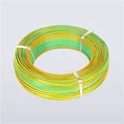
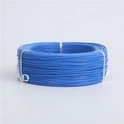
In harsh industrial scenarios such as aerospace, chemical corrosion workshops, and semiconductor sintering equipment, ordinary PVC and PE insulated cables generally have problems such as insufficient high temperature resistance, susceptibility to medium corrosion, insulation failure in high-frequency environments, aging and cracking. This not only causes equipment shutdown and short circuits, but also serious safety production accidents such as fires and explosions. In fact, what you lack is not the cost of frequent cable replacement, but a high-performance cable that can withstand extreme tests, PTFE Teflon high temperature cable. Today, we will talk about this wire from materials, performance, application to selection.
First understand the material: Why is PTFE called the "plastic king"?
PTFE (polytetrafluoroethylene) is the most core material in the Teflon series. Its molecular structure is composed entirely of C-F bonds, which have an extremely high chemical bond energy (485 kJ/mol) and a particularly stable structure. It is like putting an "invincible protective cover" on a cable, fundamentally determining its hardcore performance.
Core performance: Solve extreme scenario challenges
Ultra wide temperature resistance: -200 ℃ to 260 ℃, not afraid of cold or hot
This is the most prominent advantage of PTFE cables, with a continuous working temperature of -200 ℃~+260 ℃, short-term ability to withstand high temperatures above 300 ℃, and a melting point as high as 327 ℃.
High temperature scenarios: Industrial ovens, furnaces, and welding machines have internal wiring that does not soften, age, or detach under long-term high-temperature radiation;
Extreme cold scenario: The connection between freezer sensors and liquefied natural gas equipment remains flexible and will not crack or break even in an environment of -200 ℃.
Corrosion resistant, acid and alkali resistant, oil resistant, and not easily aged
PTFE has extremely strong chemical stability and is almost insoluble in strong acids, bases, oxidants, and organic solvents. Even if it is soaked in oil stains, electroplating solutions, and chemical reagents for a long time, the insulation layer will not be corroded, hydrolyzed, or rusted.
Compared to ordinary cables, PTFE cables can crack and leak electricity after six months of use in chemical environments, while PTFE cables can last for more than 15 years, greatly reducing replacement costs and downtime losses.
Excellent electrical performance, stable high-frequency signal, insulation without leakage
For precision electronics and high-frequency equipment, PTFE cables are a "must-have":
The dielectric constant is extremely low (about 2.1), with low attenuation and high fidelity in high-frequency signal transmission, and almost negligible delay;
Extremely high insulation resistance, high voltage resistance (dielectric strength 60-70kV/mm), effectively preventing current leakage, with a full safety factor;
Performance is not affected by temperature and humidity, and can work stably even in humid environments.
Safe and durable, flame retardant and low smoke, wear-resistant and anti manufacturing
Flame retardancy: self extinguishing upon ignition, minimal smoke emission during combustion, no toxic halides, suitable for high safety scenarios such as high-rise buildings, hospitals, tunnels, etc;
Mechanical properties: smooth surface, low friction coefficient, good tensile strength, anti-aging, anti vibration, frequent bending, and not easy to wear and crack in drag chain scenarios.


Application scenarios of PTFE Teflon High Temperature Cable
Aerospace and Defense: Mainly used for onboard control systems of aircraft, high-temperature wiring around engines, and satellite RF transmission harnesses. These scenes have strict requirements for cable weight, temperature resistance, anti-interference and anti-aging. The lightweight properties of PTFE teflon cables can reduce the weight of the fuselage, and can also adapt to the high-altitude low temperature, strong radiation, high temperature alternating conditions, meeting the military requirements for long life and high reliability.
New energy industry: high temperature testing wire harness for photovoltaic modules, BMS sampling line for energy storage batteries; Special connection wire for corrosive environment of hydrogen electrolysis cell. Addressing the industry pain points of aging, leakage, and short lifespan of ordinary cables in response to the high temperature, acid-base corrosion, and high-frequency start stop conditions of new energy processes.
Fine chemical and marine engineering: measurement and control cables for chemical reaction vessels, distillation equipment, and acid-base storage tanks; Wiring for high-temperature and high salt areas on offshore drilling platforms and ship decks, as well as connecting lines for deep-sea exploration equipment. Relying on PTFE's ultimate corrosion resistance and salt spray resistance, it can resist chemical media erosion and complex marine environmental losses, significantly reducing the frequency of equipment maintenance and replacement.
Semiconductors and Precision Electronics: Semiconductor etching machine, 5G base station RF feeder, high-frequency precision sensor connection line; Internal wiring harness of medical high-temperature sterilization equipment. Utilizing PTFE to stabilize low dielectric loss properties, ensuring non-destructive transmission of precision signals, while adapting to the special requirements of dust-free, high-temperature sterilization, and clean workshops.
Automation and metallurgical industry: industrial robot active joint reciprocating bending wire harness, high-temperature kiln temperature control cable, metallurgical melting equipment power connection line, heat treatment equipment sensor cable. Adapt to the dual working conditions of frequent mechanical motion and high temperature radiation, reducing the probability of wire harness failure shutdown.
Considerations for wire selection
Accurately distinguish material grades and avoid material confusion traps: Many merchants in the market sell modified fluoroplastics such as FEP and PFA as pure PTFE products, and the performance difference between the two is significant: FEP has a long-term temperature resistance limit of only 200 ℃, while PFA has a higher cost and weaker chemical corrosion resistance, although its temperature resistance is close to PTFE. When selecting, it is necessary to clearly require the supplier to provide a material testing report, UL material certification, label the insulation layer as 100% original new PTFE powder, refuse to recycle materials or modify mixed materials, and eliminate early aging and failure problems under high temperature conditions.
According to the working conditions, corresponding production processes can be matched: low-voltage fine diameter electronic wiring, ordinary signal transmission scenarios, and more cost-effective paste pushing process cables can be selected; High voltage power supply, frequent bending, long service life, strong corrosion and high temperature superposition conditions require the use of thin film wrapping and sintering process products. Do not blindly pursue low prices and replace wrapping process products with pushing process products to avoid insulation layer breakdown and delamination faults.
Strictly control the specifications and material standards of conductors: High purity oxygen free copper conductors are preferred under high temperature conditions, and copper-clad aluminum and low purity impurity copper materials are eliminated; It is recommended to use a multi strand thin twisted structure for dynamic bending scenarios to balance flexibility and conductivity stability. At the same time, it is necessary to check the cross-sectional area of the conductor and be alert to manufacturers' false marking of line specifications and reduction of conductor diameter, which may cause high temperature overload and heating.
Setting insulation thickness based on environmental parameters: Thin walled insulation styles can be selected for static room temperature conditions to save wiring space; In scenarios of high temperature, high pressure, strong mechanical friction, and direct contact with corrosive media, it is necessary to thicken the insulation layer or add a dedicated protective sheath. Do not simply pursue lightweighting and excessively reduce insulation thickness. If the insulation layer is too thin, it will directly reduce the withstand voltage and corrosion resistance, and bury safety hazards.
Verification of core certification and third-party testing data: For export, aviation, military, and new energy head projects, product selection must verify UL and RoHS compliance certifications, as well as third-party testing data such as temperature resistance level, breakdown voltage, aging life, and chemical corrosion resistance. Small niche products without formal certification and testing reports, even if they are low-priced, are prohibited from being purchased and used in bulk.
Supporting storage and construction standards to extend cable life: After procurement, it is necessary to store in a dark and moisture-proof environment. Long term exposure to sunlight will accelerate the aging of the insulation surface; During the construction process, violent pulling and sharp cutting tools are prohibited from scratching the insulation layer, and the bending angle strictly follows the minimum bending radius standard of the product; When welding terminals, it is necessary to control the operation time of the high-temperature welding gun to avoid local instantaneous high-temperature burns to the insulation layer.
Zhejiang IRONFLON specializes in the research, development, production, sales, and service of FEP, PFA, XLPE, ETFE, and PTFE teflon cables. We have 22 years of rich experience and a modern production base, which can independently produce the entire process from conductor drawing, insulation extrusion to finished product testing. We are also equipped with imported production equipment and a complete set of precision testing instruments, such as wire thickness detection, resistance detection, flame retardant detection, etc. Accumulating 22 patented technologies and multiple qualification certifications (UL, CUL, VDE, RoHS, ISO9001, SGS), the product quality has reached the international advanced level.