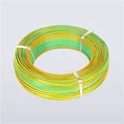
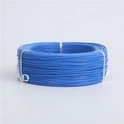
Fluoroplastic high temp electrical wire cables are essential materials in harsh environments such as high-temperature workshops, new energy equipment, aerospace, and semiconductor manufacturing. The reasons are usually attributed to two points: high temperature resistance and non flammability. These two properties are not independent design results, but rather two manifestations of the same molecular structural feature, the high bond energy of C-F bonds, under different conditions.
the super stability of C-F bonds
The reason why fluoroplastics (such as PTFE, FEP, PFA, ETFE, etc.) have special properties lies in the presence of a large number of carbon fluorine bonds (C-F) in their molecular main chains.
The bond energy of the C-F bond is as high as about 485 kJ/mol, making it one of the most stable chemical bonds in known organic compounds, far higher than the C-H bond (about 413 kJ/mol) and C-Cl bond (about 339 kJ/mol) commonly found in plastics. This means:
- Breaking the C-F bond requires more energy consumption, and it is difficult for the thermal energy in a normal high-temperature environment to decompose it;
- Fluorine atoms have a small radius but strong electronegativity, tightly wrapped around the outer side of the carbon chain, forming a protective layer to further protect the internal carbon chain from oxidation and decomposition.
So PTFE can work for a long time at 260 ℃, withstand even higher temperatures for a short time, while ordinary PVC cables are close to their limit at around 105 ℃.
The relationship between bond energy of C-F bond and high temperature resistance
It is the combination of these mechanisms that enables high temperature resistant cable made of fluoroplastics to operate stably for a long time under extreme working conditions.
High thermal decomposition temperature
The thermal decomposition temperature of fluoroplastics is generally above 400 ℃ (PTFE can reach about 500 ℃), far exceeding the actual operating temperature of most industrial scenarios. Therefore, material degradation, brittleness, or cracking will hardly occur during long-term high-temperature operation.
Highly symmetrical molecular structure and high crystallinity
Taking PTFE as an example, its molecular chains have a highly symmetrical spiral structure with a crystallinity of over 90%. This tightly arranged crystalline structure enhances the interaction force between molecular chains, and the material can maintain good mechanical strength and dimensional stability at high temperatures, making it less prone to softening and deformation.
Low molecular chain activity
Fluoroplastic molecular chains are flexible, but very stable, and even in environments with large temperature fluctuations (such as repeated changes between -200 ℃ and 260 ℃), the material can still maintain stable electrical and mechanical properties. This is also why extreme temperature scenarios such as aerospace and nuclear power prefer fluoroplastic cables.


Where does flame retardancy come from?
The flame retardancy of fluoroplastic cables does not rely on external flame retardants, but on the "self flame retardant" characteristics of the material itself:
Extremely high Limiting Oxygen Index (LOI)
The ultimate oxygen index of PTFE is over 95, far exceeding the 21% oxygen content in ordinary air. Simply put, under normal atmospheric conditions, PTFE is hardly ignited because the oxygen concentration required to maintain combustion is much higher than what the natural environment can provide.
No droplets are produced during combustion, and it does not support combustion
Many plastics melt and drip during combustion, causing the fire to spread (known as the "droplet effect"). Even if fluoroplastics decompose at high temperatures, they mainly undergo gasification, which makes it difficult to form droplets and splashes, greatly reducing the risk of fire spread.
The decomposition products have the ability to self inhibit combustion
When fluoroplastics decompose at extreme high temperatures (far beyond their normal operating temperature), they release fluorine-containing gases. These gases will dilute the oxygen concentration locally, forming a certain self extinguishing effect, which is also one of the auxiliary mechanisms of their flame retardant performance (note: decomposed gases are irritating, so high temperature protection and ventilation measures still need to be taken in practical engineering, not "absolutely safe and harmless").
Not relying on additive flame retardants, long-term performance is more stable
Ordinary flame-retardant cables often achieve flame retardant effects by adding bromine based, phosphorus based, and other flame retardants, but the additives carry risks of migration, aging, and failure. The flame retardancy of fluoroplastics comes from the intrinsic structure of the material and does not decay over time, which is also an important reason why they are highly favored in long-life equipment.
Other advantages
It is worth mentioning that the stability brought by the C-F bond also gives rise to other advantages of fluoroplastic high temperature resistant cable. These characteristics often work synergistically with high-temperature resistance and flame retardancy, making this high temp electrical wire competitive in various extreme scenarios:
- Excellent chemical corrosion resistance: hardly reacts with acids, bases, and organic solvents;
- Extremely low friction coefficient: convenient for pipe threading and wiring construction;
- Excellent electrical insulation performance: able to maintain stable dielectric strength at high temperatures, suitable for high-frequency and high-voltage scenarios;
- Strong weather resistance and radiation resistance: suitable for long-term exposure environments such as outdoor photovoltaics and nuclear power.
The high temperature resistance and flame retardancy of fluoroplastic wires and cables are essentially the "natural result" of the super strong stability of C-F bonds in their molecular structure, rather than relying on later additives "stacking". This is also why in fields such as new energy, semiconductors, aerospace, and nuclear power that require extremely high safety and long-term reliability, as a typical high temperature resistant cable, fluoroplastic cables have always been the preferred choice for engineers.
If you are selecting high temp electrical wire cables for projects with high temperature or fire protection requirements, please consult our technical team for further selection advice based on specific working conditions.