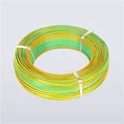
With the popularization of new energy vehicles, charging pile cable as a key component connecting charging pile and vehicle, its bending resistance is directly related to charging safety and service life. This article will comprehensively analyze the new energy vehicle charging pile cable bending resistance standard, including structural requirements, test methods, industry standards and technology development trend.
Structure and material composition of charging pile cable
The cable of the new energy vehicle charging pile adopts a multi-layer composite structure design, mainly including the following components:
Conductor layer: Multiple strands of finely twisted oxygen free copper wire are used to ensure good conductivity and flexibility.
Insulation layer: Made of cross-linked polyethylene (XLPE) material with a thickness of ≥ 1.4mm, providing excellent electrical insulation performance.
Shielding layer: metal braided layer or aluminum foil structure, effectively reducing electromagnetic interference.
Sheath layer: Made of halogen-free flame-retardant polyolefin (HFFR) material, with added Kevlar tensile fiber to enhance wear resistance.
Strengthening layer: Some high-end products use steel strips or fiber materials to enhance mechanical strength.
These material combinations endow cables with excellent bending resistance, wear resistance, and environmental resistance, which can meet the needs of frequent plugging and complex usage scenarios.
Recommended charging pile cable


Bending resistance standard core requirements
1. Bending times standard
According to different usage scenarios, the bending resistance requirements for new energy vehicle charging pile cables vary:
Household slow charging cable: usually requires not less than 50,000 times bending test.
Public fast charging cables: usually require not less than 100,000 bending tests.
High-end products: some high-quality products can reach more than 300,000 times of bending life.
2. Bending radius requirement
The bending radius of a cable is a key parameter that affects its service life, and the specific requirements are as follows:
| Outer diameter of wire harness (mm) | Minimum bending radius (mm) |
| 10-20 | Not less than 8 times the outer diameter |
| 21-30 | Not less than 10 times the outer diameter |
| 31-40 | Not less than 12 times the outer diameter |
A too small bending radius can cause excessive stress on the conductor and insulation layer, which may lead to fracture or damage, affecting charging safety.
Bending resistance test methods and indicators
1. International standard test methods
IEC 62893 series of standards: specifies the construction, dimensions, materials and general test requirements for cables.
IEC 62893-2: details specialized test methods for extruded insulated and sheathed cables.
IEC 62893-3: Test standards applicable to AC charging cables.
2. domestic standard test methods
GB/T 33594-2017: national standard for electric vehicle charging cables.
T/CAS 755-2023: Test method for wire and cable flexibility moment.
GB/T 20234.1-2023: new energy vehicle charging gun test standard.
3. Main test indexes
Bending test: use the bending test machine to simulate repeated bending, requiring a pulley diameter of 60-200mm and a bending speed of 0.33m/s.
Environmental adaptability: after cyclic impacts at temperatures ranging from -40°C to +125°C Stable performance.
Mechanical strength: Evaluate the durability through bending, pendulum impact and other tests.
Material properties: Hardness (Shore hardness) and tensile properties of insulation/sheath materials.
Industry best practices and technological trends
1. Innovative material applications
Multi strand precision twisted oxygen free copper wire conductor: with a bending resistance of over 10000 times and a wear resistance of over 50000 times.
Modified high-temperature resistant elastomer: capable of withstanding extreme temperatures ranging from -40 ℃ to 125 ℃.
Low smoke halogen-free flame retardant material: self extinguishing in the event of fire and free of toxic gases.
2. Structural design optimization
Four layer stranded conductor: using 100% complete untwisting and twisting process to improve flexibility
Double layer shielding structure: enhances the ability to resist electromagnetic interference.
Circular heat dissipation groove design: improves heat dissipation efficiency by 30%.
3. Patent technology cases
Huaxin Cable Bending Resistance Patent: solves cable bending problems through structural designs such as protective jackets and stabilizing sleeves.
Lixun Precision Anti bending Wire Harness: Utilizing anti bending rigid sheets to limit bending amplitude and reduce damage.
Fulxin vibration resistant cable: designed with four layers of stranded conductors to improve bending resistance.
Selection and Maintenance Recommendations
Certification marks: Choose products that comply with IEC 60245, GB/T 5013 and other standards.
Current matching: choose the appropriate cable specifications according to the vehicle battery capacity.
Installation specification: Ensure that the bending radius is not less than the specified value and avoid excessive bending.
Regular inspection: Pay attention to the state of cable sheath and replace products with wear or cracks in time.
The bending resistance of new energy vehicle charging pile cables is a key indicator for charging safety and service life. With the progress of material science and manufacturing process, the new generation of cable products in bending resistance, wear resistance and environmental performance continues to improve, providing a reliable guarantee for the popularization of new energy vehicles.