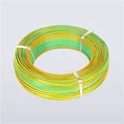
PFA and PTFE, two types of perfluorinated plastic insulation materials, have always been the mainstream choices for high-end high-temperature resistant cables in high-temperature wiring scenarios of industrial equipment, aerospace supporting facilities, semiconductor production, and highly corrosive chemical equipment. Both have excellent corrosion resistance, extremely low dielectric loss, and can withstand high temperature environments for a long time. Their performance foundations are very similar, which is also the main reason why many engineering selections easily confuse the two.
But in the actual production and on-site use process, I found that there is a considerable practical difference between two seemingly similar materials in terms of forming difficulty, bending durability, and extreme temperature adaptability. The short service life, installation and adaptation difficulties, and mismatching of working conditions seen in many cables are not product quality issues, but rather the result of failing to fully understand the characteristic differences between the two materials.
Processing and Manufacturing Restrictions
Polytetrafluoroethylene (PTFE): Due to its extremely high melt viscosity, it cannot be processed by melting. PTFE insulation material needs to be extruded into a paste first, and then subjected to high-temperature sintering (or spiral winding). This leads to limited mass production scale and more complex production processes.
PFA: Melt processed resin. PFA can undergo conventional melt extrusion like standard thermoplastic materials, achieving seamless, ultra long continuous production and high dimensional consistency.
Flexibility and mechanical durability
Compared to PTFE, PFA has significantly higher mechanical toughness and bending fatigue resistance. PFA insulation material can better resist stress cracking and dielectric fatigue in dynamic, high vibration or continuous bending application environments.
Thermal limit and chemical inertness
These two polymers have the same heat resistance threshold and excellent universal chemical resistance:
- Temperature resistance: Both PFA and PTFE can operate continuously at 260°C (500°F).
- Chemical Immunity: Neither material degrades when exposed to concentrated acids, strong bases, or aggressive solvents. However, PFA's smooth, non-porous extruded surface provides lower permeability against gas phase permeation, making it the preferred choice for ultra-clean cleanroom and chemical line monitoring cables.


Application Selection Guide
Based on the three core differences mentioned above, in order to simplify industrial selection, the applicable scenarios for PFA and PTFE insulated cables are summarized as follows:
PFA cables are preferred for the following working conditions:
- Continuous long-distance cables are required without joints.
- This cable can operate in continuous motion, high flexibility robots, or drag chains.
- Ultra pure semiconductor manufacturing requires extremely low trace gas emissions and smooth resin surfaces.
PTFE cables are preferred for the following working conditions:
- Static fixed wiring scenarios with no frequent bending and high requirements for structural stability;
- Need for extreme chemical inertness and adaptability to environments with extreme chemical corrosion;
- High self-lubricating and wear-resistant static wiring scenarios.
There is no absolute superiority or inferiority between PFA and PTFE cables, the core lies in their different adaptability to working conditions. PFA cables excel in flexible processing, high forming accuracy, excellent dynamic fatigue resistance, and low-temperature performance, making it more suitable for precision, dynamic, and ultra-low temperature industrial wiring scenarios;PTFE cables rely on their stable high-temperature impact resistance, ultimate chemical stability, and structural rigidity, making it more suitable for harsh working conditions such as static high temperature and strong corrosion.
In engineering applications, selecting matching cable materials based on equipment operating status, environmental temperature, corrosion conditions, and construction processes can effectively avoid early cable failure problems, improve electrical system operation stability, and reduce equipment maintenance costs.