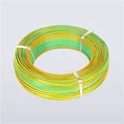
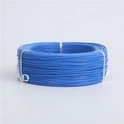
In recent years at Zhejiang IRONFLON, when dealing with PTFE high temperature wires every day, the most common questions from customers are "what are the advantages of it over ordinary wires" and "is it worth it so much. Today, let's introduce this versatile wire used in high-end and demanding scenarios such as industrial workshops and aerospace.
The scientific name of PTFE is polytetrafluoroethylene, which is commonly referred to as the "plastic king" by industry insiders. Its carbon fluorine bond structure is particularly strong, like putting a layer of protective clothing on wires. PTFE insulated wires use this "plastic king" as the insulation layer, with copper conductors inside, mostly tin plated or silver plated copper.
Tell me about its advantages, its temperature resistance is really amazing. Ordinary PVC wires, if used for a long time, are prone to aging and cracking when the temperature exceeds 80 ℃. In winter, when the temperature drops to minus ten degrees Celsius, they may even become brittle and break easily; Even a silicone wire with a good reputation can only withstand up to 200 ℃ at most. But PTFE high temperature wires are different. If used for a long time, they can easily withstand temperatures from minus 65 ℃ to 260 ℃. Even short-term high temperatures of 300 ℃ are not a problem. Even in extremely cold environments of minus 200 ℃, they can remain flexible and not brittle. Whether it's the high-temperature areas inside industrial ovens and furnaces, or the icy cold scenes of liquefaction equipment and cold storage, it can work steadily.
In addition to its temperature resistance, its corrosion resistance can also be called "abnormal", which is also the most confident point I usually recommend to customers. PTFE has a particularly strong chemical inertness and hardly reacts with any chemicals, whether it is strong acids, strong bases, organic solvents, oil stains, or fuels. After long-term contact, its insulation layer will not corrode or break.
There was a customer who worked in an electroplating workshop before. The workshop was filled with corrosive liquids, and ordinary wires would be corroded beyond recognition after six months. They had to be replaced frequently, which was both expensive and laborious. After replacing with PTFE insulated wire, the insulation layer remained intact after more than two years of use, reducing replacement costs and avoiding leakage faults caused by wire damage. To be honest, in such harsh environments, PTFE wires have unparalleled durability compared to other wires.
Of course, as a special type of wire, its electrical performance is also fully utilized, especially in high-frequency and high-voltage scenarios, where its advantages are particularly evident. Someone may ask, what is a high-frequency scenario? In fact, the 5G base stations, radars, and precision medical instruments we use in our daily lives all belong to high-frequency scenarios, with particularly high requirements for signal transmission, without distortion or loss.
The dielectric constant of PTFE wire is only 2.1, and the dielectric loss is as low as 0.0002, which can perfectly maintain the stability and integrity of the signal. And its dielectric strength exceeds 30kV/mm, even in high voltage environments, it will not be broken down or leak electricity. Nowadays, many high-voltage wiring harnesses for new energy vehicles and industrial high-voltage equipment use PTFE wires.

Another thing is that it is particularly worry free and does not require any effort to maintain. It is inherently flame retardant, and even if accidentally caught on fire, it will extinguish immediately. Moreover, it emits very little smoke when burning, so scenes with extremely high safety requirements such as aviation and rail transit almost cannot do without it.
In addition, its surface friction coefficient is particularly low, wear-resistant and anti-aging. Even if it is bent for a long time and in a vibration environment, it is not easy to break. I have seen some factories' production equipment that requires frequent bending of wires. If ordinary wires are used, they break every few months. After replacing them with PTFE wires, they can be used for three to five years, and their service life is directly increased by 3-5 times. And it doesn't absorb water or stick to dirt. After installation, it can run stably for a long time without much care, saving a lot of maintenance trouble.
Many customers initially feel that PTFE wires are more expensive than regular wires and have a lower cost-effectiveness. But I have always told them that when choosing wires, we should not only consider the initial price, but also the long-term usage cost. In many specific scenarios, PTFE wires must be used, such as high temperature, corrosion, and high frequency. Ordinary wires cannot withstand these scenarios, and forced use will only lead to frequent failures, production stoppages, and even safety accidents, which will cost more money.
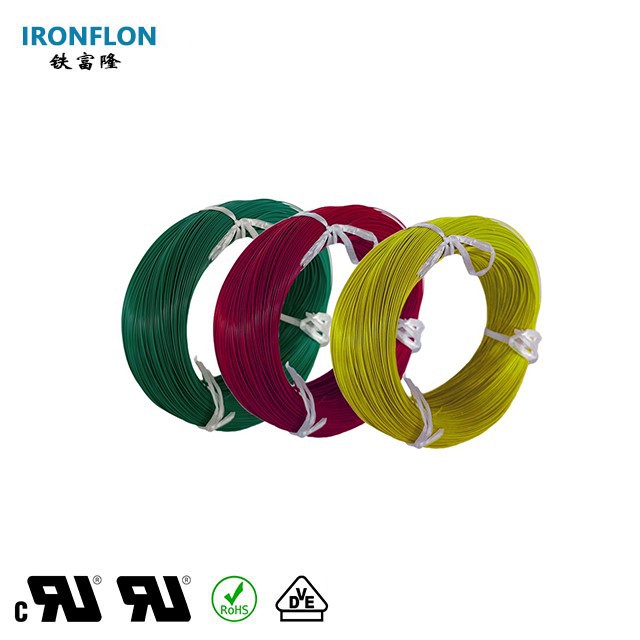
We have been deeply involved in fluoroplastic wires at Zhejiang IRONFLON for many years, offering a full range of insulated wires from PTFE, FEP to PFA. We can also customize different wire gauges, colors, and conductor types according to customer needs. Our products have also passed UL certification, providing suitable solutions for aviation, industrial, high-frequency electronics, and new energy fields. If you are currently worried about wiring in high temperature, corrosion, and high-frequency environments, and don't know which wire to choose or how to select, don't worry, feel free to contact me anytime. I can't say that our product is the cheapest, but I can guarantee that we will match you with the most suitable PTFE insulated wire and cable solution based on your actual scenario.