In the "friend circle" of electronic components, there are two "strong players" who are often compared --- silver plated copper wire and nickel plated copper wire. Many buyers often confuse them with gold-plated materials when they first encounter them, but in fact, these two advantages are more down-to-earth and have higher cost-effectiveness, making them core materials that are indispensable from consumer electronics to aerospace. Simply put, they are all wrapped in a layer of "protective clothing" on a copper wire substrate, but the material and skill points of this layer of clothing are completely different: one dominates the high-frequency field with "fast conductivity", and the other conquers harsh environments with "durability". Today, let's use the most straightforward way to explain the core advantages, applicable scenarios, and selection techniques of these two types of wires. Whether you are a procurement manager or an engineer, reading them will help you avoid detours.
Silver plated copper wire: the king of high-frequency fields who relies on their "conductivity talent" to attract fans
The core competitiveness of silver plated copper wire, to put it simply, is "conductivity" - the electrical resistivity of silver is second only to superconducting materials among all metals. Plating it on copper wire is equivalent to paving a "highway" for electric current. Let's first take a look at a set of hard core data: the conductivity of high-quality silver plated wire can reach 101% IACS (International Annealed Copper Standard), which is even higher than pure copper wire, while the conductivity of ordinary nickel plated wire is only 45% -55% IACS, the difference is clear at a glance. This talent is particularly crucial in high-frequency scenarios because high-frequency signals have a "skin effect" - the signal mainly propagates along the surface of the conductor, and the low resistance of the silver coating can minimize signal loss, which is also the reason why 5G base stations and satellite navigation receivers must use it.
In addition to fast conductivity, silver plated wire also has high temperature resistance and stability. In the field of medical equipment, magnetic resonance imaging (MRI) machines have strict requirements for circuit accuracy to the millimeter level. Silver plated wires can accurately control current signals, providing doctors with clear diagnostic basis; In the aerospace field, it can operate stably under extreme temperatures and pressures, ensuring smooth communication between satellites and spacecraft. However, it also has a temper: silver easily reacts with sulfides in the air, and the surface turns black to form a silver sulfide film. Fortunately, this type of film has little effect on conductivity. As long as it is stored properly (with a relative humidity below 40% and a temperature of 20-25 ℃) and vacuum packaged to isolate the air, it can effectively delay oxidation.
Nowadays, the industry has also developed the "composite coating" technology, such as coating copper wire with a thin layer of nickel first and then silver plating, which can block the atomic diffusion of copper and silver, and enhance the adhesion of the coating. It will not turn black after 96 hours of testing in a high temperature and high humidity environment at 85 ℃. This upgraded version is particularly popular in high-end communication equipment.


Nickel plated copper wire: a strong opponent in harsh environments with its "durable properties"
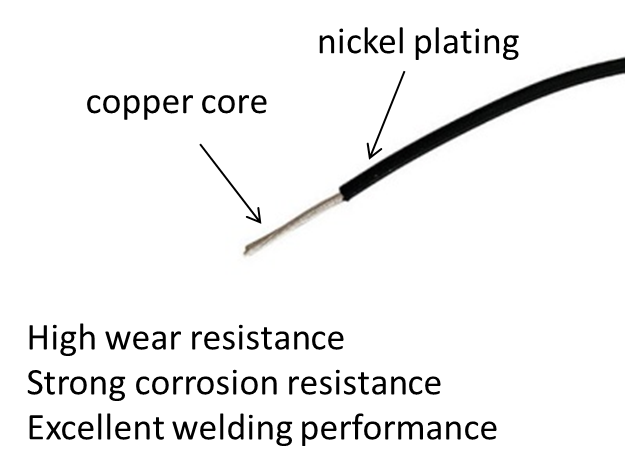
If silver plated electrical wire is a "sophisticated technology stream", then nickel plated copper wire is a "strong force in manufacturing resistance". Its core advantages are concentrated in "corrosion resistance" and "wear resistance", all of which are attributed to the chemical properties of nickel - nickel quickly forms a dense passivation film in the air, just like putting a "protective armor" through copper wire, which can resist the corrosion of corrosive media such as acid, alkali, salt spray, etc. For example, in chemical workshops, equipment often comes into contact with corrosive gases such as ammonia and sodium hydroxide. Nickel plated electrical wires can easily withstand them, while bare copper wires will rust and corrode within a week; On the lifting equipment in coastal ports, the salt spray environment has extremely strong corrosion on metals. The salt spray test tolerance time of nickel plated electrical wire can reach more than 500 hours, which is more than 10 times that of bare copper wire.
Wear resistance is also a bonus for nickel plated wires. Nickel has much higher hardness than silver, and plating on copper wire can significantly improve surface strength, making it particularly suitable for scenarios that require frequent plugging and unplugging, such as power switches for household appliances and connectors for industrial equipment. A certain household appliance OEM factory has conducted tests: even after 100000 insertions and removals, the contact wear of nickel plated wire is only one-third of that of silver plated wire. This is also why nickel plated wire is the mainstream choice in low-cost household appliances such as fans and desk lamps.
Another easily overlooked advantage is good welding performance. In the copper aluminum welding scenario, nickel plating can prevent atomic diffusion of copper and aluminum, avoid the formation of brittle alloy layers, and improve the strength and service life of the welded joint. This is simply a "gospel for engineers" in fields such as automotive wiring harnesses and photovoltaic modules that require a large amount of welding. However, it should be noted that the conductivity of nickel plated wire is not as good as silver plated wire, and it is not suitable for use in high-frequency signal transmission scenarios, otherwise signal delay and excessive loss may occur.

Core comparison: Choose right or wrong in 3 minutes, understand key parameters in one table
Many customers are struggling to find a balance between "performance requirements" and "cost budget" when choosing a product. The following table clearly lists the core parameters, applicable scenarios, and precautions of both, and presents lengthy data points at a glance:
| Comparing dimensions | silver-plated copper wire | Nickel-plated copper wire |
| Core strengths | High conductivity (101% IACS), low high-frequency signal loss, high temperature resistance and oxidation resistance | Strong corrosion resistance (alkali/salt spray resistance), high wear resistance, excellent welding performance |
| Cost coefficient | Medium (about 1.8-2.5 times that of bare copper wire) | Economy (about 1.2-1.5 times that of bare copper wire) |
| Applicable scenarios | 5G base station, MRI equipment, high-frequency communication cables, aerospace electronics | Chemical equipment, marine engineering, home appliance switches, automotive wiring harnesses, photovoltaic modules |
| Taboo | Avoid long-term exposure to sulfur-containing environments (which can easily generate silver sulfide) | Not suitable for high-frequency signal transmission (high conductivity loss) |
If your product is a high-frequency, high-precision device (such as communication base stations, medical equipment), even if it costs a little more, you should choose silver plated wire; If it is a scenario with high requirements for corrosion and wear in industrial environments, household appliances, etc., but no requirements for high-frequency performance, the cost-effectiveness of nickel plated wires can be fully utilized.
Usage and Trends: Small details determine lifespan, combining coatings into a new trend
Choosing the right wire, using and storing it correctly can maximize its value. Here are two tips that customers often overlook: for silver plated cables, it is important to wear sulfur free gloves during processing to avoid sweat and grease from accelerating sulfurization and blackening. When storing, use vacuum packaging and inert gas filling to extend the shelf life to over 18 months; For nickel plated cables, although they have strong corrosion resistance, the welding temperature should be controlled below 800 ℃. Excessive temperature can damage the passivation film on the surface and affect the protective effect.
In terms of industry trends, "composite coatings" are becoming the new mainstream. For example, the "copper nickel silver" composite coating is first coated with a layer of nickel as a base to enhance adhesion and corrosion resistance, and then coated with a layer of silver to improve conductivity. This type of wire not only solves the problem of corrosion resistance in silver plated cables, but also fills the gap in conductivity of nickel plated cables. It is increasingly used in high-end automotive electronics and new energy equipment. In addition, cyanide free electroplating technology is also becoming popular, especially for environmental compliance issues that are of concern to EU customers. The use of thiosulfate silver plating solution for wire can fully comply with RoHS standards and improve biocompatibility. This type of product is particularly favored in the medical field.
Finally, I want to say that there is no absolute "best" wire, only the "most compatible" choice. Whether it's the high-frequency advantage of silver plated copper wire or the durability of nickel plated copper wire, as long as you identify the core requirements of your product and combine them with your cost budget, you can choose the most cost-effective solution. If there are any specific scenario selection confusion, feel free to communicate with the product parameters at any time!