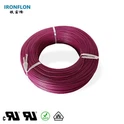
As the two main forms of power transmission, DC cables(such as UL1180 high temperature stranded wire ,PTFE insulated silver plated copper wire and so on) and AC cables have significant differences in structural design. These differences stem from their respective working principles and application scenario requirements. The structural characteristics of these two types of cables will be analyzed in detail from multiple dimensions.
Structural characteristics of DC cables
The structural design of DC cables mainly considers the particularity of DC electric field distribution. The electric field strength of DC cables is proportional to the insulation resistance coefficient, which varies with temperature. This means that the maximum electric field strength in the insulation layer of a DC cable is not only related to the applied voltage, but also to the load current.
A typical high-voltage direct current cable structure includes:
Conductor layer: High purity copper or aluminum is usually used as the conductor material.
Insulation layer: Adopting a three-layer co extrusion structure, including a non crosslinked conductor shielding layer, a non crosslinked insulation layer, and a non crosslinked insulation shielding layer, the matrix material is mostly non crosslinked polypropylene.
Semi conductive buffer layer: wrapped around the insulation layer, used for uniform electric field distribution.
Metal sheath layer: usually a flat aluminum sheath, providing mechanical protection and electromagnetic shielding.
Outer layer: a three-layer co extruded structure consisting of a hot melt adhesive layer, an outer sheath, and a semiconducting electrode.
Another important characteristic of DC cables(such as UL1180 high temperature stranded wire ,PTFE insulated silver plated copper wire and so on) is that the insulation must be able to withstand rapid polarity transitions. Polarity conversion under load can cause an increase in the electric field strength inside the insulation, usually by 50% to 70%. Therefore, the insulation material of DC cables needs to have special electrical properties.


Structural Characteristics of AC Cables
The structural design of AC cables primarily considers the properties of alternating electric fields. These cables feature uniform electric field distribution, absence of tangential stress, lightweight construction, and high current-carrying capacity. The structure of cross-linked polyethylene (XLPE)-insulated power cables and polyvinyl chloride (PVC)-insulated power cables for 1kV and below is fundamentally identical.
The typical structure of AC cables comprises:
Conductor: Typically employs a stranded conductor configuration to enhance flexibility and electrical conductivity.
Insulation Layer: Common materials include polyvinyl chloride (PVC), cross-linked polyethylene (XLPE), and fluoroplastics.
Shielding Layer: Prevents interference signals from penetrating inner layers while reducing transmission signal loss.
Sheath: Comprising an inner and outer sheath to protect the cable core from environmental impacts.
AC cables must account for the effects of the skin effect and proximity effect. The skin effect causes current to distribute unevenly across the conductor cross-section, with higher current density near the surface; the proximity effect induces electromagnetic field interactions between conductors that influence current distribution. These phenomena increase the conductor's AC resistance, thereby reducing its permissible current-carrying capacity.


The main structural differences between DC and AC cables
1. Differences in insulation design
DC cables need to solve the problem of uneven electric field distribution (DC electric field is affected by material resistivity), and the insulation layer may be thicker or special materials (such as cross-linked polyethylene XLPE) may be used. And the insulation of AC cables is optimized for AC electric fields (such as PVC, XLPE).
The maximum field strength of DC cables under transient and no-load conditions usually occurs on the surface of the conductor, while under load, the maximum field strength occurs on the surface of the insulation layer. The electric field distribution of AC cables is relatively uniform.
2. Differences in shielding layer
High voltage DC cables require enhanced shielding to suppress space charge effects, while low-voltage cables have relatively lower shielding requirements. The shielding layer of DC cables(such as UL1180 high temperature stranded wire ,PTFE insulated silver plated copper wire and so on) requires stricter design to prevent electric field interference.
3. Differences in conductor structure
DC cables usually adopt a single core structure, consisting only of positive and negative poles. The communication cable adopts a three-phase four wire or five wire system, with a more complex structure.
4. Differences in polarity requirements
DC cables need to have clear positive and negative pole connections, as incorrect polarity may cause equipment damage. AC cables do not have polarity requirements, only need to distinguish phases.
5. Differences in loss characteristics
DC cables do not have the skin effect and eddy current losses of AC cables, making them suitable for long-distance power transmission. AC cables have lower costs in short distance distribution, but higher losses over long distances.