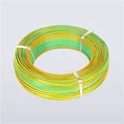
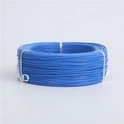
Overview of Sheath Wire
Sheathed wire is a household electrical wire consisting of two or three parallel BV wires with an insulated sheath layer. Its outer sheath can replace a conduit and has the characteristics of easy installation and neat appearance. Sheath wires are divided into two types based on material: copper core (BVV, BVVB, RVV, RVVB) and aluminum core (BLVV, BLVVB), where the letter code L represents aluminum core, V represents PVC insulation and sheath, and R represents soft.
Sheath wires are mainly divided into two categories:
- Soft sheathed wire (RVV): made of multiple stranded copper wires, with good flexibility.
- Hard sheathed wire (BVV): The conductor is a single stranded BV wire with high hardness.
- According to shape, it can be divided into round sheathed wire (multi-core) and flat sheathed wire (single core).
Structural characteristics of single-layer insulated sheathed wire
The single-layer insulated sheathed wire adopts polyvinyl chloride (PVC) insulation material, with a thickness usually ranging from 0.8-1.2mm, and has the following characteristics:
Thermal stability: Long term allowable working temperature of 70 ℃, short-circuit temperature of 160 ℃ (within 5 seconds).
Flame retardant rating: Complies with GB/T 19216.21-2003 standard, self extinguishing upon ignition.
The insulation layer adopts three-layer co extrusion technology:
- Add flame retardant to the inner layer;
- Middle layer enhances mechanical strength;
- Improve the wear resistance of the outer layer;
Characteristics of double-layer sheathed wire structure
The double-layer sheathed wire is made up of multiple stranded copper wires, wrapped with a polyvinyl chloride insulation layer and a polyvinyl chloride sheath layer. The number of cores varies from 2 to 24. Some models (such as 3-core soft sheaths) will also add additional fillers to make the wire body more rounded.
The main features of double-layer sheathed wire include:
- Better mechanical protection performance;
- Better environmental adaptability;
- Higher electromagnetic compatibility;
- Some models have shielding function;
Comparison of structural differences
| Comparison item | Single layer insulated sheathed wire | Double layer sheathed wire |
| Structural complexity | Simple, single-layer insulation | Complex, double-layer protection |
| Manufacturing process | Relatively simple | Relatively complex |
| Electrical performance | Basic satisfaction of needs | Better, with less harmonic content |
| Mechanical strength | Average | Higher |
| Cost | Lower | Higher |
| Flexibility | Poor | Better |
Application Scenario Analysis
Single-layer insulated sheathed cable applications
Domestic refurbishment: Replaces traditional cable ducting, saving space while enhancing wall aesthetics.
High-safety-requirement areas: Such as children's rooms, bathrooms, etc.
Fixed installation environments: Can be directly embedded within walls or affixed to wall surfaces.
Low-voltage circuits: Including domestic lighting, sockets, and electrical appliances.
Double-layer sheathed cable applications
Harsh Environments: Industrial plants, outdoor open-air sites.
Frequently Relocated Settings: Locations requiring regular cable movement.
High-Voltage Circuits: Connection cables for motors, generators, and large electrical equipment.
Specialised Protection Needs: Corrosion-resistant, oil-resistant, UV-resistant, and other demanding conditions.