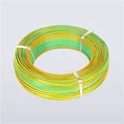
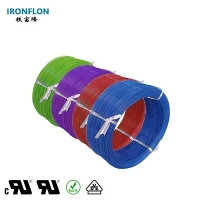
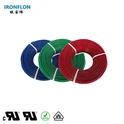
What is Teflon wire?
Teflon wire is a special cable with fluoroplastic (PTFE\FEP\PFA\ETFE\XLPE) insulation wrapped around the conductor, which has extreme high temperature resistance (-70°C to +260°C), strong chemical resistance, very low coefficient of friction and excellent electrical insulation, specially designed for the military, aerospace, medical and other high-demand scenarios. It is designed for military, aerospace, medical and other demanding scenarios.
The difference between different insulation materials:


Teflon wire conductor structure:
Tin plated copper (anti-oxidation) or silver plated copper (high-frequency scenario), the conductor structure is mostly 19 thin copper wires twisted together to enhance flexibility.
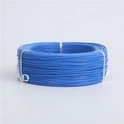
What is silicone wire?
Silicone wire is a high-temperature flexible cable with silicone rubber as the insulation layer. It has excellent temperature resistance (-60 ℃~200 ℃), aging resistance and flexibility, and is suitable for home appliances, medical equipment and dynamic wiring scenarios.


Silicone wire Conductor structure:
Tin plated copper (anti-oxidation), silver plated copper or bare copper wire, the conductor structure is mostly twisted with fine copper wires (such as 0.10mm filaments) to enhance flexibility.
Silicone wire Sheath:
Transparent or colored silicone rubber layer for easy phase differentiation and shielding layer inspection during installation.
Teflon wire vs silicone wire
| Teflon wire | silicone wire | |
| physical property | The surface is as smooth as plastic, the texture is hard and has a "memory", and it is easy to retain permanent deformation after bending. The tensile strength is twice that of silicone wire, and it has excellent wear resistance. | Silicone rubber insulation is similar to rubber bands to the touch, extremely soft and flexible, repeated bending can be restored to its original state, tear resistance is weak. |
| Temperature resistance | Regular operating temperature -70℃ to 260℃, instantaneous temperature resistance up to 300℃. Strong stability at high temperature and slow aging. | Standard temperature range -60℃ to 200℃, high quality models can reach 250℃. Better flexibility at low temperatures, but may carbonize at extreme high temperatures. |
| Chemical and environmental resistance | Almost immune to all strong acids (concentrated sulfuric acid, hydrofluoric acid), strong alkalis, organic solvents and oils, excellent waterproofing, suitable for chemical industry, electroplating and other highly corrosive environments. | Resistant to weak acids and alkalis, but solvents such as acetone and xylene are easily dissolved. Flame retardant is better (combustion produces white powder), and low smoke and non-toxic, suitable for places with strict fire prevention requirements. |
| Electrical performance | Low dielectric constant, high insulation strength (same specification withstand voltage 600V vs silicone wire 300-500V), low high-frequency signal transmission loss, suitable for precision instruments and aerospace. | The insulation resistance is stable, but the high-frequency performance is slightly weaker. High voltage models (such as UL3239) can withstand 3-50kV and are suitable for motors and energy storage systems. |
| Key points for maintenance and use |
Anti-mechanical damage: avoid sharp bends (minimum bending radius ≥ 4 times wire diameter), otherwise the insulation layer is easy to break.
|
Anti-pollution aging: dust, grease adhesion will accelerate the embrittlement at high temperatures (e.g., food machinery flour residues lead to failure rate of 80%), need to be cleaned regularly. Regular cleaning is required.
|
| Industry application scenarios | Aerospace wire (lightweight+resistant to extreme temperatures) Injection molding machine heating ring (continuous operation at 300 ℃) High frequency microwave equipment (low signal attenuation) |
LED strip (flexible and easy to install)
|
If you have any other questions, please send an email to luna@ironflon.com We will respond promptly.