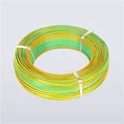
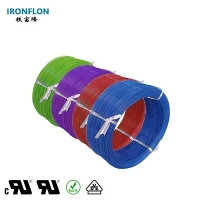
1. High-frequency communication
PFA wires have a dielectric constant (Dk) as low as 2.0-2.1 (1-10GHz band) and a dielectric loss factor (Df) of less than 0.0005, so that the speed of signal propagation tends to be close to the speed of light, which reduces the propagation differences of different frequency components and avoids broadband signal dispersion; and it can also inhibit the conversion of electromagnetic energy into thermal energy, and control the attenuation of signals for kilometre-level transmission within 0.5 dB or less, ensuring long-distance fidelity transmission of 5G millimetre wave (e.g. 28GHz) and high-speed serial data (e.g. PCIe 6.0).
2. Stable performance in a wide temperature environment
PFA in the temperature range of -200 ℃ to +260 ℃, the electrical performance fluctuation is less than 3%, and nickel plated copper wires are far better than PVC and other materials more than 15% of the parameter drift. This characteristic enables it to maintain the stability of characteristic impedance (e.g., 50Ω coaxial) in the high and low temperature alternating environment of base station antennas, and next to high temperature equipment in industrial IoT. At the same time, its chemical inertness can resist acid and alkali corrosion in industrial scenes and outdoor ultraviolet aging, to avoid signal crosstalk caused by the deterioration of the insulation layer, especially suitable for chemical factories, refineries, and other harsh environments such as sensor networking.
3. Typical applications for high-speed communication
In 5G base stations, PFA-insulated foamed coaxial cables with nickel plated copper wires are used to connect antenna units (AAUs) and baseband units (BBUs), achieving an insertion loss of <0.8dB per metre in the 24GHz band to guarantee the reception sensitivity of millimetre-wave signals; and high-speed differential pairs of cables are applied to The high-speed differential pair cables are used in server backplanes to support data transmission over 400GbE Ethernet, with an eye diagram opening of more than 80%. In addition, the internal wiring of precision test instruments such as network analysers relies on the low-loss characteristics of PFA made of nickel plated copper wires to achieve sub-millimetre signal measurement accuracy, while the cables for high-temperature sensors in the industrial Internet of Things (IoT) need to be temperature-resistant and corrosion-resistant to maintain long-term stable communication.