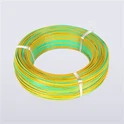
What is single core copper wire?
Single-core copper wire is a cable consisting of a solid or stranded copper conductor wrapped in an insulating material for the transmission of electrical energy or signals.
Application scenarios of Single Core Copper Wire
Residential fixed wiring
Distribution backbone: used for fixed laying from the distribution box to each room, safer for long-term loading due to the low risk of oxidization of the joints (oxidation rate 40% lower than that of multi-core wires) and high mechanical strength.
Socket and lighting circuits: suitable for wall or ceiling conduits, especially for air conditioners (e.g. wall-mounted units), refrigerators and other fixed high-power electrical appliances power supply, 4mm² single-core wire can carry about 5,800W under 220V environment.
Underground/Outdoor Installation: Highly resistant to humidity and corrosion, suitable for scenes such as garden lights and outdoor sockets.
Power distribution for commercial buildings
Power supply for lighting and fixed equipment in office buildings and shopping malls, due to the high degree of line regularity and the insulation layer is not easily broken when threading the pipe.
Power transmission and distribution system
Fixed connection of factory power distribution cabinet and substation, with short circuit current resistance up to 40kA (better than multi-core wire), suitable for high voltage environment.
Fixed power supply for equipment
Power supply wiring for large equipment such as machine tools, motors, etc. It can withstand large mechanical stress due to its high tensile strength (230MPa).
Special Scenarios
Bridge/Tunnel Engineering: Wiring for load-bearing supports that require anti-slip, with a 58% lower rate of loosening of fixtures than multi-core wires.
High-temperature workshop: customized high-temperature-resistant models (105°C insulation) are suitable for high-temperature environments.
Common models of Single Core Copper Wire


What is Multi-core copper wire?
Multi-core copper wire is a wire made up of multiple thin copper wires stranded together for better flexibility and is often used for electrical connections that require bending.
Application scenarios of Multi-core copper wire
Open wiring system
ceiling lamps and lanterns, track spotlights and other scenes that require multiple bending installation, multi-core wire minimum bending radius of only 8 times the diameter of the wire, the construction efficiency by 40% and resistance to bending more than 2,000 times.
Mobile sockets, home appliances power lines (such as air conditioning, electric water heaters) due to frequent plugging and unplugging, multi-core wire can avoid repeated bending breakage.
Complex wiring environment
Old house remodeling through the pipe turning more scenes, multi-core wire flexibility can easily pass through the narrow bends (such as 5cm diameter bends), to reduce trenching damage.
Commercial space visualization wiring (such as LOFT industrial style), the surface is beautiful and easy to adjust the direction.
Power supply for mobile equipment
Dynamic equipment connection such as industrial robotic arm, automatic production line, etc. Multi-core wire is anti-stretch and resistant to repeated bending to avoid fatigue breakage of internal copper wire.
Crane, power tools and other portable equipment power cord, flexibility to protect the operational flexibility.
High-frequency and frequency conversion equipment
Frequency converter, servo motor control lines, multi-core wire fine copper wire structure to reduce the skin effect, high-frequency impedance is 12%-15% lower than single-core wire.
Data center server short distance high-speed connection (such as AEC active copper cable), support more than 25Gbps signal stability transmission.
Heat dissipation sensitive scenarios
Kitchen multiple appliances in parallel (e.g. oven + induction cooker), multi-core wire conductor gap to enhance heat dissipation efficiency, temperature rise under sustained load is lower than single-core wire by 5-8℃.
Dense cable bridge laying, air circulation design to slow down the aging of the insulation layer.
Environment with high anti-interference requirements
Connection cable for medical equipment and laboratory instruments, multi-core wire stranding structure can shield electromagnetic interference and guarantee signal stability.
Common models of Multi-core copper wire


Single-core copper wire VS Multi-core copper wire
| Single Core Copper Wire | Multi-core copper wire | |
| Conductor construction | A solid round or shaped (e.g. fan-shaped) copper wire | A number of fine copper wires twisted together according to a certain rule. |
| Flexibility/Bending | Poor | Excellent |
| Vibration/fatigue resistance | worse | Better |
| Ease of Installation | Fair | Better |
| Electrical conductivity | Slightly better theoretical electrical conductivity for the same cross-sectional area (minimal influence of skin effect) | Slightly lower conductivity for the same cross-sectional area (increased stranding gaps, oxidized surfaces) |
| Cost | Relatively low | Relatively high |
| Reliability of fixing connections | Excellent | Note the crimping method. |
| Typical application scenarios | Fixed laying, less bending occasions. * Concealed wiring in homes/buildings (conduit, trunking) * Busbar connections in distribution boxes * Certain applications requiring rigidity |
Flexible, frequently moving, vibrating environments are required. * Power cords for electrical equipment (extension cords, equipment pigtails). * Internal wiring of industrial equipment * Automotive wiring harnesses * Temporary power cables * Cables that require frequent plugging and unplugging * Instrumentation cables * Large cross-section power cables (usually multi-core) |
| High-frequency signal transmission | worse (skin effect is more pronounced) | better (filament structure efficiently utilizes the entire cross-section) |
Selection Recommendations --- Choose multi-core for high frequency, single-core for low frequency
Scenarios that prioritize single-core copper wires:
Fixed laying: e.g., residential concealed wiring (pipe penetration in the wall), main distribution box Long-term hidden projects such as residential concealed wiring (pipe penetration in the wall), main circuit of distribution box, ceiling wiring, and so on.
High-power equipment: industrial motors, home air conditioning lines and other low-frequency high-current loads.
Preferred scenarios for multi-core copper wires:
Environments that need to be moved or bent: such as power cords for electrical appliances (air-conditioner plugs), sockets for small appliances in the kitchen, and connecting cords for lamps and lanterns.
High-frequency or signal transmission: audio lines, communication equipment, automotive circuits and other high-frequency applications.
If You Have Any Other Questions, Please Send An Email To Luna@Ironflon.Com We Will Respond Promptly.