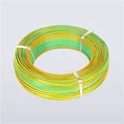
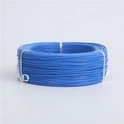
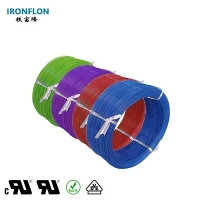
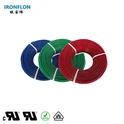
Etfe cables have a super wide range of use temperature, from cold -60 ℃ to hot +200 ℃, impact strength is also first-class, high impact resistance and toughness, tensile strength and other characteristics, even if encountered accidental fire, but also can be quickly self-extinguishing, safety is very high. Not only that, ETFE wire also has stable chemical properties, electrical insulation and irradiation resistance are quite excellent, but also provides a single-layer, double-layer, triple-layer three insulation options. Although ETFE wire is considered to have the lowest temperature resistance in the Teflon wire series, it also has the obvious advantage of being thinner and lighter, which is a boon for instrumentation and equipment that requires a lot of weight and space! Although flame and corrosion resistance may be slightly inferior, its radiation resistance and excellent elongation make it the first choice in many fields. In transport aviation, chemical and nuclear plants, oil wells and downhole insulation of all kinds of cables and communication lines, ETFE wire by many people's choice, it's super abrasion resistance, can ensure the integrity of the insulation, even in harsh environments, but also to maintain stable performance and, ah, it will not burn through under the hot soldering iron.
Ul10126 and so on as a kind of tinned electrical wire is gradually being valued. In recent years, the application of ETFE as building curtain wall and roofing material is increasing. This material is favoured for its unique visual aesthetics, self-cleaning ability, energy-saving properties, good fire performance and long life. For example, the Bird's Nest Stadium and the Water Cube Swimming Pool, the landmark buildings of the 2008 Beijing Olympics, used ETFE film as a roofing material, with a total volume of about 300 tonnes. In addition, ETFE is also used in agricultural films in Japan, with the volume of use reaching 600 tonnes in 2001, accounting for 46 per cent of total ETFE consumption in that year.