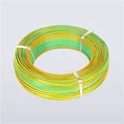
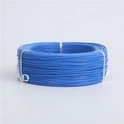
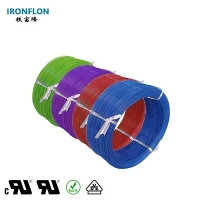
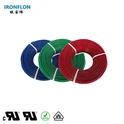
There are differences in chemical structure:
PFA (Perfluoroalkoxy Polymer) is a copolymer of polytetrafluoroethylene (PTFE) and perfluoropropyl vinyl ether. PFA adds perfluoroalkoxy to PTFE, which means that one fluorine atom in PTFE is replaced by perfluoroalkoxy, thereby reducing melt viscosity and facilitating processing.

Different chemical properties and processing performance:
1. Temperature resistance: PTFE wires perform well in high temperature environments of 327 ° C and below, and even in high temperature environments, their outer insulation will not drip, only become soft. When the temperature drops, the insulation layer will return to its original state. At a high temperature of 320 ° C, the insulation layer of PFA wires will burn, melt, and drip.
2. Processing difficulty: PTFE has a high melting point and viscosity, so the processing process is relatively difficult. PFA can be melt processed at lower temperatures and has good fluidity and plasticity.
3. Insulation performance: PTFE has excellent dielectric properties, especially in the field of high-frequency radio. Its dielectric constant and dissipation coefficient are similar to PFA, but its dielectric strength is higher than PFA.

Different application scenarios:
PTFE wire: PTFE wire is suitable for applications that require high temperature resistance. In fields such as electrical industry, electronic equipment, aerospace, etc., it is commonly used to produce high-frequency radio equipment, cables, connecting wires, etc.
PFA wire: Due to its lower melting point and better processing performance, PFA wire is commonly used in applications that require higher flexibility and lower temperature environments. Commonly used for high-temperature wires, cable insulation layers, anti-corrosion equipment, sealing materials, etc.

In summary, PTFE wires are superior to PFA wires in terms of temperature resistance and dielectric strength, making them more suitable for high temperature and high dielectric performance applications; PFA wires, on the other hand, exhibit excellent resistance to high temperatures and corrosion, making them suitable for certain industrial applications. The choice of wire depends on specific usage requirements and environmental conditions.