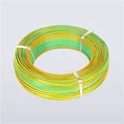
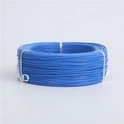
Friends who are involved in cable procurement, equipment matching, and industrial control projects are likely to have come into contact with fluoroplastic high-temperature wire. The two most commonly used and easily confusing products on the market are PTFE insulated wire and FEP insulated wire.
Many people find it difficult to make purchases: both models are insulated with fluoroplastic, which is resistant to high temperatures, corrosion, and has excellent insulation properties. They also look highly similar in appearance, but there is a price difference. What are the differences? How to choose the appropriate model? Is there an absolute distinction between superiority and inferiority?
As a salesperson who has been deeply involved in the cable industry for many years, I am here to comprehensively analyze the core differences between PTFE and FEP insulated wires and help everyone make accurate selections.
The materials of the two wires are different
- PTFE (polytetrafluoroethylene): commonly known as "tetrafluoroethylene", is a single material polymerized from pure tetrafluoroethylene monomer. It is also the most classic and longest used material in fluoroplastics, and can be called the "old powerhouse" in fluoroplastic cables.
- FEP (perfluoroethylene propylene): It is a copolymer modified material of tetrafluoroethylene and hexafluoropropylene, which is equivalent to a formula upgrade and improvement on the basis of PTFE. It is an optimized fluoroplastic material that specifically addresses some of the shortcomings of PTFE.
Summary: FEP is an improved version of PTFE, with similar basic performance, but different emphasis on processing characteristics and user experience.


Core performance comparison
High temperature resistance performance (the most critical distinguishing point)
PTFE wins completely. PTFE can operate stably at 260 ℃ for a long time. For aircraft engines, semiconductor high-temperature chambers, and petroleum logging, which can operate continuously at temperatures above 240 ℃, only PTFE insulated wire can be used; FEP is capped at 200 ℃, which is more suitable for medium to high temperature environments such as ovens, temperature control equipment, and industrial control cabinets. Occasional short-term overheating is not a problem, but it cannot exceed 200 ℃ for a long time.
Flexibility and wiring convenience
FEP has obvious advantages. PTFE has a relatively hard texture and high rigidity, making it prone to cracking after multiple bending and repeated wiring in narrow spaces; FEP has a fracture elongation rate of up to 300% -400%, with a soft touch. The equipment is equipped with dense wiring, robot activity harnesses, and small sensor wires. Choosing FEP for threading and assembly is easy, and the assembly efficiency of workers is higher.
Chemical corrosion resistance, oil resistance, and solvent resistance
PTFE has a slight advantage. Both can resist strong acids, strong alkalis, engine oil, cutting fluids, and most organic solvents, but PTFE molecules are denser and have stronger resistance to penetration and swelling in the face of high concentrations of strong corrosive agents and high-temperature oil bath environments; Under normal oil pollution and weak corrosion conditions, FEP is completely sufficient, and the difference perception is not significant.
Electrical high-frequency transmission performance
Both have a stable dielectric constant of 2.1, and there is minimal difference between normal temperature and conventional high-frequency signal transmission; However, under sustained high temperature conditions, PTFE medium loss fluctuates less, and high-precision signal transmission such as RF cables, radars, and high-frequency testing instruments prioritize PTFE wires.
Production process, delivery time, and procurement cost
FEP processing is simple, and there is sufficient stock in large quantities. Under the same line specifications, the price is 20% -40% lower than PTFE. Purchasing in large quantities can significantly reduce material costs; When the PTFE sintering process is complex, the production capacity of small-sized fine wires is low, the delivery time is longer, the raw material cost is higher, the budget is limited, and the working conditions are not extreme, there is no need to hard coat PTFE.


Which one is better? On demand selection
The two types of cables have different positioning and adaptation scenarios. Choosing the right one instead of the expensive one is the optimal procurement solution.
Scenario where PTFE insulated wire is preferred
- The long-term operating temperature of the equipment is 200 ℃ -260 ℃ under ultra-high temperature conditions;
- High voltage, high frequency, radio frequency, aerospace, military, precision instruments and other highly demanding electrical scenarios;
- Chemical strong corrosion, long-term outdoor exposure, high humidity and other extreme harsh environments;
- Projects that have extremely high requirements for the service life and performance stability of wires, and do not consider small cost premiums.
Scenario where FEP insulated wire is preferred
- Normal high temperature conditions, temperature ≤ 200 ℃;
- Narrow cabinet wiring, frequent bending of equipment harnesses, and flexible wiring requirements;
- Data centers, rail transit, industrial control automation, medical equipment, and precision electronic signal transmission scenarios;
- Bulk procurement, pursuing projects with stable quality, fast delivery time, and high cost-effectiveness.
Many customers make selection errors and fall into the misconception of 'the more expensive the better'. In fact, for 90% of daily industrial control, equipment, and automation projects, FEP cables are fully sufficient and offer higher cost-effectiveness; Only in scenarios where the operating temperature is extremely high, the environment is extreme, and the performance requirements are fully met, do PTFE wires need to be upgraded.
In addition, we would like to remind everyone that many low-priced fluoroplastic wires on the market have problems such as thin insulation layers, mixed materials, and poor high temperature resistance. When purchasing, do not only look at the unit price, but also pay attention to material purity, temperature resistance parameters, and insulation accuracy to avoid equipment leakage, wire aging, downtime and rework in the later stage, which are not worth the loss.
We at Zhejiang IRONFLON have been deeply involved in the development of fluoroplastic high-temperature cables for many years. Whether it is standard PTFE, FEP insulated wires, or customized wires with special specifications, we can ensure that the materials are pure, the performance meets the standards, and the delivery time is stable. If you have specific working conditions and parameter requirements, feel free to consult and help you accurately select and match cost-effective wire solutions for free, reducing procurement costs and avoiding selection risks.