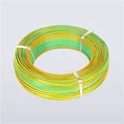
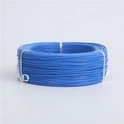
There is no absolute "best" material for insulated wires and cables, only the most "suitable". If you are selecting wires for your industrial equipment, medical devices, or aerospace projects, you are likely to come across two names: XLPE (cross-linked polyethylene) and PFA (perfluoroalkoxy resin). Although they all look like "plastic sheets" wrapped around conductors, their personalities are vastly different. Today, we take you into the world of these two top-notch insulation materials, helping you see at a glance who is the best choice for your project.
First meeting: Who exactly are they?
XLPE: The 'King of Cost Performance' in Power Transmission
The full name of XLPE is Cross Linked Polyethylene. You can imagine it as a "reinforced version" of ordinary polyethylene (PE). Through chemical or physical methods, the chains inside PE molecules that were originally scattered like sand are tightly locked together, forming a three-dimensional network structure.
This transformation has freed it from the weakness of ordinary plastics that melt when heated, making it both heat-resistant and sturdy. It is currently the absolute mainstream in the fields of power transmission and building wiring wire, with a focus on being "practical, easy to use, and cost-effective".
PFA: The 'Noble Player' in the Materials Industry
PFA belongs to the fluoroplastic family (closely related to Teflon). If XLPE is a pragmatist, then PFA is a hardcore player who pursues the ultimate. It is almost immune to all chemicals and can laugh and talk at extreme temperatures.
This material typically appears in laboratories, semiconductor factories, or near aircraft engines. The main theme is' fearless and extremely stable '.
Core showdown: These dimensions determine your choice
To make it more straightforward for you, we will put them on several key "arenas" to compete.
Challenge 1: Temperature endurance limit (who can resist heat better?)
- XLPE performance : It typically works stably between 90 ° C and 105 ° C. At the moment of a short circuit (within a few seconds), it can even withstand 250 ° C. For most urban power grids and interior decoration, this is more than enough.
- Performance of PFA : PFA is a true "refractory diamond". Its long-term operating temperature limit is as high as 260 ° C, and it can maintain toughness even at extremely low temperatures. If your insulated wires and cables need to be closely attached to high-temperature boilers or work in polar environments, PFA is the only choice.
Challenge 2: Chemical Resistance (Who is More Afraid of Corrosion?)
- XLPE : It can resist general acids, bases, and salts, but it can feel pressure when exposed to certain strong solvents or long-term exposure to ultraviolet light.
- PFA : It is a typical case of 'oil and salt not entering'. Strong acids, strong bases, strong oxidants, and even aqua regia are difficult to harm it in the slightest. At the same time, it also has excellent non stickiness, making it difficult for dirt to hang on it.
Challenge 3: Physical Resilience and Processing
- XLPE : It has a hard texture, high mechanical strength, and is wear-resistant and scratch resistant. Its outer diameter can usually be made relatively large, making installation easier.
- PFA : Relatively soft, with excellent bending resistance. Its insulation layer can be made very thin, which is a lifesaver for precision instruments with limited space, such as medical endoscopes.


Why should you choose XLPE? (Applicable scenario analysis)
If your project meets the following characteristics, please take XLPE home decisively:
The 'evergreen tree' of building wiring
XLPE is almost standard in modern construction projects (commercial buildings, residential buildings, data centers).
- Security Line : Building Wiring Wire is most afraid of fires caused by overload heating. The temperature resistance level of XLPE (90 ° C) is higher than that of traditional PVC (70 ° C). This means that XLPE insulated wires are less prone to aging and cracking under the same current load.
- The best partner for Low Smoke Zero Halogen (LSZH) : Skyscrapers and subway stations now require the use of LSZH cables to ensure that toxic smoke is not produced during a fire. XLPE is very easy to composite with these environmentally friendly flame retardant materials and is a core member in creating "green buildings".
- Resist moisture invasion : The walls and underground pipe galleries of buildings often have water vapor infiltration. XLPE has excellent water treeing resistance, and even if buried in damp walls for decades, its insulation performance will not collapse.
The 'economic pillar' of large-scale power transmission
For example, urban underground power grids and factory power distribution systems.
- Ultra low energy consumption : XLPE has extremely low dielectric loss, which means that the "unknown loss" of electrical energy during long-distance transmission will be minimized. For factories with high electricity bills, this is not only environmentally friendly, but also a direct way to save money.
- Durable and sturdy : The construction site environment is complex, and wires often need to be pulled back and forth in steel bars and concrete pipes. The mechanical strength of XLPE is very strong, and ordinary scratching cannot damage the internal conductor at all.
Budget sensitive large-scale projects
On the premise of meeting high performance requirements, the material cost of XLPE is much lower than that of PFA. If you need to lay wiring for a 50 story building or construct an industrial park covering several kilometers, choosing XLPE can help you save an extremely considerable material budget while ensuring safety.
Why should you choose PFA? (Applicable scenario analysis)
The Terminator of Ultra High Temperature
Many insulation materials start to doubt life at around 150 ° C, but PFA's working comfort zone is far beyond your imagination.
- 260 ° C ultra long standby : PFA's long-term continuous use temperature can reach 260 ° C. This means that it can still work stably in close proximity to aircraft engines, industrial furnaces, or automotive turbocharging systems, just like in an air-conditioned room.
- Heat resistant and non deformable : Even if the ambient temperature suddenly rises, it will not melt, drip or undergo physical deformation like ordinary wires. This thermal stability ensures that the signal transmission of critical equipment will never be interrupted.
The 'Inert to Chemicals' in the Chemical World
In chemical plants or semiconductor laboratories, the air may be filled with corrosive acid mist.
- Omnipotent resistance : PFA is almost immune to all chemical agents, strong acids, strong bases, and organic solvents. Even if the cable is directly immersed in highly corrosive industrial fluids, it will not degrade or expand.
- Semiconductor grade purity : PFA does not contain additives or plasticizers, which means it will not precipitate any small chemical components at high temperatures. For wafer processing equipment that requires' zero pollution ', this is the only insulation option.
Pursuing ultimate 'Space&Weight Saving'
In satellites, drones, or expensive medical equipment, space is money.
- Ultra thin insulation wall : Due to the extremely strong insulation performance of PFA, it can achieve the withstand voltage level that other materials need to achieve with a very thin layer of skin (even as thin as cicada wings).
- Flexibility and fatigue resistance : PFA cables are very soft and have excellent bending life. At the joints of surgical robots, cables need to be folded tens of thousands of times frequently, but PFA can still ensure that no cracks occur.
Bio compatibility, the guardian of medical and food safety
- Non toxic and smooth : PFA surface is extremely smooth, making it difficult for bacteria to hang on, and the material itself has excellent biocompatibility. It can withstand the repeated "torture" of high-pressure steam sterilization (Autoclave) in hospitals, and is therefore widely used for internal wiring of endoscopes, sensors, and various implanted devices.
PFA Applicable Scenarios List
For your convenience in making quick decisions, we have summarized PFA's "comfort zone":
| industry sector | specific scenario | Why is it necessary? |
| Aerospace | Engine compartment monitoring, satellite wiring | Resistant to extreme high and low temperatures, with extremely light weight |
| Semiconductor Manufacturing | Etching machine, cleaning equipment inside | Extremely high purity and chemical corrosion resistance |
| Oil Exploration | Deep well drill bit sensor | Endure underground high temperature and high pressure oil pollution |
| Medical Device | Surgical robots, ultrasound probes | Resistant to high temperature disinfection and excellent softness |
| Automotive Industry | Oxygen sensor, automatic transmission wiring harness | High temperature environment adjacent to the engine |


Frequently Asked Questions
Q1: PFA is so good, can we use all PFA?
Boss, take a look at your wallet! The raw material price and processing difficulty of PFA are several levels higher than XLPE. Forcefully using PFA in situations where extreme temperature resistance is not required is a typical case of "excess performance", which can greatly reduce the project's return on investment.
Q2: Is XLPE really not heat-resistant?
Not really. For 99% of daily life and general industrial applications, the upper limit of 90 ° C-105 ° C is already very safe. You have to understand that ordinary plastic (PE) begins to soften around 70 ° C, while XLPE is already an elite that has undergone "magic modification".
Q3: How to distinguish them from their appearance?
By naked eye observation, XLPE usually has a solid and hard color; The insulation layer of PFA often has a semi transparent texture (although it can also be made in various colors), which feels smoother and feels a bit like a non stick coating.
The ultimate advice for decision-makers
When choosing insulation materials for wires, don't just look at their unit price, but also consider their total lifecycle cost.
- If the environment is mild, the usage is large, and long-distance transmission is emphasized: choose XLPE. It is your economic pillar.
- If the environment is extreme, the space is limited, and high reliability is emphasized: choose PFA. It is your safety line of defense.
Why did you choose us as your partner?
As a supplier who has been deeply involved in the industry for many years, we not only sell wires, but also provide solutions.
- Customized production : Whether you need special colored XLPE power cables or ultra-fine PFA signal cables, we can customize them according to your needs.
- Strict quality inspection : Every roll of our wire undergoes rigorous voltage resistance, aging, and environmental testing. We know that any small wire failure in your project can result in significant losses.
- Global logistics : We are familiar with various international export standards, and no matter which continent you are on, we can ensure that your goods are safely and quickly delivered to you.
- Comprehensive service guarantee : equipped with a professional technical team before sales, providing customers with scenario based cable selection suggestions, and optimizing product solutions based on customer equipment parameters; Real time synchronization of production progress during the sales process, providing sample transportation services, and assisting customers with preliminary testing and verification; Establish exclusive after-sales service files, provide technical support and problem-solving solutions, and respond promptly and efficiently.
Do you need professional advice for your next project?
Don't worry about material selection anymore. Our engineering team is ready to answer various complex technical questions for you.
Do you want to obtain more detailed specifications or free samples? Contact us directly( luna@ironflon.com ). Let's work together to create the most suitable insulated wires and cables for your equipment!