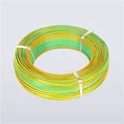
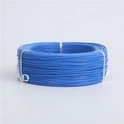
When we use our mobile phones to watch ultra high definition live broadcasts and remotely control industrial equipment, we rarely think that the wires and cables hidden in base stations and data centers are silently working hard. From the popularization of 5G to the acceleration of 6G research and development, communication networks have increasingly high requirements for data transmission accuracy and speed, and a seemingly ordinary material - fluoroplastic, is becoming a "hidden hero" in the field of high-speed communication with its unique advantages. Why can fluoroplastic insulated wire and cable stand out among numerous insulated wires and become a must-have choice in the 5G/6G era? Today we will unveil its mysterious veil.
From 5G to 6G: Communication Wire Transmission Meets' Exam Questions' First
The high-definition video and Internet of Things device interconnection in the 5G era have led to explosive growth in data transmission volume, and the upcoming 6G will achieve "intelligent connection of all things", even supporting more complex scenarios such as space communication and holographic projection. At this point, traditional wires and cables are a bit inadequate. For example, the commonly used PVC insulated wire and cable are prone to "signal attenuation" when transmitting high-frequency signals, just like how the sound of a person's voice becomes lighter when it is transmitted far away, and data becomes weaker when it is transmitted far away; In case of high temperature in the base station machine room, outdoor rainstorm exposure and other harsh environments, aging and cracking of the insulation layer may also occur, affecting the transmission stability.
Engineers in the communication industry have found that the key to solving these problems lies in the insulation material of the wires. Fluoroplastics, known as the "plastic king," happen to be able to meet these challenges. It is not a single material, but a family name that includes polytetrafluoroethylene (PTFE), perfluoroethylene propylene (FEP), and others. It is born with the "gene" to adapt to high-speed communication, and can be seen in everything from RF cables in 5G base stations to high-speed communication wire in data centers.


Three Core Advantages: The "Hard-Core Strength" of Fluoroplastics
Someone might ask, "What exactly makes fluoroplastic insulated wire and cable so superior?" In fact, there's no need to delve into complex academic concepts-its exceptional qualities are evident in practical usage scenarios. The most outstanding feature is "uninterrupted signal transmission." As we know, signals are prone to interference during transmission, much like how speech gets interrupted in a noisy environment. Fluoroplastic boasts outstanding dielectric properties, which simply means it can create a "dedicated pathway" for signals, minimizing mutual interference and reducing signal loss during transmission. This makes it perfectly suited for high-frequency signal transmission in 5G base stations and potentially for millimeter-wave frequency bands in future 6G applications.
In addition to its strong signal transmission capabilities, it also boasts outstanding durability. Outdoor base stations expose wires to extreme cold of minus several tens of degrees Celsius and high temperatures from summer sun exposure, while data centers see continuous temperature rises due to heat dissipation from numerous devices. Fluorinated plastic-insulated cables can operate stably within a temperature range of -200°C to 200°C and even withstand short-term exposure to 260°C, far exceeding the tolerance limits of traditional PVC and PE wires. More impressively, it resists corrosion from acids, alkalis, and chemical solvents, ensuring the insulation layer remains intact even when used in base stations within petrochemical zones.
Safety performance is an additional advantage. Fire hazards caused by aging and short-circuiting wires are a major concern in the industry. Fluoroplastics have a high oxygen index, making them resistant to combustion. Even in the event of a fire, the flames spread over a limited area, produce minimal smoke, and do not release toxic substances. In high-rise buildings, subways, and data centers-environments with extremely stringent fire safety requirements-this property can buy valuable time for personnel evacuation and equipment protection. Moreover, its service life is exceptionally long. Traditional wires may degrade after just a decade or so, while fluoroplastic-insulated wires can last several decades under normal conditions, making them more cost-effective over the long term.


the "all-around player" from base stations to data centers
In practical applications, fluoroplastic insulated wires have long become a "standard" in the field of high-speed communication. In the construction of 5G base stations, RF cables and coaxial cables are the key to transmitting signals. By using fluoroplastics as insulation layers, signal attenuation can be effectively reduced, allowing remote areas to receive 5G signals stably. Engineers have conducted tests and found that under the same transmission distance, the signal attenuation of fluoroplastic insulated cables is much lower than that of traditional cables. This is also one of the reasons why many mountainous base stations can achieve stable coverage.
The data center is also the "main battlefield" for fluoroplastic insulated wires. Nowadays, large data centers need to handle massive cloud computing and big data businesses, with increasingly high requirements for transmission speed. For example, high-speed Communication Wire such as Cat6A require stable insulation materials to support them. Fluoroplastic insulated wires not only meet high-speed transmission requirements, but also reduce crosstalk between signals, making data processing more efficient. More importantly, data center equipment is dense and the heat dissipation pressure is high. The high temperature resistance of fluoroplastics can adapt to this environment and reduce failures caused by overheating of wires.
Even in high-end fields such as aerospace and new energy vehicles, fluoroplastic insulated wires are playing a role. The temperature in the aircraft engine compartment is extremely high, and it can also come into contact with corrosive substances such as fuel. Fluoroplastic wires can work stably in such harsh environments; The internal temperature of the battery pack in new energy vehicles is relatively high, and the high-voltage wiring harness is insulated with fluoroplastic, which can withstand high temperatures and ensure electrical safety. The application of these scenarios further proves its irreplaceability.
It is worth mentioning that China has also achieved breakthroughs in the field of fluoroplastic wire related equipment. Previously, high-end fluoroplastic physical foaming extrusion equipment relied on imports for a long time, but domestic enterprises have successfully developed the first domestically produced production line suitable for "448G high-speed copper cables", which not only benchmarks the performance against international advanced levels, but also achieves independent controllability of core components, providing strong support for the large-scale application of fluoroplastic insulated wires.


6G is approaching: the "evolutionary path" of fluoroplastics
With the advancement of 6G research and development, communication networks will enter an era of higher frequency bands and larger bandwidths, and the requirements for wires and cables will also reach a new level. Industry experts predict that 6G may use new technologies such as terahertz waves, with transmission rates reaching TB level. This requires insulation materials with lower losses and more stable performance, and fluoroplastics are undoubtedly one of the most promising materials.
At present, the industry has begun to modify and optimize fluoroplastics, such as improving thermal conductivity through nanofilling technology, allowing wires to dissipate heat quickly even during high-power transmission; Alternatively, special materials can be added to reduce surface resistance and adapt to special scenarios such as explosion prevention. These technological upgrades not only meet the demand for 6G, but also expand the application boundaries of fluoroplastic insulated wires, such as playing a role in emerging fields such as quantum communication and deep-sea communication.
For enterprises in the communication industry, choosing suitable insulated wires is the key to ensuring network quality. Fluoroplastic insulated wires have become a must-have product in the 5G era due to their advantages of stable signal transmission, strong environmental adaptability, and long safety life. In the upcoming 6G era, their importance will further increase. With the continuous breakthroughs in domestic technology, the cost of fluoroplastic insulated wire and cable is gradually decreasing. We believe that in the future, more companies will choose this "hard core" material to build a "lifeline" for high-speed communication networks.
From daily mobile internet access to cutting-edge aerospace communication, fluoroplastic insulated wires, although hidden behind the scenes, support the development of the entire communication industry. At the critical juncture of the transition from 5G to 6G, this inconspicuous material is writing a new chapter in high-speed Communication Wire.