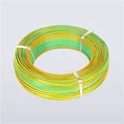
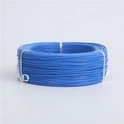
Product Overview
Conductor material: tinned copper wire, silver-plated copper wire or nickel-plated copper wire are mostly used to enhance electrical conductivity and corrosion resistance.
Insulation: Fluoroplastic materials such as PTFE (polytetrafluoroethylene), FEP (fluorinated ethylene propylene copolymer) or PFA (perfluoroalkylated) are mainly used.
Sheath: Some models have an additional protective layer added to increase mechanical strength.
High temperature resistance: long-term working temperature up to -65 ℃ ~ 260 ℃, short-term peak temperature resistance up to 300 ℃.
Chemical inertness: can resist the corrosion of strong acids, alkalis and organic solvents.
Electrical properties: high dielectric strength, low dielectric loss, suitable for high frequency signal transmission.
Non-sticky: extremely low surface friction coefficient (about 0.04), not easy to adhere to pollutants.
Technical Analysis of 260℃ Temperature Resistance
The key for Teflon cable to realize 260℃ temperature resistance lies in its special molecular structure and manufacturing process:
PTFE molecular structure PTFE: C-F bonding energy in PTFE is extremely high, the thermal decomposition temperature exceeds 400 ℃, which gives the material excellent thermal stability.
Material classification:
PTFE: temperature resistance up to 260°C, best chemical stability.
FEP: Resistant to 200°C, but with better processability.
PFA: Temperature resistant to 260°C and flexible.
Process guarantee:
adopts a special push-extrusion process to ensure that the insulation layer is free of porosity, and the thickness tolerance can be controlled within ±3μm.
Temperature level comparison:
| Material Type | Long term working temperature | Short term peak temperature resistance | Typical Applications |
| PVC | 70℃ | 90℃ | Ordinary wiring |
| silicone | 180℃ | 200℃ | General high temperature environment |
| PTFE | 260℃ | 300℃ | Extreme high temperature environment |
Typical application scenarios
Teflon insulated cables are widely used in multiple high-end fields due to their unique performance:
In the field of electronics and electrical engineering
High temperature electronic equipment: used for internal wiring of micro motors, thermocouples, programmable devices, aviation radars, rockets and other equipment, with a temperature resistance range of up to -60 ℃~260 ℃.
Household appliances: The internal connecting wires of high-temperature components such as air conditioners, microwave ovens, and electric ovens need to withstand high temperature environments above 200 ℃ for a long time.
High voltage transmission and communication: suitable for AC transmission lines below 1kV and high-frequency communication equipment, with low high-frequency loss and high insulation resistance.
Industrial and mechanical fields
Chemical and Corrosive Environment: Transporting corrosive media such as strong acids and alkalis, such as sealed circuits in chemical reaction vessels.
Mobile devices and machinery: Tensile and heat-resistant wiring for driving vehicles and transmission machinery, meeting the requirements of dynamic bending and high temperature working conditions.
Nuclear power and military industry: critical connecting components for high-temperature pipelines in nuclear power plants, military engines, and other extreme environments.
High tech and emerging fields
New energy vehicles: Insulated wiring harnesses for high-voltage battery packs (above 800V) must be heat-resistant and flame-retardant.
5G and communication base stations: Low dielectric loss coaxial cables ensure stable transmission of high-frequency signals.
Medical equipment: Aseptic wiring of medical devices (such as endoscopes and catheters) that meets biocompatibility requirements.
Other Special Scenarios
Aerospace: lightweight cables for fuel delivery systems.
Food Processing: Insulation protection for food grade fluid transfer lines.
Laboratory equipment: high purity gas transmission to avoid impurity contamination.


Selection and use of recommendations
1. Selection points
Temperature requirements: sustained below 200 ℃ optional FEP, 260 ℃ must be selected PTFE.
Conductor selection: high-frequency applications recommended silver-plated copper, strong corrosive environment with nickel-plated copper.
Certification standards: UL758, IEC60331 and other international certifications to ensure reliability.
2. Installation Precautions
Bending radius: ≥ 5 times the wire diameter (very fine wire needs to be ≥ 6 times).
Welding protection: use 260℃ temperature resistant heat shrink tubing, shrinkage force to maintain more than 92%.
Parallel spacing: ≥2 times the wire diameter between multi-core wires to avoid insulation resistance drop.
3. Maintenance points
Regular inspection: oxidized condition of joints, especially in high temperature and high humidity environment.
Cleaning method: prohibit strong alkaline solvents, recommended to wipe with isopropyl alcohol.
Replacement cycle: It is recommended to fully inspect every 3-5 years, and shorten to 2 years for extreme environments.