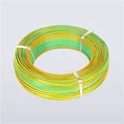
" Single core wire or multi core wire? "Is a difficult problem that everyone faces when decorating. Some people recommend single core copper wire for durability, while others say multi core copper wire is easy to construct. In fact, not only in home decoration scenes, but also in industrial wiring, home appliance manufacturing and other fields, the "choice problem" between single core copper wire and multi core copper wire often occurs. As the two main categories in the wire market, each has its own advantages. Today, let's talk about these two types of copper wires in the most down-to-earth way.
Single core copper wire: the "reliable responsibility" for fixed wiring
At home decoration wire selection sites, single core wire is often the "initial choice" for many homeowners. The most intuitive feature of this type of wire, which is composed of a single solid copper conductor, is its "toughness", and its stiffness can be clearly felt when held in the hand. It is precisely this structural advantage that allows single core electrical wire to demonstrate its strength in fixed wiring scenarios - such as conduit installation in residential walls and ceiling wiring, which rarely change once installed. Single core Teflon insulated wire can maintain its shape stably and will not deform due to long-term static stress.
The reliability of single core Teflon insulated wire is also reflected in the stability of current carrying capacity. Due to the fact that the conductor is a complete single copper material, the distribution of current through it is more uniform, and there will be no local heating problems caused by conductor splicing. That's also why electricians tend to recommend single core wire for fixed wiring of high-power appliances such as home distribution boxes and air conditioners. In addition, the connection of single core electrical wire is also very convenient. It can be firmly fixed by directly connecting it to the terminal, and the interface can be checked more clearly during later maintenance. However, it also has its own shortcomings. If used in scenarios that require frequent bending, it is prone to cracking after repeated bending, making it less flexible than multi core electrical wire.


Multi core copper wire: the "flexible master" in flexible scenarios
Unlike the "toughness" of single core wire, multi core wire has gained countless fans in the decoration market due to its "flexible body". It is made up of multiple thin copper wires twisted together, which can be bent and curled freely in the hand. Even if it is repeatedly bent thousands of times, it is not easy to break. This fatigue resistance makes it shine in complex wiring scenarios. For example, when encountering water pipes, beams, and columns that require bending during decoration, multi-core copper wire can easily pass through the pipes, saving a lot of construction trouble; In industrial scenarios such as robot joints and conveyor belts that require dynamic wiring, multi core electrical wire is the core choice.
The advantages of multi core Teflon insulated wire go beyond flexibility. Due to the larger total surface area after twisting multiple thin copper wires, the heat dissipation performance is better than that of single core cable of the same specification, and the temperature control is more stable during long-term use. In high-frequency signal transmission scenarios, multi core wire cable can effectively reduce losses caused by skin effect. Therefore, the application of multi core Teflon insulated wire is becoming increasingly widespread in fields such as smart home sensor wiring and audio equipment signal lines. However, attention should be paid to the connection of multi core wire cable, usually using cold pressed terminals to ensure that each thin copper wire can tightly contact and avoid virtual connection problems. With the increasing demand for personalized home decoration, multi core electrical wire with colored insulation layers are becoming more and more popular. Color markings such as red, blue, and yellow make circuit differentiation clearer, especially suitable for surface mounted circuits in smart home renovation.


Core Duel: The Key Logic of Choosing Right or Not Choosing Expensive
In fact, there is no absolute superiority or inferiority between single core wire and multi core wire, their "battlefield" is already different. Many people are struggling with how to choose between the two, and the key is to consider the needs of the usage scenario. We can quickly judge from three dimensions: first, whether it needs to be moved or bent. For fixed wall and floor wiring, choose single core Teflon insulated wire; for frequently moving power strips and small household appliance power cords, choose multi core Teflon insulated wire; Secondly, it depends on the power level. Single core cable is more secure for the fixed main line of high-power appliances, while multi core Flexible Electrical Wire is more suitable for flexible wiring of small and medium power equipment; Finally, let's look at the wiring environment. Both are suitable for simple and spacious wiring environments, while multi core cable are preferred for complex bends and narrow spaces.
In terms of price, multi core Flexible Electrical Wire of the same specifications require the twisting of fine copper wires during production, making the process more complex. The cost may be slightly higher than that of single core cable, but the difference is not significant. From the perspective of long-term usage costs, single core cable has lower maintenance costs in fixed scenarios, while multi core cable has a longer service life in dynamic scenarios. Therefore, it is still necessary to choose according to the scenario in order to be more cost-effective. It is worth mentioning that regardless of which type of copper wire is chosen, it is important to identify products from reputable manufacturers to ensure that the purity of the copper material meets the standards. After all, the safety of the wire is of utmost importance.


Industry observation: Segmented demand drives category upgrade
With the development of industries such as power, electronics, and new energy, the copper wire market is also upgrading towards segmentation and high-end. Single core wire cableand multi core wire cable are constantly optimizing in their respective tracks. Under the guidance of the "dual carbon" goal, many enterprises have begun to use recycled copper to produce single core wire cable, which not only reduces raw material costs but also enhances environmental protection properties. This green upgrade makes single core copper wire more competitive in the field of building power distribution. And multi core Flexible Electrical Wire is developing towards finer diameter and functionalization. The application of multi-core wire twisted with ultra-fine copper wire in precision electronic equipment is becoming more and more widespread. High temperature resistant and flame-retardant multi core cable has gradually become the core wiring material for new energy vehicles and photovoltaic systems.
Industry insiders say that in the future, there will not be a situation of "who replaces whom" for single core wire and multi core wire, but rather more accurate scene coverage will be achieved through downstream demand segmentation. For consumers, understanding the core differences between the two and choosing according to their own needs is sufficient, without blindly pursuing high priced products. After all, whether it is the stability and reliability of single core wire cable or the flexibility and flexibility of multi core Flexible Electrical Wire , the best choice is one that can adapt to the scene.
If you want to further understand the selection techniques of single core copper wire and multi core copper wire, you can contact our professional consultants( luna@ironflon.com )I am always available to answer your questions and clarify any doubts!