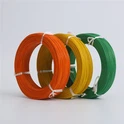
In the daily work of elevator operation and electrical wiring, people often ask: Can UL10316 single core copper wire be used in elevator control systems? In fact, there is no absolute "can" or "cannot" answer. The key is whether it matches the actual needs of the elevator control system - after all, elevators are special equipment related to life safety, and the choice of each cable directly affects the stability and safety of elevator operation. UL10316 single core copper wire is no exception. We will gradually explain it from several key dimensions based on practical application scenarios.
Electrical Requirements
The core of elevator control system is "precise power transmission and stable signal transmission". Unlike power circuits that require carrying large currents, it places more emphasis on the conductivity, current carrying capacity, and voltage drop of cables, which is also the core advantage of UL10316 single core copper wire. Firstly, the conductivity of copper itself is second only to silver. Under the same wire diameter, the electrical energy loss is much smaller than that of materials such as aluminum wire, which can reduce power waste caused by resistance heating. This is particularly important for elevator systems that require 24-hour standby and precise transmission of control signals.
The wire diameter range of UL10316 single core copper wire is usually suitable for the needs of elevator control systems, just matching the current carrying capacity requirements of elevator control circuits - the current of elevator control circuits is generally small, mainly used for transmitting weak electrical signals such as call registration, leveling signals, door control, etc. This wire diameter copper wire can easily carry and the voltage drop can be controlled within 3% of the rated voltage, without signal attenuation or transmission errors.
However, it should be noted that there are strong electrical circuits (such as traction machine power supply) and weak electrical circuits (such as PLC signal transmission) in the elevator control system. UL10316 single core copper wire is more suitable for weak electrical control circuits. Thicker power cables should be selected for strong electrical circuits and cannot be used as substitutes. This must be clearly distinguished when wiring to avoid electrical faults caused by improper cable selection.
Safety Standards
Elevators belong to special equipment, and the safety standards for their electrical systems are extremely high. Whether it is the domestic GB7588-2003 "Safety Specification for Elevator Manufacturing and Installation" or the international UL standard, there are clear regulations on the safety performance of cables. UL10316 single core copper wire, produced according to UL standards, has a certain guarantee in terms of safety performance.
From the perspective of safety core requirements, the first is insulation performance. The insulation level of UL10316 single core copper wire meets the requirements of elevator control system, which can effectively prevent leakage and short circuit, and avoid elevator shutdown or fire hazards caused by cable insulation damage. Next is flame retardancy. Elevator machine rooms and shafts are enclosed spaces, and cables must have a certain degree of flame retardancy. The insulation layer of UL10316 single core copper wire has undergone flame retardant treatment, meeting the flame retardant level requirements for elevator wires. Even in the event of a fire, it can slow down the combustion rate and buy time for personnel evacuation and equipment rescue.
In addition, there are special requirements for the safety monitoring circuit of elevators. According to GB7588-2003, the cross-sectional area of the safety circuit wire is not less than 0.75 square millimeters, and the contact resistance of each switch contact is not greater than 50 milliohms. UL10316 single core copper wire can meet this requirement as long as the appropriate wire diameter is selected, and its copper conductor has strong stability and will not cause the safety circuit to fail due to poor contact - it should be noted that the safety circuit is the "emergency brake" of the elevator. Once it fails, the consequences are unimaginable.
Here is a small reminder: when using UL10316 single core copper wire, it is necessary to ensure that the product has complete UL certification and complies with relevant regulations for elevator electrical installation in China. Uncertified and unqualified cables cannot be used, as there is no "fault tolerance space" for elevator safety.
Flexibility and Durability
The wiring environment of elevators is quite unique, with complex wiring paths between the machine room, shaft, and car. Some areas require bending and threading, while others are in a state of long-term vibration, which tests the flexibility and durability of the cables. The performance of UL10316 single core copper wire can only be said to be "suitable for some scenarios", with advantages and limitations.
Firstly, let's talk about the advantages. The copper conductor of UL10316 single core copper wire has excellent ductility and undergoes strict wire drawing process during production. Although it is a single core structure, it is not easy to break within a reasonable bending range, making it suitable for fixed wiring in elevator machine rooms, such as wiring inside control cabinets and wiring in fixed cable trays in machine rooms. These places do not require frequent bending, and the stability of single core copper wire is more advantageous. Moreover, its wiring is simple and can be directly inserted into wiring holes or wound around screws, which is not easy to spread and can reduce the risk of faults during the wiring process.
But its limitations are also obvious: the flexibility of single core copper wire is not as good as multi strand copper wire, and it is prone to fatigue fracture after repeated bending, so it is not suitable for parts that require frequent movement or vibration, such as the accompanying cables between the elevator car and the shaft, and the wiring near the door machine - these parts will continue to bend and stretch with the up and down operation of the elevator and the opening and closing of the door machine. If single core copper wire is used for a long time, it is easy to cause cable breakage, signal interruption, and ultimately elevator failure.
In terms of durability, UL10316 single core copper wire has strong chemical stability as a copper conductor. At room temperature, it forms a dense oxide protective film, which can effectively prevent further oxidation of the internal metal. In a dry and ventilated environment, it has a long service life. But if the environment is humid and contains corrosive gases, protective measures need to be taken, otherwise the insulation layer is prone to aging and damage, affecting the service life of the cable.


Environmental Conditions
The operating environment of elevators varies greatly, such as elevators in office buildings and residential buildings, where the environment is dry and comfortable. UL10316 single core copper wire is basically stress free; But the elevators in shopping malls and underground garages are different. They are damp and dusty, and outdoors or near chemical plants, the temperature fluctuates, and even corrosive gases can affect the effectiveness of cable use.
The temperature in the elevator machine room is usually between 5 and 40 degrees Celsius. Within this range, UL10316 single core copper wire can fully withstand it. No matter how hot the machine room is in summer or how cold it is in winter, the electrical performance can remain stable, and the insulation layer will not age or the conductivity will deteriorate due to temperature issues. But if the ventilation in the computer room is poor and the temperature always exceeds 40 degrees Celsius, it is necessary to replace the cables with higher temperature resistance, otherwise it is easy to malfunction.
In the damp environment of an underground garage, the humidity in the shaft and machine room can sometimes exceed 85%, and even condensation may occur. At this time, the insulation layer of UL10316 single core copper wire is prone to moisture, which not only reduces the insulation performance but also poses a risk of leakage. In this case, the cable needs to be treated with moisture-proof measures, such as wearing a waterproof pipe or using a model with a moisture-proof insulation layer. There is a lot of dust in the elevators near the construction site, and the dust adheres to the surface of the cables, which will wear down the insulation layer over time. It is better to clean and protect them regularly.
There is also the grounding system for elevators. UL10316 single core copper wire is used as the control cable, which needs to be well coordinated with this grounding system to ensure reliable grounding. The grounding resistance should be controlled within 4 ohms to avoid electromagnetic interference and ensure stable transmission of control signals.
Compatibility with Other Components
The elevator control system is a complex whole, which includes various components such as PLC controllers, frequency converters, contactors, relays, sensors, etc. In addition to cables, the compatibility of UL10316 single core copper wire with these components is also a key factor that many people tend to overlook.
From the perspective of interface matching, the wire diameter specification of UL10316 single core copper wire is matched with the wiring terminals of PLC and contactors in the elevator control system, and there will be no interface mismatch or loose wiring - loose wiring may seem like a small problem, but it may cause signal transmission interruption, leading to elevator misoperation, inaccurate leveling and other faults.
From the perspective of signal interference, in elevator control systems, frequency converters can generate high-order harmonics and radio frequency interference, which can easily affect the transmission of control signals. If UL10316 single core copper wire does not have a shielding layer, its anti-interference ability is weak, which may lead to signal distortion. However, the signals in the elevator control circuit are mostly low-frequency signals. As long as the strong and weak electrical circuits are laid separately and shielded with metal partitions at intersections, interference can be effectively reduced. UL10316 single core copper wire can be used normally. If it is high-frequency signal transmission, it is recommended to choose UL10316 single core copper wire with shielding layer to further enhance anti-interference ability.
In addition, UL10316 single core copper wire is compatible with other cables of the elevator (such as power cables and accompanying cables). As long as the wiring is in accordance with the specifications, strong and weak electricity are distinguished, and mutual interference between cables is avoided, it can be integrated into the entire elevator control system and play its role in transmitting signals. Here, you can also refer to the parameter table provided by the supplier and conduct sample testing if necessary to ensure that the cable works in conjunction with other components.
If you want to learn more about the application details of UL10316 single core copper wire in elevator control systems, please contact us( luna@ironflon.com )We will reply promptly.