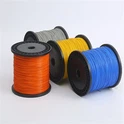
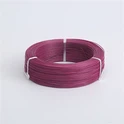
Whole house intelligence is no longer an unattainable concept. Nowadays, entering most households, there is an intelligent door lock that automatically senses when entering, a smart light bulb in the living room that can adjust brightness according to mood, a temperature and humidity sensor in the bedroom that quietly monitors the environment, and smart curtains on the balcony that automatically open and close when the time comes. These devices may seem independent, but they are all connected by an inconspicuous wire, supporting the "intelligent linkage" of the entire home. After years of working on smart home wiring, whether it's home appliance manufacturers or engineering construction friends, the most common question they ask me is: Can UL1558 tinned ETFE insulated wire be used on smart home devices? The answer is actually very simple. Not only can it be used, but it is also the preferred cable in many of the mid to high end projects I have handled.
The reason why everyone is struggling with this issue is ultimately due to a lack of understanding of this cable. Based on my years of practical experience, let's talk about the real situation of UL1558 standard and ETFE material, and explain its adaptation logic to smart homes. After all, practicality and ease of use are the core of our wire selection.
Let me clarify a common misconception. Many people think that UL1558 wire is a model of a certain wire, but it is not. It is a standard developed by UL (Insurance Testing Institute) in the United States specifically for insulated wires used in electrical equipment. Simply put, it sets a set of "qualified wires" for wires, such as how thick the insulation layer should be, how much temperature it can withstand, what degree of flame retardant effect should be achieved, and what material should be used for conductors, all of which have clear requirements. And the tinned ETFE insulated wire we are talking about is a type of wire that exactly meets this standard, which I have found to be the most suitable for smart homes in actual wiring.
The focus here is on its insulation layer, which is made of ETFE material. Some people may find it unfamiliar, but let's talk about it based on reality. The smart gateway and central controller at home are basically powered on 24 hours a day, and there is always a slight warmth to the touch. The normal working temperature is about 40 to 60 ℃. If ordinary PVC insulated wire is used, its temperature resistance can only reach 70 to 90 ℃. If it is in this slightly heated state for a long time, after one or two years of use, the insulation layer will become brittle and crack, making it easy to have short circuits and leakage problems.
But ETFE material is different. According to UL1558 standard, its long-term working temperature can reach 125 ℃, and short-term overload can even withstand 150 ℃. Even if the equipment is powered on for a long time and generates heat, it can completely withstand it. And the molecular structure of this material is very stable, with excellent resistance to aging and wear. I used this wire for wall embedding in a whole house intelligent renovation project in an old residential area before, and it has been almost 5 years now. When I opened it for inspection, the insulation layer was still intact without any signs of aging.
Flame retardancy is also the most important factor in home wiring. The flame retardant performance of this wire has passed the VW-1 vertical combustion test in UL1558 standard. I have seen actual test scenarios where there are no droplets or toxic smoke emitted during combustion. The flame spread speed is particularly slow, not exceeding 100 millimeters per minute. When used at home, it can indeed provide a lot of peace of mind.
Speaking of the conductor part, it uses high-purity oxygen free tin plated copper with a wire diameter of approximately 0.12 to 0.20 millimeters. It is made up of 7 to 19 thin conductors twisted together - the specific number of wires used depends on the actual wire specifications required. Some people may think that there is no difference between twisting or not twisting conductors, but in smart homes, this difference is too big.
The signals of smart homes are particularly weak, such as the induction signals of human sensors and the control signals of smart switches. The voltage is mostly between 5V and 12V, and the current does not exceed 1A. If there is slight interference or signal attenuation, problems will occur. I have encountered a project before that used a regular single copper conductor wire, but the smart curtains often opened and closed incorrectly, and the human sensor always gave false alarms. Later, I switched to this twisted wire structure and the problem was solved directly.
High purity oxygen free copper has a conductivity of over 99.97% and a particularly stable resistance. At 20 ℃, the resistance per square millimeter does not exceed 0.0172 ohms, and signal transmission is almost not attenuated. The outer tin plating layer is also very practical, with a thickness of at least 0.8 microns, which can firmly isolate air and moisture, prevent copper conductors from oxidizing and turning black - everyone should have seen old wires, where copper wire turning black is prone to poor contact, and this wire, even if buried in the wall for a long time without maintenance, will not have this problem.
When it comes to environmental protection, this is also the most concerned point for people's decoration nowadays, especially for enclosed spaces such as bedrooms and children's rooms. The environmental friendliness of wiring directly affects indoor air quality. This wire complies with the EU ROHS 2.0 standard and REACH regulations, which means it does not contain harmful substances such as lead and mercury. The insulation layer is halogen-free and low smoke, and even if accidentally burned, it will not release toxic gases. I used to do wiring for a family with children and specifically tested its smoke toxicity index, which was only 1.0, much lower than the national standard requirement of 3.0. It can be used in a children's room with complete peace of mind.
And its processing is also very flexible. Nowadays, smart home devices are becoming smaller and smaller, such as smart panels and small sensors, with particularly compact internal space. This wire can be made into 2 to 16 core twisted pair or multi-core twisted pair, with a wire diameter controlled between 0.8 and 2.0 millimeters, which can be easily inserted into the device without taking up space. It is also convenient to embed during decoration, with good flexibility and less likely to break when threading pipes. Construction workers have reported that it is better to use than ordinary wires.
Some people may ask, why do I always recommend this product when there are so many cables on the market? Let me give you some actual test data. I have done a comparison before. Ordinary PVC tinned copper wire, after running continuously for 3000 hours at 80 ℃, the insulation layer aged by 35% and the signal transmission also decayed by more than 10%; And UL1558 wire, running continuously for 5000 hours in an environment of 125 ℃, has an insulation aging rate of only 5% and signal attenuation not exceeding 3%, with poor durability.
More importantly, most ordinary wires have not passed the UL1558 standard certification, and key indicators such as temperature resistance and flame retardancy are not guaranteed. UL1558 certification is particularly strict, requiring 12 core tests. Wires that can pass certification will definitely have good quality. That's also why many mid to high end smart home brands prioritize using this wire when producing smart gateways and smart switches.
In the projects I have handled, this cable has a wide range of adaptation scenarios. Last year, we worked on whole house intelligence for a high-end residential area. All the smart lighting, human body sensors, and smart curtain motors used this type of wire, which has been running for almost 3 years without any wire failures. The equipment response delay has also remained within 0.1 seconds, and the feedback from the owners is particularly good. There is also a well-known home appliance brand that uses this type of wire for their smart gateway and smart switch. The equipment failure rate has been directly reduced from 1.5% to 0.3%, greatly reducing after-sales troubles.
To sum it up, UL1558 tinned ETFE insulated wire can be fully used for smart home devices, and is more stable, safe, and environmentally friendly than ordinary wires. Whether it's home appliance manufacturers producing equipment or engineering contractors wiring construction, choosing it can save a lot of detours.
If you are currently working on wire selection for smart home projects, you may want to pay more attention to this wire and choose a legitimate product that meets the UL1558 standard based on your project's wire diameter and core requirements. After all, a reliable wire is the only one that can truly make the whole house smart worry free and reassuring.