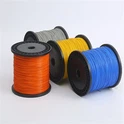
Renewable energy systems have witnessed exponential growth in recent years, driven by the global push towards sustainable energy solutions. As a supplier of XLPE insulated wire, I've often been asked about the suitability of our products in these systems. In this blog, I'll delve into the properties of XLPE insulated electric wire and explore its potential for use in renewable energy applications.
XLPE insulated wires can be used in renewable energy systems. Whether for connecting lines between rooftop photovoltaic panels, power transmission inside wind turbine towers, or cable arrangement in energy storage cabinets, XLPE wires can reliably perform, offering better compatibility and durability compared to many conventional insulated wires.
Some friends might be unfamiliar with XLPE. XLPE stands for cross linked polyethylene, which essentially means an "enhanced upgrade" of regular polyethylene. Through special processes, its molecular chains become more tightly structured, transforming from a "linear" to a "network like" configuration. It's like putting on a sturdy protective suit for the insulation layer of wires, offering significantly better performance than ordinary insulating materials.
Some might wonder, isn't it just about transmitting electricity? Can't ordinary wires suffice? To be honest, they really can't. Those who have worked on renewable energy projects are well aware-these systems operate in far more complex environments than typical indoor setups. Take photovoltaic systems for example: solar panels are either mounted on rooftops or laid out in deserts, enduring constant wind and sun exposure. During summer heatwaves, their surface temperatures can soar above 60°C, while winter lows of minus dozens of degrees Celsius are common. Wind power systems are even more extreme-onshore wind turbines must withstand sandstorms and severe cold, while offshore counterparts face salt corrosion and relentless sea breezes as year round challenges. As for energy storage systems, they require frequent charge discharge cycles with high current fluctuations, placing exceptionally high demands on wire stability.
XLPE insulated cables are specifically designed for these "harsh scenarios." Drawing on our years of experience in supplying products for photovoltaic and wind power projects, let's explore its advantages.
First, let's address the durability concern, as outdoor equipment must be built to last. Ordinary PVC insulated wires tend to degrade and crack after just a few months of outdoor exposure, with potential leakage risks in rainy weather, leading to costly and labor intensive maintenance later. However, the "resilience" of XLPE insulation truly exceeds expectations. It can operate stably at 90°C for extended periods and even withstand occasional extreme heat up to 140°C. Even when solar panels heat up in summer, the wires can still transmit electricity normally while pressed against the edges.
There is no need to worry about low temperature environments either. Even in winter with temperatures as low as minus 30 to 40 degrees, it won't become brittle or break. Moreover, it has strong resistance to UV rays and corrosion. Photovoltaic power stations are exposed to sunlight year round, and the XLPE insulation layer can effectively resist UV degradation. The salt spray in offshore wind farms and even the acidic or alkaline environments in some chemical industrial areas won't cause damage, significantly reducing the hassle of future wire replacements.
In addition to its durability, it also boasts outstanding energy saving effects. The core of renewable energy lies in "efficient utilization." If the power cables themselves consume excessive electricity, the generated power would be wasted, making it highly inefficient. XLPE insulation material has a very low dielectric constant, approximately 2.3. In simple terms, it means "not consuming electricity" during power transmission, maximizing the delivery of generated electricity to where it's needed and minimizing losses during the process.


And its insulation performance is particularly good, not easily broken down, and can effectively prevent current leakage. Whether it is the commonly used 1500V high voltage transmission in photovoltaic systems or the repeated charging and discharging of energy storage systems, power stability can be ensured without short circuits or leakage. This is also the key to our XLPE insulated wires successfully passing international certifications such as UL and CUL.
Another thing is that it is particularly worry free during construction. Those who have worked on projects know that the wiring scenarios for renewable energy are particularly complex. The gaps between photovoltaic panel supports, narrow spaces inside wind power towers, and dense wiring inside energy storage cabinets all require flexible bending of wires. XLPE insulated wires have a very soft texture and are much lighter than ordinary insulated wires. Workers can easily bend them for high altitude wiring and narrow space operations without requiring much effort, which can greatly improve construction efficiency.
And its mechanical strength is also good. If accidentally touched or rubbed during construction, it is not easily damaged, which can reduce the risk of faults during construction. What's even more rare is that it doesn't contain halogen, has low smoke, and even in case of unexpected situations, it won't produce toxic gases, which perfectly fits the concept of "green and environmentally friendly" renewable energy. This is also one of the reasons why we recommend customers to choose it first.
Many people believe that as long as it is XLPE insulated wire, it can be used in renewable energy systems. Actually, it's not like that. XLPE wires used in renewable energy systems have specific standard requirements. For example, photovoltaic systems must comply with specialized standards such as UL 4703 and TUV 2-PFG-1940, and the voltage level must also be matched with the system. It is best to choose high purity oxygen free copper conductors to ensure long term stable operation. If you randomly choose an XLPE wire, it is easy to encounter faults in the later stage, which can delay project progress and increase costs.
In fact, it's quite simple to summarize. XLPE insulated wires can not only be used in renewable energy systems, but also are a cost-effective and high-performance choice. With the increasing popularity of the photovoltaic, wind power, and energy storage industries, choosing a durable, efficient, and safe wire can reduce many maintenance troubles in the later stage and make project operation more worry free.
If you are working on a renewable energy project and unsure which specification of XLPE insulated wire is more suitable, or if you want to learn more about practical usage details, feel free to contact us anytime. As a supplier for many years, we not only provide high-quality products, but also offer practical advice based on our project experience, accompanying everyone to do a good job in the project.