In the realm of electrical conductors, the question of whether single core copper wire is more efficient than other conductors is a topic that has intrigued electrical engineers, installers, and industry enthusiasts alike. As a supplier of single core wire, I am uniquely positioned to delve into this subject and provide insights based on scientific principles and real world applications.
I have been working in the wire and cable industry for many years and have been exposed to cable selection in various scenarios. To be honest, single core wire is not suitable for all scenarios, but if it is commonly used in home decoration, engineering fixed wiring, or static wiring of industrial equipment, its function is indeed much better than aluminum conductors and multi strand thin copper wire conductors. It conducts electricity quickly, lasts long enough, is easy to install, and even saves a lot of money in the long run. After all, in engineering and material selection, the goal is to be worry free, durable, and not rework.
Perhaps some friends are not very familiar with single core wire. In other words, it is a complete copper conductor without the thin copper wires twisted together. Most of the wires buried in the walls of our homes and fixed to equipment in factories are like this.
Our core requirement for selecting conductors is actually very simple: whether the electrical energy can run smoothly and not be wasted. The conductivity of copper itself is much stronger than that of aluminum, which is an advantage of the material itself and cannot be compared. Single core wire, on the other hand, is a complete conductor without the dense gaps between multiple strands of copper wire. When current passes through, it experiences much less resistance, just like walking. A wide and flat road is definitely easier to walk than several small roads pieced together, and the traffic efficiency is much higher.
Besides conductivity efficiency, what people are most concerned about is probably the service life. Whether it's home decoration, engineering, or industrial equipment, most cables are buried in the dark or fixed on the equipment. Once there is a problem, it is costly and laborious to repair, and sometimes work has to be stopped, resulting in greater losses. In terms of service life, single core copper electric wire is really beyond words, it can be considered the "durable old buddy" I have seen before.
Single core electric wire is a monolithic structure with no gaps on the surface. Moisture, dust, and some corrosive gases in the air are difficult to penetrate. Unlike multi stranded copper conductors, the gaps between thin copper wires are particularly prone to dirt and grime accumulation. Over time, the copper wires will oxidize, rust, and in severe cases, they may even break; Aluminum conductors are not to mention, they are particularly prone to oxidation, forming a layer of aluminum oxide, and their conductivity will deteriorate. After a few years of use, there may be hidden dangers of circuit aging and short circuits, which is particularly troublesome.


Our IRONFLON single core copper wire, combined with high-quality insulation materials such as PFA, can withstand temperatures ranging from -60 ℃ to+250 ℃ according to the actual usage scenarios of our customers. Even in harsh environments with high humidity and temperature, it can work stably. Based on my experience, its service life is 3-5 times longer than that of ordinary aluminum conductors.
Moreover, single core copper electric wire has high mechanical strength, moderate hardness, and strong tensile strength. When buried in walls or pipes, it is not easy to break or scratch even with a slight pull; When wiring, the connection with the terminals is also very firm, unlike multi stranded copper conductors, which require additional crimping or tinning treatment, which is not only troublesome but also prone to leaving wiring hazards.
Many customers choose conductors, and at first glance, they will look at the unit price, thinking that single core copper electric wire is more expensive than aluminum conductors, so they feel that it is not cost-effective. In fact, when choosing a conductor, one cannot only consider the unit price, but also the long-term comprehensive cost. The installation and maintenance costs of single core copper wires are much lower than other conductors, and in the long run, it is actually more cost-effective.
Let's talk about installation. Single core copper wire has moderate hardness, and the wiring is particularly neat and beautiful. Whether it is wall buried pipes or ceiling wiring, it is very convenient and does not require complex tools. The construction efficiency of workers is also high, which can save a lot of labor costs. On the other hand, multi stranded copper conductors are relatively soft and prone to deformation. When wiring, they also need to be paired with cable trays and trunking, otherwise they will appear disorganized and increase installation costs invisibly; Aluminum conductors are brittle and prone to breakage. During construction, workers need to be extra careful as even a slight negligence can result in rework, which can be even more costly.
In terms of maintenance, single core copper electric wire has a long service life. As long as the selection is appropriate and the installation is standardized, there is basically no need for much maintenance in the later stage, saving a lot of trouble in inspection and replacement; Aluminum conductors are prone to aging and oxidation, while multi stranded copper conductors are prone to breakage and poor contact, requiring frequent inspection and replacement in the later stages, and maintenance costs are not low at all.
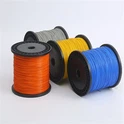
Moreover, IRONFLON can also provide customized services, customizing single core copper wires of different diameters and colors according to customers' actual scenarios, with specifications ranging from AWG30 to 10. We can also provide free samples for customers to try before placing an order, further reducing selection risks.
Of course, I won't exaggerate the advantages of single core electric wire, as it also has "not good at" scenarios. For example, devices that require frequent bending and movement, such as vacuum cleaners and portable instruments, are more suitable for using multi stranded copper conductors because multi stranded copper conductors are softer and less likely to break even after repeated bending; But for scenarios such as buried walls in home decoration, fixed wiring of industrial equipment, and high-voltage lines that are "fixed and immovable", single core electric wire is definitely the optimal solution.
As a supplier of Zhejiang IRONFLON Wire&Cable, we have been deeply involved in the cable industry for many years. Whether you need single core copper wire or other types of cables for home decoration, engineering, or industrial production, we can provide cost-effective products and professional selection advice. We can also provide customized services to meet your personalized needs. If you have any further questions, such as "What diameter of single core copper electric wire should I choose for my home decoration?" or "Can single core copper electric wire be used in industrial high-voltage scenarios?", please feel free to contact me and I will answer them for you as soon as possible.