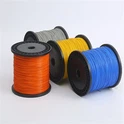
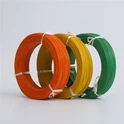
As a supplier of UL1508 tin plated ETFE insulated wire, I often get asked about the surface resistivity of the ETFE insulation in our UL1508 wire. So, I thought I'd write a blog post to share some insights on this topic.
First off, let's talk about what surface resistivity actually means. Surface resistivity is a measure of how well a material resists the flow of electric current across its surface. It's usually expressed in ohms per square (Ω/sq). The surface resistivity of ETFE insulation is crucial as it helps determine the ability of the wire to prevent leakage and maintain proper insulation.
Why Surface Resistivity Matters in UL1508 Tin Plated ETFE Insulated Wire
In electrical applications, especially those that require high reliability and safety, having the right surface resistivity in the insulation is super important. For our UL1508 wire, the ETFE insulation with appropriate surface resistivity ensures that the wire can handle electrical currents without any unwanted electrical discharges or short circuits.
Imagine you're using our wire in a complex electrical system, like in an industrial control panel or a high tech electronic device. If the surface resistivity of the ETFE insulation is too low, there's a risk of electrical leakage, which can lead to malfunctions, equipment damage, and even safety hazards. On the other hand, if it's too high, it might affect the overall electrical performance of the system in some cases.
Factors Affecting the Surface Resistivity of ETFE Insulation
Temperature: Temperature plays a big role. Generally, as the temperature increases, the surface resistivity of ETFE insulation tends to decrease. This is because higher temperatures provide more energy to the electrons in the material, making them more mobile and thus increasing the conductivity across the surface.
Humidity: Humidity can also have an impact. When the environment is more humid, moisture can accumulate on the surface of the insulation. Water can act as a conductor, reducing the surface resistivity.
Contamination: Any contaminants on the surface of the ETFE insulation can change its surface resistivity. Dust, dirt, or chemical residues can create conductive paths on the surface, lowering the resistance.
Measuring the Surface Resistivity of ETFE Insulation in UL1508 Wire
To measure the surface resistivity of the ETFE insulation in our UL1508 wire, we use specialized equipment. There are two main methods: the four point probe method and the two point probe method.
The four point probe method is more accurate and is commonly used in laboratory settings. It involves using four metal probes in contact with the surface of the insulation. A current is passed through the outer two probes, and the voltage is measured between the inner two probes. From these measurements, we can calculate the surface resistivity.
The two point probe method is simpler but less accurate. It uses just two probes to measure the resistance directly across the surface. This method is often used for quick checks during production.
How Our UL1508 Wire Compares
When it comes to surface resistivity, our UL1508 wire is top notch. We've optimized the manufacturing process to ensure that the ETFE insulation has the right surface resistivity for a wide range of applications.
Compared to other types of insulation materials, ETFE offers excellent surface resistivity characteristics. It has a high initial surface resistivity, which can withstand a wide range of operating conditions. And even under some challenging environmental factors like temperature fluctuations and moderate humidity, our wire can maintain relatively stable surface resistivity.


Applications of UL1508 Wire
In the aerospace industry, the high surface resistivity of the ETFE insulation makes our wire suitable for use in avionics systems, where reliability and safety are of utmost importance.
The automotive industry also uses our wire in electric vehicle components. The stable surface resistivity of the ETFE insulation helps in the efficient transfer of electrical power and prevents electrical interference.
In home appliances, our Household Electrical Wire provides a safe and reliable electrical connection. The proper surface resistivity ensures that there's no electrical leakage, keeping the users safe.
Other Related Products in Our Portfolio
We also offer other great products related to ETFE insulated wire. For example, our UL1508 Insulated Power Wire is designed for high power applications. It has the same high quality ETFE insulation with well controlled surface resistivity.
Our ETFE Wire Insulation is available for those who want to customize their own wire solutions. We can provide the insulation material with the desired surface resistivity characteristics.
If you're looking for a single core power cable, our product is a great choice. It offers excellent electrical performance thanks to the proper surface resistivity of the ETFE insulation.
If you're in the market for high quality UL1508 tin plated ETFE insulated wire or any of our other related products, I'd love to have a chat with you. Whether you're working on a small DIY project or a large scale industrial application, we've got the right wire for you.