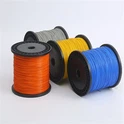
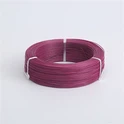
As a supplier of Zhejiang IRONFLON Wire&Cable, we receive various inquiries from customers every day, and the most commonly asked question is whether our UL1558 tinned ETFE insulated wire can be used underwater. After all, everyone knows that the underwater environment is high in salt, high in voltage, and humid all year round, coupled with invisible corrosion and marine life invasion, which has very high requirements for wires and cables.
The customer is afraid of choosing the wrong line, and the later maintenance will be costly and laborious, which will also delay the progress of the entire project. Today, let's talk about this issue. UL1558 tinned ETFE insulated wire is fully compatible with underwater applications, and its performance can exceed expectations in many underwater scenarios. Of course, it cannot be directly used in all situations. The specific requirements still depend on the project, such as the depth of the seabed, whether it is used for communication, monitoring, or power supply, and whether it is possible to withstand strong mechanical impacts, all of which will affect its adaptability.
Everyone will surely be curious, how can this cable withstand the harsh test of the underwater world? Let's talk slowly, in fact, it just happens to be able to deal with the most core problems of the underwater environment. The most headache inducing problem at the bottom of the sea is the corrosion caused by high salt environments. The salt in seawater is soaked for a long time, and the conductors and insulation layers of ordinary wires will soon be corroded, either leaking or disconnecting, which is particularly troublesome. But our UL1558 wire is very well done in terms of corrosion resistance.
Its conductor is made of tin plated copper, and the tin layer can firmly isolate seawater and salt spray, preventing copper conductors from oxidizing and rusting, greatly extending their service life. The insulation layer is made of ETFE material, which is commonly known as ethylene tetrafluoroethylene copolymer. This material itself is particularly resistant to chemical corrosion, not to mention seawater. Even when encountering some acidic, alkaline substances, fuels or oil stains on the seabed, it can maintain stable performance without aging or cracking.
In addition to corrosion resistance, the high-pressure environment of the seabed also needs to be withstood. If the insulation layer of the wire has insufficient compressive strength, it is easily crushed on the seabed, leading to a short circuit. The insulation layer thickness of UL1558 has been precisely designed, coupled with the mechanical strength of ETFE material itself, it can withstand conventional seabed pressures of tens to hundreds of meters.
Moreover, it is produced according to UL standards and has undergone strict withstand voltage testing. Its electrical insulation and dielectric properties are excellent, effectively preventing issues such as leakage and insulation breakdown. Whether it is power transmission or signal transmission, it can maintain stability.
Waterproof and moisture-proof are not to mention. The seabed is humid all year round, and ordinary wires are prone to insulation moisture and decreased conductivity. However, the sealing of ETFE insulation layer is particularly strong, which can achieve complete waterproof and moisture-proof. Even if immersed in seawater for a long time, the insulation performance will not be affected.
In addition, it also has several small advantages that are particularly practical. For example, it is resistant to high temperatures and can reach a rated temperature of 125 ℃. Even if there are hot springs on the seabed or if the equipment dissipates heat during operation, it can still work normally; The flame retardancy also meets the standard, which can effectively prevent the spread of fire in case of unexpected situations, and the safety is more guaranteed.
And its processing performance is very good, adapted to different underwater wiring needs, and also meets ROHS/REACH environmental standards. It has low smoke and no harmful substances, and will not cause pollution to the marine environment, which is also very important.


Of course, not all underwater scenes can use it. We don't need to deliberately classify it, just talk about the most common and suitable situations. The wiring of monitoring equipment in shallow waters is very suitable, such as water quality monitoring instruments, hydrological sensors, marine biological monitoring equipment, etc. They do not need to withstand extremely deep pressure and require stable signal transmission. The waterproof, corrosion-resistant, and electrical performance of this wire can just meet the requirements, and the wire body is lightweight, making wiring more convenient.
The power supply lines for small underwater devices can also be used, such as underwater cameras, small submersible markers, underwater LED lights, etc. The power is not large and the current carrying capacity requirements for the wires are moderate. This wire has multiple specifications of 16-30AWG, which can match different power supply needs and will not experience performance degradation even after long-term immersion.
It is also suitable for nearshore underwater communication and signal transmission lines, such as monitoring signals and data transmission lines for docks and nearshore aquaculture areas. It has low dielectric loss, which can reduce the loss during signal transmission, ensure stable communication, and is resistant to salt spray and corrosion, making it suitable for complex coastal environments.
There are also auxiliary lines for submarine cables and internal wiring of equipment (as long as the conductor temperature does not exceed 125 ℃), which are very reliable and can reduce maintenance costs in the later stage. Moreover, the quality is guaranteed by UL758, UL1581 and other standards, so there is no need to worry too much.
But if it is a deep sea (such as over 1000 meters), a scene with strong mechanical impact (such as underwater drilling, large ship anchoring areas), or a high-voltage submarine cable backbone, it is recommended to use a dedicated armor layer and protective cover. You can also consult us directly to customize a more suitable solution for the scene. After all, the underwater environment is complex, and with more caution, you can avoid later troubles.
Even if the wire itself is suitable for underwater applications, some small details during use and installation can still affect its service life. When installing, it is necessary to seal the joints and interfaces properly. Although the ETFE insulation layer is waterproof, the joints are weak links where seawater can easily penetrate and cause short circuits. It is recommended to use specialized underwater sealing joints to ensure the sealing effect.
When wiring, try to avoid rocks and sharp objects to prevent the wires from being scratched or squeezed. The underwater environment is complex, and once the insulation layer is damaged, seawater infiltration will affect its use.
Finally, to summarize briefly, UL1558 tinned ETFE insulated wire is indeed suitable for most conventional underwater scenarios, especially shallow water monitoring, small equipment power supply, and nearshore communication. Its advantages such as corrosion resistance, waterproofing, high voltage resistance, and stable electrical performance can perfectly adapt to the harsh environment of the seabed, and it has high cost-effectiveness and easy installation, which can help you reduce project costs and maintenance pressure in the later stage.
As a supplier of Zhejiang IRONFLON Wire&Cable, our UL1558 tinned ETFE insulated wires are made of high-quality tinned copper conductors and ETFE insulation materials, produced strictly in accordance with UL standards, and each batch of products undergoes rigorous testing. Moreover, it supports customized specifications, colors, and packaging methods as needed to meet the personalized needs of different customers.
If your project happens to require submarine cabling and you are unsure if this cable is fully compatible, or if you would like to know more detailed specifications and customized solutions, feel free to contact us at any time. Our professional technical team provides one-on-one answers for you, helping you avoid all pitfalls and select the most suitable wires, making your underwater projects more worry free and reliable.