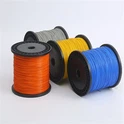
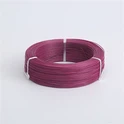
As a supplier of UL10064 tin plated FEP insulated wire, I often get asked about the salt spray resistance of this product. So, let's dive right in and explore what it means and why it matters.
Salt spray resistance refers to a material's ability to withstand the corrosive effects of saltwater or salt laden air. In a salt spray test, the wire is exposed to a mist of saltwater in a controlled environment for a specific period. This simulates the harsh conditions the wire might face in real world applications, like in coastal areas or marine environments.
Let me first introduce our company's UL10064 tinned FEP insulated wire. The conductor is made of high-purity tinned copper, available in sizes from 40AWG to 10AWG, with options for single or stranded configurations. The insulation material is FEP, commonly known as fluorinated ethylene propylene copolymer, which feels smooth and dense, offering excellent temperature resistance and corrosion resistance. Rated at 30V, it can withstand temperature ranges from -40°C to 105°C and features VW-1 flame retardancy. It is well-suited for use in instruments, home appliances, internal wiring, and sensor leads, particularly in coastal and humid environments where it serves as a targeted choice.
Some friends may not have a clear sense of the destructive power of salt spray, thinking it's just a bit more humid and salty by the seaside. However, this is far from the truth. The chloride ions in salt spray are like "invisible killers" to electrical wires. A client of our company once used ordinary PVC electronic cables for connecting lines in photovoltaic inverters by the seaside. Within less than half a year, the insulation layer of the wires began to become brittle and crack. Upon inspection, the copper conductors inside had developed green corrosion, causing resistance to skyrocket. The equipment frequently shut down, and the cost of rework later was several times higher than it would have been had the right cables been chosen from the start.
This situation essentially means that ordinary wires cannot withstand salt spray corrosion. Chloride ions can penetrate the tiny pores of regular insulation layers, directly corroding the copper conductors and gradually causing strand breakage. They also accelerate the aging and peeling of common insulation materials like PVC and PE, rendering them ineffective in protection. Consequently, issues such as leakage and short circuits are inevitable, leading to exorbitantly high overseas after-sales costs. Therefore, for coastal or high-humidity environments, the salt spray resistance of wires is not merely an optional bonus-it is a mandatory, non-negotiable performance standard.
The UL10064 model we have can withstand salt spray, thanks to the dual protection of tin-plated copper conductors and FEP insulation. In simpler terms, it's like giving the wire two layers of "armor," each precisely addressing the pain points of corrosion.
Let's start with tin-plated copper conductors. Ordinary bare copper will rust and develop verdigris in salt spray in no time, leading to increasingly poor conductivity. However, the high-purity tin-plated copper we use features an even and dense tin layer, acting like a tight "anti-corrosion coat" for the copper conductor. Tin's stable chemical properties effectively block direct contact between chloride ions and the copper conductor, eliminating electrochemical corrosion at its root.


Let's talk about the FEP insulation layer again. The molecular structure of FEP is particularly dense, and whether it's acid, alkali, salt spray, or organic solvents, they can't penetrate into it. Its surface is particularly smooth, with a water absorption rate of less than 0.01%. Salt spray cannot adhere to it at all, and even if it is in a humid environment for a long time, it will not be affected by moisture or leakage.
More practically, it also has strong resistance to high and low temperatures. It will not crack at low temperatures of -40 ℃ and can work stably at high temperatures of 105 ℃. Even if there are large temperature differences in the environment, the insulation layer will not crack or become brittle, and its anti-corrosion performance can always be online.
Overall, the salt spray resistance of UL10064 tinned FEP insulated wires is definitely among the top tier in the same specification of electronic wires. With dual protection, it can withstand salt spray corrosion while also being resistant to high temperatures and aging. It is stable and will not overturn during long-term use, especially for overseas projects and harsh working conditions. Choosing it can save a lot of worry.
We at Zhejiang IRONFLON have been focusing on fluoroplastic high-temperature wires for many years. We have stock of UL10064 full specifications, from 40AWG to 10AWG, and support customized colors and printing. We can provide salt spray test reports and UL certification certificates, ensuring worry free export. If you are working on coastal projects, export orders, or concerned about equipment issues due to salt spray over time, choosing UL10064 is definitely the right choice. If you need samples or parameter tables, just send us a private message anytime.