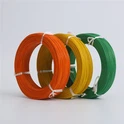
Hey there! As a supplier of UL1558 tin plated ETFE insulated wire, I often get asked about its chemical resistance. So, I thought I'd take a moment to share some insights on this topic.
First off, let's talk a bit about what UL1558 tin plated ETFE insulated wire is. ETFE, or ethylene tetrafluoroethylene, is a fluoropolymer known for its excellent electrical properties, high heat resistance, and good mechanical strength. The tin plating on the wire provides additional protection against corrosion and enhances its solderability. UL1558 is a standard set by Underwriters Laboratories, which ensures that the wire meets specific safety and performance requirements.
Now, let's get to the main question: does UL1558 tin plated ETFE insulated wire have good chemical resistance? The short answer is yes, it does. ETFE has a unique chemical structure that gives it a high degree of resistance to a wide range of chemicals. This includes acids, bases, solvents, and many other types of corrosive substances.
One of the key factors contributing to ETFE's chemical resistance is its low surface energy. This means that chemicals have a hard time adhering to the surface of the wire, reducing the risk of chemical attack. Additionally, the strong carbon-fluorine bonds in ETFE are very stable, making it difficult for chemicals to break them down.
In practical applications, this chemical resistance makes UL1558 tin plated ETFE insulated wire ideal for use in harsh environments where exposure to chemicals is likely. For example, it can be used in chemical processing plants, laboratories, and industrial settings where chemicals are handled regularly. It can also be used in outdoor applications where the wire may be exposed to environmental pollutants or other corrosive substances.
Let's take a closer look at some specific types of chemicals and how UL1558 tin plated ETFE insulated wire performs against them.
Acids: ETFE is highly resistant to most inorganic and organic acids. It can withstand exposure to strong acids such as sulfuric acid, hydrochloric acid, and nitric acid without significant degradation. This makes it suitable for use in applications where acid resistance is critical, such as in the production of chemicals or in acid storage facilities.
Bases: Similar to acids, ETFE also has good resistance to bases. It can handle exposure to strong bases like sodium hydroxide and potassium hydroxide without being affected. This makes it useful in applications where alkaline environments are present, such as in the pulp and paper industry or in water treatment plants.
Solvents: ETFE is resistant to a wide range of solvents, including alcohols, ketones, esters, and hydrocarbons. It can maintain its integrity even when exposed to these solvents for extended periods of time. This makes it a great choice for applications where solvents are used, such as in the printing, coating, and adhesive industries.
However, it's important to note that while UL1558 tin plated ETFE insulated wire has excellent chemical resistance, there are some chemicals that can still pose a challenge. For example, some highly reactive or aggressive chemicals may be able to penetrate the ETFE insulation over time. In such cases, it's important to carefully evaluate the specific chemical and its concentration, as well as the duration of exposure, to determine if the wire is suitable for the application.
Another thing to consider is the temperature. Chemical reactions are often accelerated at higher temperatures, so the chemical resistance of UL1558 tin plated ETFE insulated wire may be reduced in high-temperature environments. It's important to refer to the manufacturer's specifications to determine the maximum temperature at which the wire can maintain its chemical resistance.


When compared to other types of insulated wires, UL1558 tin plated ETFE insulated wire really stands out in terms of chemical resistance. For instance, silicone insulated copper wire has good flexibility and heat resistance, but its chemical resistance is not as good as that of ETFE. Similarly, UL10086 Teflon wire is also a high-performance wire, but ETFE offers a more cost-effective solution with comparable chemical resistance in many applications. And if you're looking for high heat resistant wire, UL1558 tin plated ETFE insulated wire combines both high heat resistance and excellent chemical resistance.
In conclusion, UL1558 tin plated ETFE insulated wire is a great choice when you need a wire with good chemical resistance. Its unique properties make it suitable for a wide range of applications in harsh environments. Whether you're working in the chemical industry, the laboratory, or any other field where chemical exposure is a concern, this wire can provide reliable performance.
If you're interested in purchasing UL1558 tin plated ETFE insulated wire for your project, feel free to reach out to us. We'd be happy to discuss your specific requirements and help you find the right solution. Our team of experts can provide you with detailed information about the wire's properties, performance, and pricing. So, don't hesitate to get in touch and start a conversation about how our UL1558 tin plated ETFE insulated wire can meet your needs.
References:
- "Fluoropolymers: Chemistry and Applications" by John Scheirs
- Manufacturer's technical data sheets on UL1558 tin plated ETFE insulated wire