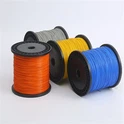
Hey there! As a supplier of UL1886 tin plated FEP insulated wire, I often get asked loads of questions about the features and properties of this wire. One question that comes up quite a lot is, "Does UL1886 tin plated FEP insulated wire have a self - extinguishing property?" Let's dig deep into this topic and find out.
FEP insulation material, naturally possessing a "self extinguishing gene"
The insulation layer of UL1886 wire is made of FEP material. Some friends may not be familiar with FEP, but it is actually a "top student" of the fluoroplastic family, and is "related" to PTFE (Teflon) that we are familiar with. However, in wire applications, it is more flexible and adaptable.
The core reason why FEP can have self extinguishing properties is its molecular structure, which contains a large number of carbon fluorine bonds (C-F bonds). The bond energy of these chemical bonds is particularly high, about 485 kJ/mol, which is much stronger than the C-H and C-C bonds of ordinary plastics. This means that it requires extremely high temperatures to be destroyed and ignite, and even if ignited, the heat released during combustion is minimal, which is simply not enough to sustain sustained combustion.
Even more impressive is that FEP does not produce a large amount of flammable gases and molten droplets like PVC and ordinary polyethylene during combustion, but instead decomposes into fluorine radicals. These fluorine radicals can "capture" key hydrogen and hydroxyl radicals during the combustion process, directly interrupting the chain reaction of combustion, equivalent to "cutting off" the fire source and achieving rapid self extinguishing.
For example, if you ignite the insulation layer of UL1886 wire with a lighter, you will find that as long as you release the lighter, the flame will quickly extinguish within 10 seconds, and the insulation layer will not drip, continue to smoke, or ignite the paper or fabric next to it - this is the self extinguishing property of FEP material, a natural "safety player".
In addition, FEP material has an advantage: its self extinguishing property is "innate" and does not require additional flame retardants. The flame retardancy of many ordinary wires is achieved by adding flame retardants, which may not only affect other properties of the wires, but also may not comply with environmental standards such as ROHS and REACH. UL1886 tin plated FEP insulated wire, on the other hand, does not require the addition of any flame retardants, which can achieve high self extinguishing standards and meet environmental requirements, killing two birds with one stone.
UL1886 standard, welding the self extinguishing property above the safety line
Having good materials alone is not enough. The UL1886 standard provides a "mandatory insurance" for the self extinguishing and safety of wires. Wires that can pass UL1886 certification must undergo a series of rigorous tests, including a specialized self extinguishing test - UL VW-1 vertical burning test.
Someone may ask, 'What is VW-1 testing?'? Is it reliable? "Here is a brief breakdown of this test for everyone. Don't remember the complex process, just focus on the qualification criteria:
- Testing method : Suspend the wire vertically, burn it with a dedicated blowtorch (flame height 125mm, thermal power 500W) for 15 seconds, and then stop burning for 15 seconds. Repeat this process 5 times to simulate extreme scenarios where the wire encounters an open flame, the flame extinguishes, and encounters another open flame;
- Qualified standard (also mandatory for UL1886 wires) : ① After each combustion, the residual flame cannot exceed 60 seconds; ② The wire burn should not exceed 25%; ③ There will be no dripping during combustion, and even a small amount of dripping cannot ignite the degreased cotton below (simulating other objects in actual scenarios); ④ After 5 burns, the wire can still maintain its basic performance without breaking or short circuiting.
Our UL1886 tinned FEP insulated wire not only easily passes this test, but also performs better than the standard in many cases - for example, the residual flame time can be controlled within 30 seconds, there are no drips, and the burn rate is much lower than 25%.
In addition, the UL1886 standard also has strict requirements for the rated temperature, rated voltage, and conductor material of wires: rated temperature resistance of 150 ℃, rated voltage resistance of 300V, and the conductor is made of tin plated copper, which can ensure conductivity and prevent oxidation, and is suitable for more complex scenarios. These requirements combined with self extinguishing properties make UL1886 tin plated FEP insulated wire a "fully safe" wire.
Tin plating process takes safety to the next level
Some friends may wonder, "Is there a relationship between tin plating and self extinguishing?" Although tin plating is mainly used to improve the oxidation resistance and conductivity of conductors, it can indirectly assist in enhancing the overall safety of wires, which can be considered a "hidden bonus point".
Firstly, tin plated copper conductors have stronger oxidation resistance, and long-term use will not rust or oxidize, which can avoid poor contact and thermal overload caused by conductor oxidation - and thermal overload is one of the common causes of wire fires. Reducing the risk of fire from the source is equivalent to providing assistance to self extinguishing.
Secondly, the tin plating process can improve the welding performance of wires. Whether used for internal wiring of household appliances, industrial equipment, or aerospace equipment, it can ensure firm welding, reduce virtual welding and desoldering, and avoid electric sparks caused by poor contact, which can lead to fires.
Simply put, although the tin plating process does not directly determine self extinguishing properties, it can reduce the "triggering factors" of wire fires, and when combined with the self extinguishing properties of FEP insulation, form a "dual protection" that ensures the safety performance of wires.
How important is self extinguishing in different scenarios?
1. Household appliance export scenarios (most common)
Whether it's a coffee machine, oven, microwave, refrigerator, or air conditioner, the internal wiring of these appliances requires high safety wires. Foreign safety certifications for household appliances, such as UL certification in North America and CE certification in Europe, explicitly require that wires must have self extinguishing properties.
For example, if the internal wires of a household appliance accidentally short circuit and heat up, igniting the insulation layer, and the wires do not have self extinguishing properties, the flame will continue to burn, not only burning the household appliance itself, but also possibly causing a home fire, with unimaginable consequences. And UL1886 tin plated FEP insulated wire, even if ignited, can quickly self extinguish, prevent the spread of fire, and protect both household appliances and users' personal and property safety.
2. Industrial equipment scenarios (high-risk)
In industrial workshops, chemical plants, new energy power plants (photovoltaic, wind power) and other scenarios, wires need to work in environments with high temperature, humidity, and corrosive gases. Moreover, equipment power is high, wire loads are high, and the risk of fire is much higher than in ordinary scenarios.
For example, in a chemical plant, there may be flammable and explosive gases and liquids in the workshop. Once a wire catches fire, if it cannot quickly extinguish itself, it is likely to cause an explosion or fire, resulting in huge economic losses and casualties. UL1886 tin plated FEP insulated wire not only has excellent self extinguishing performance, but also has excellent chemical corrosion resistance, which can resist the erosion of acid, alkali, oil, and organic solvents, and will not cause insulation layer damage, short circuit, or fire due to corrosion.
In addition, the conductor of this wire is tin plated copper, which has stable conductivity and can withstand large currents, making it suitable for high load requirements of industrial equipment; Moreover, the FEP insulation layer has good dielectric properties, low dielectric constant, and low dielectric loss, making it suitable for high-frequency signal transmission. Even in complex industrial environments, it can ensure the normal operation of equipment without signal interference, short circuits, and other problems.
3. Aerospace and medical equipment scenarios (extremely high requirements)
In fields such as aerospace and medical equipment, the requirements for the safety performance and stability of wires have reached a "stringent" level, and self extinguishing is an essential condition.
For example, the wires on airplanes and satellites need to work in extreme environments of high altitude, high temperature, and low pressure. Once the wires catch fire, the flames will quickly spread in a closed space and cannot be extinguished in a timely manner, resulting in unimaginable consequences. The self extinguishing property of UL1886 tin plated FEP insulated wire can quickly "extinguish the fire" after the open flame is extinguished, without producing toxic gases and smoke, avoiding secondary damage to equipment and personnel - it should be noted that FEP material burns with very little smoke and does not release highly toxic hydrogen halide gases like PVC, which is particularly important in enclosed spaces.
The internal wiring of medical equipment, such as surgical instruments and monitors, not only requires self extinguishing and safety of wires, but also environmental protection, no odor, and no toxic substances. UL1886 tin plated FEP insulated wire complies with ROHS and REACH environmental standards, and FEP material has good biocompatibility, which will not cause harm to the human body and fully meets the requirements of medical equipment.


By now, I believe everyone has understood that UL1886 tin plated FEP insulated wire not only has excellent self extinguishing properties, but also has outstanding comprehensive performance. Finally, summarize its core advantages in three sentences:
- 1. Safe and secure : Equipped with FEP material and self extinguishing genes, it has passed UL VW-1 strict testing. It extinguishes when the open flame leaves without dripping or toxic smoke, eliminating fire hazards from the source and complying with all mainstream safety standards abroad;
- 2. Strong comprehensive performance : high temperature resistance, low temperature resistance, chemical corrosion resistance, stable conductivity, suitable for various scenarios such as home appliances, industry, aerospace, medical, etc., long service life, no need for frequent replacement, helping customers save costs;
- 3. More worry free export : UL1886 certification+ROHS, REACH environmental certification, no need for additional customization, directly adapted to the standards of multiple countries and regions around the world, saving certification trouble and speeding up the export process.
If you're interested in learning more about our products or are ready to make a purchase, don't hesitate to reach out. We're open to having discussions about your project requirements and how our UL1886 tin plated FEP insulated wire can fit in. Let's start a conversation and see how we can work together to meet your wiring needs.
References
- Electrical Insulation Handbook, CRC Press
- Fluoropolymers: Properties, Applications, and Markets, Wiley - Blackwell