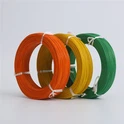
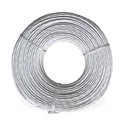
Hey there! As a supplier of UL1516 tin plated ETFE insulated wire, I've had my fair share of questions about how the tin plating on this wire impacts its performance. So, let's dive right in and explore this topic in detail.
First, let's understand: What is UL1516 cable? What is tin plating layer?
UL1516 : It belongs to the UL758 electronic wire system, with commonly used ETFE insulation, temperature resistance of -40 ℃~+105 ℃, oil resistance, acid and alkali resistance, flame retardancy, suitable for scenarios with high reliability requirements such as aviation, industrial control, instruments, motors, transformers, etc.
Tin plating layer : On the surface of pure copper conductors, a layer of micrometer sized metallic tin is covered by electroplating/hot-dip coating, with a thickness of usually 1-5 μ m, which appears bright silver/matte silver to the naked eye.
You can understand it as:
Copper is responsible for conductivity, while tin is responsible for protection and stability.
Without this layer of tin, UL1516 is just a "regular copper wire"; With this layer of tin, it is the industrial grade wire that is long-term stable, resistant to harsh environments, easy to process, and easy to maintain.
Conductivity: not 'more conductive', but 'more stable in the long run'
Many customers' first reaction is that tin's conductivity is not as good as copper. Will tin plating make the conductivity worse?
The answer is simple: DC has minimal impact and significantly improves long-term stability.
1. DC resistance: almost negligible
- Pure copper conductivity ≈ 100% IACS;
- The conductivity remains at 94%~97% IACS after tin plating;
- The coating is only a few microns, which has almost no impact on low voltage, low current, and equipment wiring;
2. True value: preventing oxidation from causing an increase in resistance
Copper fears two things the most: air and moisture.
- Exposure of bare copper for a period of time results in the formation of copper oxide/copper green on the surface;
- These substances are "poor conductors" that can increase contact resistance, heat generation, and signal degradation;
- Tin plating layer=physical barrier, completely separating copper from air/moisture;
3. High frequency scenario: smoother surface and lower loss
High frequency current has a "skin effect", which concentrates on the surface of the conductor.
- Tin plating can fill the micro unevenness of copper surface;
- Make the current distribution more uniform and reduce skin loss by about 5% to 10%;
- More friendly to instrument and signal lines;
Summarize the effect of conductivity in one sentence:
Short term conductivity remains almost unchanged, while long-term conductivity does not drift, rise, or decay.
Corrosion resistance: The key to UL1516's ability to withstand harsh environments
Because the device may be used for:
- Coastal/salt spray environment;
- High temperature and high humidity workshop;
- Industrial sites with oil and chemical gases;
- Internally sealed equipment that is not maintained for a long time;
Three hardcore improvements brought by tin plating:
1. Antioxidant
Bare copper oxidizes and turns black within a few months; Tin plated copper can maintain a bright surface and stable resistance for several years.
2. Salt spray resistance and moisture resistance
According to ASTM B117 salt spray test:
Tin plated conductors can withstand 1000 hours of salt spray with resistance fluctuations of less than 5%, making them very suitable for ships, maritime, outdoor equipment, and coastal factories.
But bare copper quickly experiences corrosion, wire breakage, and poor contact.
3. Chemical corrosion resistance
UL1516 itself is insulated, oil resistant, acid and alkali resistant. Tin plated copper is used to supplement the protection on the conductor side
Oil resistance;
Resistant to weak acids and weak bases;
Resistant to some industrial gases;
Achieve 'insulation resistance and conductor resistance'.
For customers, this directly means:
Fewer malfunctions, fewer shutdowns, fewer on-site replacements, and longer warranty periods.
Welding performance: the favorite "efficiency improvement point" for production lines
Solderability is one of the key factors for customers to decide to repurchase, and the improvement of UL1516 welding by tin plating is very intuitive:
1. Tin plating is faster and smoother
- Tin and solder have similar compositions and excellent wettability;
- No need to scrape the wire vigorously or use strong soldering flux;
- The solder joints are full, bright, and free of virtual soldering;
2. Reduce virtual welding and false welding
Bare copper issue:
- Surface oxidation → solder non stick → virtual soldering → after-sales repair.
Tin plating directly solves:
- Clean and stable surface;
- Weld strength improvement ≈ 30%;
- The first pass yield can reach over 99%;
3. Terminal crimping is more reliable
When crimping:
- The tin layer has a soft texture and fills the gap between the conductor and the terminal;
- Lower and more stable contact resistance;
- Difficult to loosen under repeated insertion and vibration;
For customers:
Faster pace, fewer defects, less rework, and lower labor costs.


Mechanical performance: more resistant to bending, wear, and handling
UL1516 is often used in:
- Drag chain;
- Robot joints;
- Frequent opening and closing of equipment doors;
- Near the motor with high vibration.
Mechanical reliability equals lifespan.
Three mechanical bonus points for tin plating layer
1. Stronger resistance to bending fatigue
Tin has better ductility than copper, can buffer stress, and reduce microcracks in copper wires.
- The dynamic bending life is increased by 2-3 times;
- Repeated bending is not prone to wire breakage or breakage;
2. More wear-resistant and scratch resistant
Coating enhances surface hardness, when installing/threading/moving:
- Reduce copper wire scratches and burrs;
- Protect the insulation from being punctured by copper spikes;
- Reduce the risk of electric leakage and short circuit;
3. Reduce wear between copper wires
Multiple stranded UL1516 wires will rub against each other.
Tin plating has a slight lubricating effect, lower friction, and lower risk of wire breakage.
Simply put:
The same bending, same vibration, and same harsh installation, the tinplate UL1516 is more "durable".
Long term reliability: enabling equipment to be used for a long time with fewer incidents
Customers in Europe, America, Japan, and Southeast Asia generally value 5-year and 10-year long-term reliability.
The role of tin plating in this regard is' invisible but decisive '.
1. Prevent copper migration from damaging insulation
Under high temperature and humidity, copper ions may migrate into the insulation, leading to insulation degradation.
Tin plating can prevent copper migration and protect ETFE insulation from long-term stability.
2. More stable at high temperatures
UL1516 rated at 105 ℃, tin plated copper at high temperature:
- Not easily oxidized quickly;
- Resistance does not float;
- Solder joints do not age or break brittle;
3. Reduce maintenance costs
contrast:
- Bare copper wire : may require inspection and replacement within 2-3 years;
- Tin plated copper wire : 5 years+stable operation;
For device manufacturers:
Less after-sales service, fewer complaints, and higher brand reputation.
If you're interested in learning more about our UL1516 tin plated ETFE insulated wire or any of our other products, don't hesitate to reach out. We're always happy to have a chat and discuss your specific needs. Whether you're working on a small DIY project or a large - scale industrial application, we've got the right wire for you. So, let's start a conversation and see how we can help you with your electrical wiring requirements.
References
- Electrical Wiring Handbook, various editions
- Journal of Electrical Engineering and Technology articles on wire plating and performance