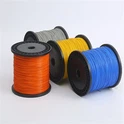
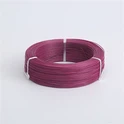
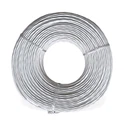
Friends who have been dealing with industrial control wiring, home appliance wiring harnesses, and new energy distribution lines for a long time will surely be familiar with UL10308 single core copper wire. It can withstand temperatures up to 200°C, has FEP insulation that is resistant to corrosion, and can withstand 600V high voltage. Whenever encountering high-temperature harsh environments or scenarios where high-frequency currents need to be routed, everyone will immediately think of it. However, many people have fallen into the same trap: although the wire diameter was chosen appropriately, when running high-frequency currents, the wire overheats severely, power loss remains high, and the signal is intermittent. After disassembling and inspecting the wire, it turns out that there is nothing wrong with the wire itself, and after a long time of troubleshooting, no clue can be found.
In fact, this is not due to the poor quality of the wire material, but rather the "invisible little temper" hidden in the conductive property that is at play - that is what people often refer to as the skin effect, also known as the proximity effect. This is a physical characteristic of alternating current, which is not noticeable in normal power frequency environments, but when placed in the UL10308 application scenarios that focus on high-frequency and high-temperature resistance, the impact will be infinitely magnified. Today, let's talk about this skin effect, help you choose the right wire and reduce losses, and make the wiring more stable and worry-free.
The core principle of the skin effect: The current distribution pattern of a single-core copper wire
There is a common misconception among the public regarding the conductivity of copper wires: Regardless of the type of current, the entire copper conductor will participate in conducting electricity. In actual conditions, the current distribution of direct current and high-frequency alternating current is significantly different, which is the fundamental reason for the occurrence of the skin effect.
UL10308 adopts a solid single-core copper conductor. In the case of direct current power supply, the current will be evenly distributed across the entire cross-section of the copper conductor. The cross-sectional area of the conductor is basically matched with the effective conductive area, and the conductive loss conforms to the theoretical calculation value. When connected to high-frequency alternating current, the alternating current will excite an alternating magnetic field. The magnetic field induces reverse eddy currents inside the conductor, and these eddy currents interact with the main current, resulting in a significant reduction in the current density in the center of the conductor, and the current gradually converges towards the surface of the conductor.
This phenomenon where the current is concentrated on the surface of the conductor and the conductivity efficiency sharply decreases in the central area is known as the skin effect. In simple terms, in a solid single-core copper wire in a high-frequency environment, only the surface part participates in conducting electricity, while the inner conductor does not play an effective role. This is an inherent characteristic of the single-core structure in high-frequency scenarios.
The key indicator for measuring the degree of current concentration is the skin depth, which is the thickness of the effective penetration of the current through the surface layer of the conductor. This value is closely related to the frequency and the material of the conductor and is not a fixed absolute value. Taking copper as an example, under the condition of 50Hz industrial frequency, the skin depth is approximately 9mm, and the utilization rate of the solid single-core conductor is relatively high; when the frequency rises to 1MHz, the skin depth significantly decreases, and the effective conductive area is only a small part of the nominal cross-sectional area. The higher the frequency, the more obvious the influence of the skin effect.
The UL10308 single-core copper wire requires attention to the objective reasons for skin effect
Not all copper wire materials need to be given special consideration for skin effect. In low-frequency and normal-temperature scenarios, the impact of this phenomenon is negligible and will hardly interfere with normal operation. The reason why UL10308 requires targeted attention lies in the particularity of its product positioning and application scenarios, rather than the quality of the product itself.
The core advantage of UL10308 single-core copper wire lies in its high-temperature resistance and the corrosion resistance of the FEP insulation layer. It is suitable for high-temperature and harsh environments, which often involve variable frequency and high-frequency signal transmission requirements, such as industrial frequency conversion equipment, special sensors, and high-temperature household wiring, etc. These scenarios precisely fall within the sensitive range of the skin effect. Additionally, the solid single-core design aims to enhance mechanical strength and adapt to fixed wiring. Compared to multi-strand twisted wires, it cannot reduce the current concentration effect by distributing the conductors. This structural feature further amplifies the manifestation of the skin effect.
Furthermore, under high-temperature conditions, the resistivity of copper materials will increase slightly. This effect, combined with the reduction in the effective conductive area caused by the skin effect, results in a slight increase in the AC resistance of the conductor. Consequently, there is an increase in heat generation and an increase in losses. This is a normal outcome of the superposition of physical properties, rather than an indication of substandard performance of the wire.


What troubles does skin effect bring to wire selection?
When many customers choose UL10308, they only look at the DC current carrying capacity and think that if the wire diameter is large enough, there is no problem. However, under high-frequency working conditions, the chain directly "falls off", and the root cause is that the influence of skin effect is not taken into account.
The most intuitive thing is that the nominal wire diameter no longer works. In high-frequency environments, the conductivity of copper wire is only related to the depth of that thin layer of skin. No matter how thick the wire diameter is chosen, the central copper material cannot help, and instead, it will incur additional material costs. Moreover, the effective conductive area decreases, the resistance surges, and the wire heats up severely, which not only increases the cost of electricity but also affects the stability of the equipment.
If used in precision circuits such as sensors and control signals, the trouble would be even greater. Skin effects can cause signal attenuation and phase deviation, ranging from data transmission errors to equipment malfunctions. The entire production line or household appliances may be affected, which is also a major disaster area for many precision wiring pitfalls.
Effective Tips for Utilizing UL10308 Single-Core Copper Wire and Avoiding Skin Effect
Skin effect is a physical law that cannot be completely eliminated. However, by combining the characteristics of UL10308 and making slight adjustments to the selection and wiring approach, we can minimize the loss and retain its advantages of high temperature resistance and corrosion resistance while avoiding performance waste.
For high-frequency circuits, don't blindly choose thick wires. For low-frequency environments, just select according to the conventional current-carrying capacity. Once the frequency exceeds 1 kHz, don't worry too much about the wire diameter. The key is to look at the effective cross-sectional area corresponding to the skin depth. It's enough if it meets the requirements. Avoid using overly large wires for unnecessary purposes.
During normal selection, scenarios can also be flexibly distinguished. For fixed and low-frequency wiring in scenarios such as internal fixed wiring of equipment, choosing UL10308 single-core is definitely correct. It has high mechanical strength and can withstand high temperatures and harsh environments. If it's high-frequency dynamic wiring or circuits that are particularly sensitive to loss, it might be better to switch to multi-strand twisted wires. This will reduce the influence of skin effect significantly after the current is dispersed.
In the design of the circuit, try to control the operating frequency and avoid keeping the equipment in an overloaded high-frequency state for a long time. At the same time, try to shorten the length of the wire. The shorter the wire, the smaller the total loss caused by the skin effect, and the more stable the performance of UL10308 can be.
Finally, I would like to say: When choosing wire materials, don't just focus on their temperature resistance and pressure resistance.
UL10308 single-core copper wire is indeed the ideal wire for extremely high-temperature and harsh environments. It has excellent temperature resistance, corrosion resistance, and mechanical strength. However, no matter how good the wire is, it must be used in the right place. Skin effect is not a drawback of this wire; it's just a detail that needs to be considered when making the selection.
Whether it's for home appliance assembly, industrial equipment wiring, or new energy wiring design, understanding this little tip can help you avoid unnecessary expenses and avoid costly damages. It enables UL10308 to perform stably and reliably in the appropriate scenarios, delivering consistent electrical conductivity.