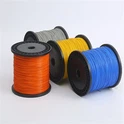
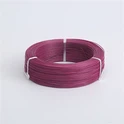
As a practitioner of Zhejiang IRONFLON Wire&Cable Co., Ltd., I often receive inquiries from clients: "Why does the resistance measurement of UL20711 multi core copper wire always have deviations? "The measurement of UL20711 multi core copper wire (commonly referred to as AWM 20711) does not rely on its ability to measure, but rather on its accuracy. Its special design for a rated temperature of 200℃ and a rated voltage of 300 V, as well as its multi-core twisted and FEP insulated structure, make the measurement process more precise than that of ordinary copper wire.
Preparation before measurement
Many customers have provided feedback that the measurement results are unstable, mostly due to inadequate preparation work. The resistance measurement of UL20711 multi core copper wire requires much higher tool accuracy and sample pre-treatment than ordinary cables. Specifically, these three points should be done well:
1. Tool selection: Prioritize the four terminal tester and reject "compromise"
A regular multimeter measuring multi-core copper wire is easily affected by the interference of lead resistance and contact resistance, especially for fine specification multi-core wires such as UL20711 (such as 18AWG), whose resistance value is small and the deviation will be infinitely amplified. It is recommended to directly use a four terminal DC resistance tester (or a dual arm Kelvin bridge), which can effectively eliminate errors caused by leads and contacts, which is also an implicit testing requirement of UL standards.
Additional reminder: If it is a rapid on-site inspection, a micro ohmmeter (current method) can also be used, but it is important to choose a model with stable output from a constant current source. The current selection should follow the principle of "copper conductor ≤ 1 A/mm²" to avoid excessive current causing conductor heating and affecting measurement accuracy.
2. Sample pre-processing: Details determine accuracy, this step cannot be omitted
The FEP insulation layer of UL20711 multi-core copper wire has high temperature resistance and strong adhesion. During pre-treatment, the insulation should be stripped off without damaging the conductor. The specific operation is as follows:
Sample cutting: According to the testing requirements, cut cables 1-5 meters long (it is recommended to be at least 1 meter long, the shorter the length, the greater the error). When cutting, use a dedicated cable cutter to avoid loose conductor twisting structure;
Stripping insulation: Use high-temperature wire stripping pliers to strip the FEP insulation layer at both ends by 2-3 cm, paying attention to moderate force and not scratching the tin/nickel plating layer on the surface of the conductor - coating damage can cause oxidation of the conductor, thereby increasing contact resistance;
Conductor sorting: After stripping, gently comb the multi-core conductor with tweezers to ensure that all copper wires are loose but not falling off, avoiding some copper wires not contacting the test probe and causing "false contact"; At the same time, gently polish the conductor end face with fine sandpaper to remove the surface oxide layer. After polishing, wipe it clean with anhydrous ethanol and air dry before measuring;
Environmental control: Place the pre-processed sample in an environment of 20℃± 2℃ and 50% ± 5% humidity for 30 minutes. Due to the temperature coefficient of resistance of copper being approximately 0.00393/℃, a temperature deviation of 1℃ can cause a deviation of about 0.4% in the resistance value. This is also a detail that many laboratories overlook, directly leading to measurement results that do not meet the standard requirements.
3. Auxiliary tools: Prepare these for more efficient measurement
Prepare testing fixtures (preferably needle fixtures for better contact with multi-core conductors), anhydrous ethanol, fine sandpaper, tape measure (for precise measurement of sample length), and temperature recorder (for real-time monitoring of ambient temperature) to avoid being flustered during the measurement process and affecting operational standardization.
Core measurement: 3 steps to complete, precise compliance with UL standards
After completing the preparation work, follow the steps below to obtain accurate resistance values. There is no need for complex calculations throughout the process, and even beginners can quickly get started:
1.Instrument calibration to ensure "zero error" of equipment
Before measurement, turn on the four terminal tester and preheat it for 10 minutes. Then calibrate it with a standard resistor (with an accuracy one level higher than the tester) and adjust the instrument to the "zero error" state. If it is the first time or if it has not been used for a long time, it is recommended to calibrate it every day after turning it on. This is the basis for ensuring measurement accuracy - many customers' measurement deviations are caused by the instrument not being calibrated, resulting in data distortion.
2.Sample fixation+wiring to avoid poor contact
Lay the sample flat on the testing table after it has been placed, measure the actual length accurately with a tape measure (accurate to 0.1 cm), and record it; Then fix the conductors at both ends of the sample onto the testing fixture, paying attention to following the "four terminal method" for wiring: connect the current terminals (C1, C2) to the outer side of the conductor, and connect the voltage terminals (P1, P2) to the center of the conductor, ensuring that the fixture is in full contact with the conductor without looseness, and avoiding the fixture pressing the conductor, which may cause deformation of the copper wire and affect the resistance value.
Important reminder: The conductor of UL20711 multi-core copper wire is a twisted structure. When wiring, it is necessary to ensure that all copper wires can contact the fixture to avoid some copper wires hanging in the air. Otherwise, the measured value may be underestimated, leading to the mistaken belief that the conductor has better conductivity and potential quality hazards.
3. Start measurement, record raw data, convert temperature, and obtain standard values
Set the measurement range of the tester (selected according to UL20711 specifications, such as 18 AWG multi-core wire, with resistance values usually in the range of a few ohms/kilometer), start the measurement, wait for 3-5 seconds, and after the data stabilizes, record the current resistance value and the ambient temperature at the time of measurement. It is recommended to measure continuously for 3 times and take the average as the final raw measurement data to reduce accidental errors.
Finally, by converting the raw measurement data to 20℃, the resistance value that meets UL standards can be obtained without complex calculations. Many testing instruments come with temperature conversion functions, which can be directly called without manually applying formulas.
Avoiding pitfalls techniques, validated through practical testing
Based on years of customer service experience, I have summarized several points that are most prone to pitfalls. Many customers neglect these details, resulting in unsatisfactory test results and even affecting product exports. It is important to pay special attention to:
1. Avoiding interference from contact resistance between wires: Sorting out conductors is key
The twisted structure of UL20711 multi-core copper wire can easily lead to poor contact between the core wires, resulting in additional contact resistance and affecting the measurement results. The solution is simple: during pre-processing, gently comb each core wire with tweezers to ensure that there is no loose entanglement between the core wires. When measuring, the fixture only contacts the conductor end face and does not compress the core wires, which can minimize the influence of wire to wire contact resistance.
2. Do not ignore the "coating effect": moderate polishing is necessary
The conductors of UL20711 are mostly tin plated copper or nickel plated copper. The purpose of the coating is to prevent oxidation, but excessive polishing can damage the coating, causing oxidation of the conductor and increasing the resistance value; If the polishing is not thorough and the surface oxide layer is not removed, it will lead to an increase in contact resistance. The correct approach is to gently sand the conductor end face 1-2 times with fine sandpaper to remove the surface oxide layer. There is no need to sand the side of the core wire to avoid damaging the coating.
3. Specification matching: Different AWG specifications have different measurement methods
The specifications of UL20711 multi-core copper wire range from 2*18 AWG to 7*14 AWG, and the conductor structure and cross-sectional area of different specifications are different. The range selection and sample length during measurement also need to be adjusted: for fine specifications (such as 18 AWG), it is recommended to cut longer samples (3-5 meters) and choose a smaller range (0-1Ω); Coarse specifications (such as 14 AWG) can capture 1-2 meter samples, with a medium range (0-10Ω) selected to improve measurement accuracy. Specific reference can be made to its conductor structure parameters to avoid deviations caused by mismatched specifications.


Summary: The key to accurately measuring the resistance of UL20711 wire in the "details"
In fact, the resistance measurement of UL20711 multi-core copper wire is not as complicated as imagined. The core is to "choose the right tool, do a good job of pre-processing, standardize operation, and accurately convert". For customers, accurate resistance measurement is not only related to whether the product meets UL standards, but also to the safety and stability of the product - excessive resistance values can cause serious cable heating and affect the service life; The resistance value is too small, which may not meet the design requirements and increase costs.
If you encounter problems such as "unstable data", "conversion errors", "improper coating treatment" during the measurement process, or need to customize a measurement plan based on specific specifications (such as 2*18 AWG, 4*16 AWG), please feel free to contact me at any time. I will provide you with targeted solutions based on years of practical experience.
References
- Electrical Engineering Handbook, CRC Press
- UL20711 Standard Documentation