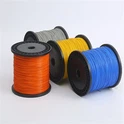
In the world of electrical wiring, the choice of insulation material can significantly impact the performance, safety, and longevity of the wire. Two popular insulation materials are Perfluoroalkoxy (PFA) and silicone. As a PFA insulated wire supplier, I've witnessed firsthand the unique characteristics of both materials and their applications. In this blog post, I'll compare PFA insulated wire to silicone-insulated wire, highlighting their differences and helping you make an informed decision for your specific needs.
1. Physical Properties
1.1 Flexibility: Silicone "soft enough to knot", PFA "not bent over when angry"
Silicone insulated wire, definitely a 'soft girl' from me! It feels like a silicone wristband, soft and elastic. Even if you fold it into a U-shape, wrap it in a circle, or repeatedly bend it dozens or even hundreds of times, it will not break or crack. The bending life can easily exceed 200000 times, without any "temper". Moreover, even in a low temperature environment of -60 ℃, it can maintain over 90% flexibility and will not become brittle or brittle like ordinary wires, making it particularly suitable for places that require frequent bending and narrow wiring space.
PFA insulated wires are definitely a tough guy. Its insulation layer is made of fluoroplastic material, with a relatively hard texture and average flexibility. When bent, there is a significant "resistance", and the bending radius is about 8 times the wire diameter, unlike silicone wires that can be bent freely. Especially in low-temperature environments (such as below -65 ℃), it becomes more brittle, and if forcibly bent, it is prone to cracking, making it less suitable for scenarios that require frequent movement and bending.
1.2 Temperature resistance: Both are resistant to high temperatures, but have different upper limits
Whether it's PFA or silicone, they are both good at high temperature resistance. After all, they can be widely used in industrial scenarios, and their temperature resistance is definitely good. However, the "heat-resistant ceiling" of the two is different. Let's distinguish them clearly and avoid using them in the wrong scenario.
First, let's take a look at PFA insulated wires : they can maintain a stable temperature range of -65 ℃~260 ℃ for long-term use, and can even withstand high temperatures up to 300 ℃ in the short term. Even if they work in a high-temperature environment for a long time, they will not experience aging, softening, or cracking. Their temperature stability is particularly strong and fully meets the requirements of UL 758 standard.
Looking at silicone insulated wires again : the long-term use temperature is -60 ℃~200 ℃. Although it can withstand high temperatures, if it is exposed to an environment above 200 ℃ for a long time, it will age, harden, and even affect the insulation performance. However, its advantage is that it has a wide temperature resistance range, and its low-temperature performance is comparable to PFA. It can also be used outdoors in cold regions without any problems.
1.3. Wear resistant and corrosion-resistant: PFA is "knife and gun resistant", silicone "needs protection"
In this regard, PFA can be said to be a "crushed" silicone. The insulation layer of PFA has high hardness, strong wear resistance, and tear resistance. It is unlikely to be damaged by accidental scratching or collision; And its chemical stability is extremely strong, able to withstand more than 98% of strong acids, strong bases, and organic solvents. Even if placed in a chemical environment, it will not corrode or swell, just like the armor that is "invulnerable".
And silicone insulated wires are more delicate. Its insulation layer is soft in texture, and its wear resistance and tear resistance are much worse than PFA. If not protected properly, it is easily scratched and worn out; And its chemical resistance is relatively weak. Although it can tolerate weak acids and bases, once it comes into contact with oil stains, strong acids and bases, it will swell and its performance will deteriorate. Therefore, in chemical and oil contaminated scenarios, a protective cover must be added before use.
1.4. Other small details: Waterproof and flame retardant each have their own advantages
In terms of waterproofing, PFA is superior - it does not absorb water at all, even if the insulation layer is made very thin, moisture will not penetrate into the interior, making it suitable for use in damp and wet environments; Although silicone is also waterproof, it can absorb a small amount of moisture, and long-term exposure to humid environments may affect its insulation performance.
In terms of flame retardancy, both are good: most silicone insulated wires can achieve UL 94 V-0 flame retardancy, which does not produce a large amount of toxic smoke when burned, and will turn into powder after burning, making it easy to clean; PFA itself also has good flame retardancy, it does not drip or produce toxic gases during combustion, and has high safety.
2. Electrical Properties
2.1. Insulation resistance: Both are excellent, but PFA is more stable
The higher the insulation resistance, the better the insulation performance of the wire, the less likely there is to be leakage, and the safer the equipment operation.
The volume resistivity of silicone insulated wires is usually between 10 ¹⁴ and 10 ¹⁶Ω· cm, and the insulation performance is already excellent, which can meet the needs of most conventional scenarios; PFA insulated wires have higher insulation resistance and are minimally affected by temperature and humidity. Even in high temperature, humid, and corrosive environments, they can maintain stable insulation performance without the risk of leakage or short circuit, making them suitable for scenarios with extremely high insulation requirements.
2.2. Dielectric properties: PFA is suitable for high frequencies, silicone is suitable for medium and low frequencies
The dielectric constant and dielectric loss determine the "fidelity" of wires when transmitting signals - the lower the dielectric constant and the smaller the dielectric loss, the more stable the signal transmission, and the less likely it is to experience interference and attenuation.
The dielectric constant of PFA insulated wires is very low, and the dielectric loss is almost negligible. The high-frequency loss is particularly small, and even when transmitting high-frequency signals, the signal integrity can be maintained without distortion. Therefore, it is particularly suitable for scenarios with high frequency, high voltage, and high insulation requirements, such as precision electronic equipment and high-frequency communication equipment.
The dielectric performance of silicone insulated wires is also good, with a dielectric constant between 2.8 and 3.2. The dielectric loss is extremely low at low frequencies, but in high frequency environments, the loss is slightly higher than PFA, making it more suitable for wiring in medium and low frequency circuits, such as ordinary industrial equipment and household electronic devices.
2.3. Breakdown strength: Both are sufficient, with different requirements depending on the scenario
Breakdown strength, simply put, is the maximum voltage that a wire can withstand. The higher the breakdown strength, the less likely the wire is to be broken down by high voltage, and the higher the safety.
The breakdown field strength of silicone insulated wires is very high, exceeding 20 kV/mm under uniform electric field conditions, which can meet the needs of most medium and high voltage scenarios; The breakdown strength of PFA insulated wires is also not low, and the breakdown strength will not significantly decrease in high temperature and corrosive environments, making them suitable for use in high voltage and harsh environments, such as chemical high-voltage equipment and aerospace equipment.
2.4. Special features: PFA radiation resistance, silicone does not store charges
There are two small details that many people may overlook, but they are important in special situations:
PFA insulated wires have good radiation resistance and can withstand gamma radiation (>1000kGy), making them an irreplaceable choice in special scenarios such as nuclear power plants and radiation detection equipment; Silicone insulated wires do not have radiation resistance and cannot be used in such scenarios.
Silicone insulated wires have a small characteristic: they retain capacitive charges for a long time, while PFA does not, which requires special attention in some charge sensitive electronic devices.


3. Applications
3.1. PFA insulated wire: suitable for "harsh environment + high-end demand"
The "tough guy" attribute of PFA determines its suitability for working in various harsh environments, especially in scenarios that require high temperature resistance, corrosion resistance, and high-frequency transmission:
- In the aerospace field, PFA insulated wires are used for Boeing 787 aircraft because they can maintain stable signal transmission under temperature differences of -55 ℃~125 ℃, and are resistant to radiation and corrosion, making them suitable for harsh environments in space and high altitude.
- In the field of chemical engineering, scenarios such as chemical reaction vessels, electroplating equipment, and high-temperature probes are subjected to strong acid, strong alkali, and high temperature environments for a long time, which ordinary wires cannot withstand. PFA can withstand various chemical corrosion and high temperatures of 260 ℃, which is a rigid requirement for such scenarios.
- In the fields of semiconductors and precision electronics, semiconductor equipment, quantum computers, high-frequency communication equipment, etc. require extremely high stability and insulation performance for signal transmission. PFA's low dielectric loss and high insulation resistance can ensure that signals are not distorted or leaked, and it has high creep resistance, making it suitable for wiring that can withstand mechanical stress for a long time.
- In the field of new energy vehicles : With the popularity of 800V high-voltage platforms, the working temperature of automotive motor controllers has been raised to 150 ℃. PFA insulated wires can easily withstand this temperature and are oil resistant and wear-resistant, suitable for wiring battery packs and motor systems in new energy vehicles.
- Other special scenarios, such as instrument lines for nuclear power plants, wiring for high-temperature sintering furnaces, and low-temperature superconducting cables for quantum computers, all rely on the support of PFA.
3.2. Silicone insulated wire: suitable for "flexible wiring+conventional environment"
The "soft girl" property of silicone makes it more suitable for scenarios that require frequent bending, flexible wiring, and relatively mild environments:
- In the field of industrial robots, the joints of industrial robots require frequent rotation and bending, and the wires must be soft and resistant to bending. The bending life of silicone wires exceeds 200000 times, and they can also maintain softness at low temperatures, making them the preferred choice for wiring industrial robots.
- In the fields of new energy and rail transit, silicone insulated wires are commonly used for DC side wiring of centralized photovoltaic power plants and distributed photovoltaic systems, traction power supply systems of high-speed rail and urban rail, as well as submarine wind power and submarine cables for cross ocean communication. They have strong weather resistance (UV and ozone resistance) and relatively low cost, which can meet the needs of large-scale applications.
- In the field of medical equipment, some small medical devices (such as portable detectors) have narrow wiring spaces and require soft and lightweight wires. Additionally, silicone is non-toxic and odorless, meeting the environmental requirements of medical equipment and suitable for such scenarios.
- Household and conventional industrial fields : For wiring of ordinary household electronic devices, lighting equipment, and some industrial equipment that does not need to withstand high temperatures and corrosion, silicone wires are sufficient to meet the needs, and the price is affordable with high cost-effectiveness.
- In the field of safety cables : In high-rise buildings, hospitals, schools, tunnels and other places, safety cables need to maintain circuit integrity in extreme situations such as fires. Silicone insulated wires are non-toxic, residual gas safe when burned, and can maintain conductivity, making them an ideal choice for such scenarios.
4. Cost Considerations
4.1. Raw material cost: PFA is much more expensive than silicone
PFA is a type of fluoroplastic, and the raw materials themselves are relatively expensive, with complex production processes, especially for high-end PFA materials. In the past, they mainly relied on imports, and prices have remained high.
The raw material price of silicone is relatively affordable, and the production process is also relatively mature. Whether it is domestic or imported, the price is much lower than PFA, about 30% lower than PFA. Moreover, the supply of raw materials is sufficient, and there will be no shortage or significant price increase.
4.2. Production and processing costs: PFA is difficult to process, while silicone is easier to produce
The processing difficulty of PFA is relatively high, requiring high-temperature melting and precision extrusion, with high requirements for production equipment and processes. In addition, defects are prone to occur during the processing, and strict control of temperature and extrusion speed is required. Therefore, the production and processing costs are also relatively high, which is one of the reasons for the high price of PFA wires.
The processing of silicone is much simpler, with mature extrusion and vulcanization processes that do not require high equipment requirements. In addition, defects are less likely to occur during the processing, resulting in high production efficiency and much lower processing costs than PFA. If produced in bulk, the cost can be further reduced.
4.3. Cost of use: PFA has a long lifespan and silicone is easy to maintain
Although the initial procurement cost of PFA wires is high, their service life is very long - in harsh environments, PFA wires can last for more than 15 years and require almost no maintenance, without aging, corrosion, or damage. In the long run, it can save a lot of maintenance and replacement costs.
The initial procurement cost of silicone wire is low, but its service life is relatively short, especially in high temperature and oily environments, requiring regular maintenance and replacement, and it is easy to be scratched and worn. Over long-term use, maintenance and replacement costs will be higher than PFA.
5. Conclusion
In conclusion, both PFA insulated wire and silicone-insulated wire have their own unique advantages and disadvantages. PFA insulated wire excels in extreme temperature and chemical environments, offering high mechanical strength, excellent dielectric properties, and long - term reliability. Silicone-insulated wire, on the other hand, is more flexible, cost - effective for less demanding applications, and has good electrical properties.
When choosing between the two, it's important to consider the specific requirements of your application, including temperature, chemical exposure, mechanical stress, electrical performance, and budget. If you're still unsure which type of wire is right for your needs, feel free to contact us. As a PFA insulated wire supplier, we have the expertise to help you make the best choice. We also offer a wide range of products, such as 20 Gauge Insulated Wire and silver plated copper cable, that can meet your specific requirements.
If you're interested in purchasing PFA insulated wire or need more information about our products, don't hesitate to reach out. We're here to assist you in finding the perfect wiring solution for your project.
References
- Electrical Wiring Handbook, McGraw - Hill Professional
- Insulation Materials for Electrical Applications, Wiley - VCH